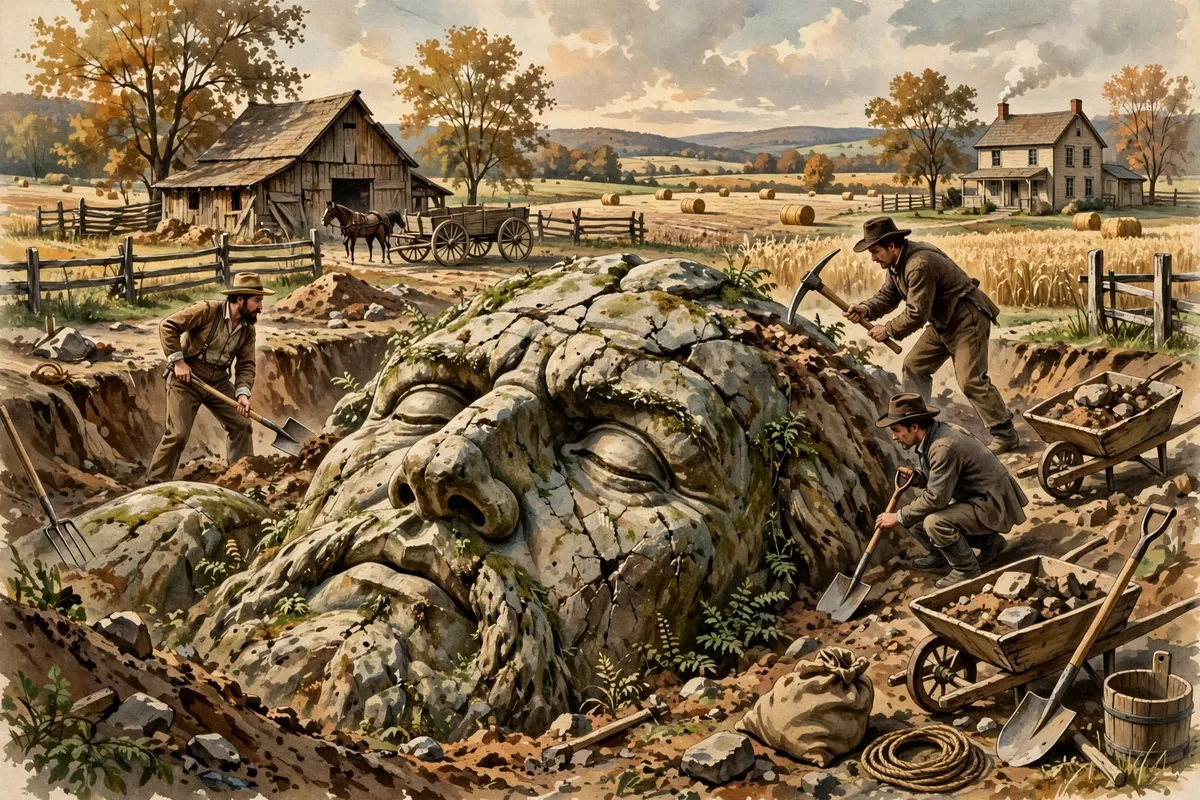
On October 16, 1869, two workers were digging a well behind the barn of a farmer named William "Stub" Newell in Cardiff, New York. Their shovels struck something enormous. It was a stone man, more than 10 feet tall and weighing nearly 3,000 pounds, that looked as if it had been buried for ages.
It was a fake, and one of the most famous hoaxes in American history. The Cardiff Giant was a carved gypsum statue, secretly made and buried a year earlier by Newell's cousin, a New York tobacconist named George Hull. Before the truth came out, thousands of people paid to see it.
A Hoax Born From an Argument
Hull was a skeptic who loved science, especially Darwin's theory of evolution. He reportedly got into an argument at a Methodist revival meeting over a Bible verse saying giants once lived on Earth. He lost the argument, and he was annoyed by how easily people believed things. So he decided to prove how easily they could be fooled.
In 1868, Hull had a large block of gypsum quarried in Fort Dodge, Iowa, telling the workers it was for a monument to Abraham Lincoln. He shipped it to a stonecutter in Chicago, where two sculptors carved the giant. They hung up quilts to muffle the sound of the work.
Hull modeled the giant on his own body. A geologist told him hair wouldn't petrify, so the giant got no hair or beard. To make it look ancient, it was scrubbed with sand and water, beaten with steel knitting needles to fake skin pores, and rubbed with sulfuric acid. The whole scheme cost him $2,600.
Fifty Cents a Look
The giant was buried on Newell's farm in late November 1868. Almost a year later, Newell hired two men to dig a well, conveniently in the exact spot. One of them reportedly exclaimed, "I declare, some old Indian has been buried here!"
The first day, people could see it for free. The next day, Newell put up a tent and charged 50 cents for a 15-minute visit. Soon 300 to 500 people a day were coming, and local hotels and restaurants had never been busier.
The Experts Weren't Fooled
Some visitors believed it was a petrified giant from the Bible. Scientists were less impressed. Andrew D. White, the first president of Cornell University, pointed out that nobody had any reason to dig a well in that spot, since it was handy to neither house nor barn and there was already good water nearby.
Yale paleontologist Othniel C. Marsh noted that gypsum dissolves in water. A gypsum figure buried in wet earth for centuries wouldn't still have fresh tool marks, and this one did. He called it "a most decided humbug."
Then P.T. Barnum Made a Fake of the Fake
Hull sold his share for $23,000 to a group led by David Hannum, who moved the giant to Syracuse. Showman P.T. Barnum offered $50,000 for it. When they refused, Barnum had a copy made and displayed it in New York, claiming his was the real giant and theirs was the fake.
Here's a twist. The famous line "There's a sucker born every minute" is often credited to Barnum, but newspapers reported that Hannum said it about the crowds paying to see Barnum's copy. Hull confessed to the press in December 1869, and in February 1870 a court revealed both giants as fakes.
The original giant has been on display since 1947 at the Fenimore Farm & Country Village in Cooperstown, New York, after a stint as a publisher's basement coffee table. Not a bad retirement for a stone man who fooled a nation.