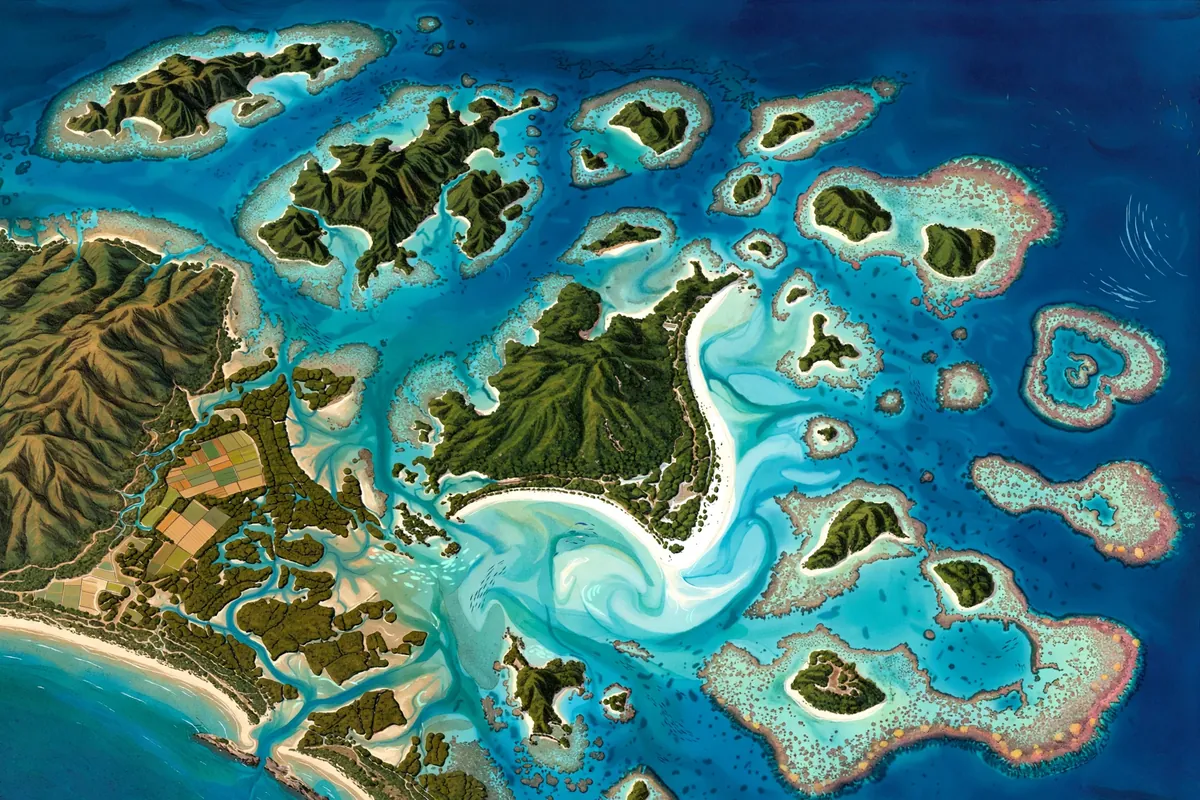
When people talk about seeing things from space, they usually mean city lights, giant deserts, or huge mountain ranges. But one of the most famous sights from orbit is alive. It sits just off the coast of Australia, glowing in shades of turquoise and blue.
It's the Great Barrier Reef, the largest coral reef system in the world. It stretches for more than 1,400 miles and can be seen from outer space. It's also the biggest single structure on Earth made by living things, built over time by billions of tiny animals called coral polyps.
Bigger Than You Can Imagine
The reef isn't one long wall. It's made up of more than 2,900 individual reefs and 900 islands, covering about 133,000 square miles in the Coral Sea off the coast of Queensland. In some places, it's separated from the mainland by a channel 100 miles wide.
From high above, all those reefs form patterns of bright blue and green against the deep ocean. That's what makes it so striking from orbit, and why it's such a favorite view from space.
Built by Tiny Animals
Coral might look like colorful rock or plants, but it's made of animals. Each coral polyp is a small, soft creature that builds a hard skeleton of calcium carbonate, the same basic material as limestone. Over many generations, those skeletons pile up into massive reefs.
Most reef corals have a secret partner. Tiny algae live inside their tissues, turning sunlight into food through photosynthesis, and they give corals much of their color. That's why reef-building corals need clear, shallow, sunny water, usually less than about 200 feet deep.
A City Full of Life
The reef is home to an astonishing variety of creatures. More than 1,500 kinds of fish live there, including the clownfish. Thirty species of whales and dolphins have been recorded, and six of the world's seven species of sea turtles come to the reef to breed.
There are also close to 5,000 kinds of mollusks, including the giant clam, about 125 kinds of sharks and rays, large populations of gentle dugongs, and 215 species of birds that visit or nest on its islands. It was named a World Heritage Site in 1981.
The reef also has a long human history. It has been known to and used by Aboriginal Australian and Torres Strait Islander peoples for a very long time, and it's an important part of their cultures. The first European to explore it was Captain James Cook, whose ship ran aground on it in 1770 and took seven weeks to repair.
A Wonder Under Pressure
The reef faces serious threats, including pollution, outbreaks of coral-eating crown-of-thorns starfish, and warming oceans. When corals get stressed by high water temperatures, they can expel their algae partners and turn white, which is called bleaching. Studies have found the reef lost more than half of its coral cover in recent decades.
A large part of the reef is protected as a marine park, and scientists are working hard to understand and protect it. It's a reminder that even something visible from space depends on very small things, like a tiny polyp and the algae living inside it.
And here's a fun twist: the famous claim that you can see the Great Wall of China from space with the naked eye is questionable, because the wall is so narrow. The reef, built by animals typically just a few millimeters wide, has no such problem.