Getting a good night's sleep can be tricky enough at home. Now imagine trying to drift off when you're literally drifting, there's no up or down, and the Sun rises and sets every 90 minutes. That's bedtime for astronauts on the International Space Station.
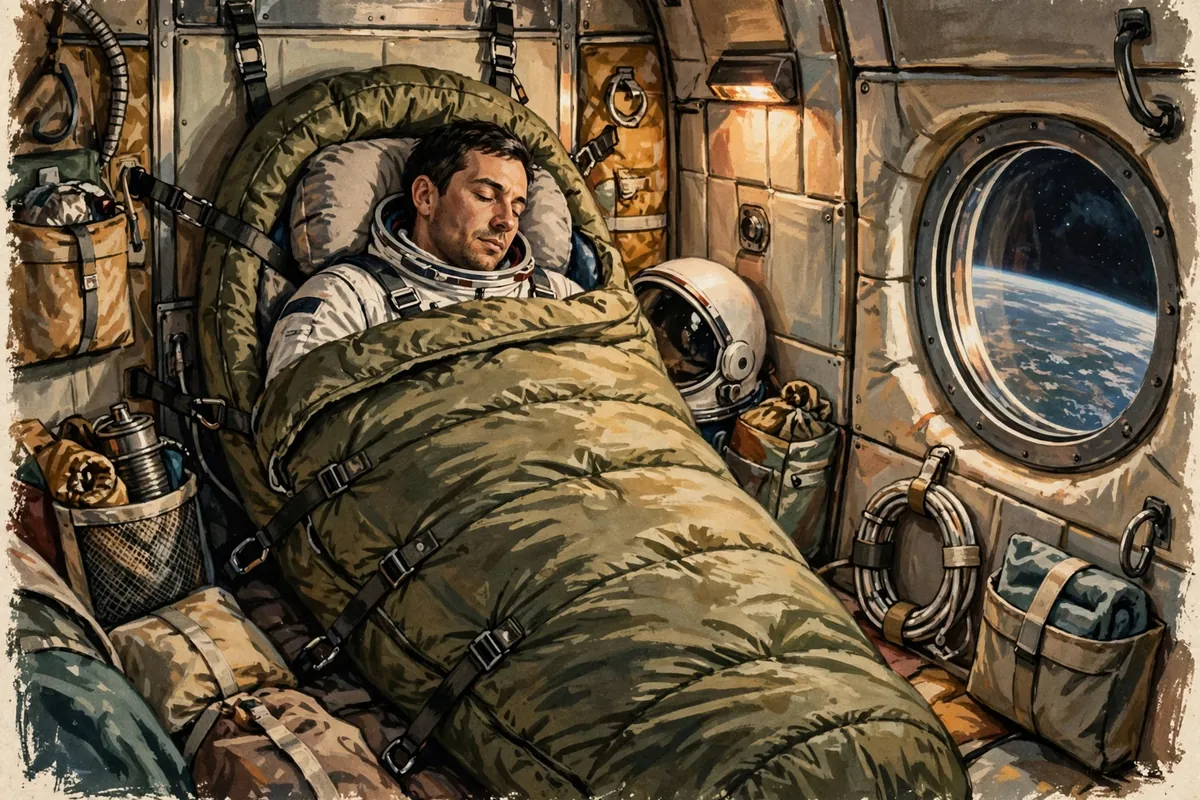
So how do they do it? Astronauts sleep in tiny private cabins about the size of a phone booth or shower stall. Inside, they zip into a sleeping bag that's strapped to the wall so they don't float away. Windows are covered during sleep periods to make it feel like night, and fans keep fresh air moving around their faces.
A Bedroom the Size of a Phone Booth
The station has dedicated crew quarters for its long-term crew: two in the Russian Zvezda module, one in Nauka, and four in the American Harmony module. These soundproof booths give each astronaut a bit of privacy, along with a sleeping bag, a reading lamp, and space for personal items.
Since there's no gravity pulling them onto a mattress, "lying down" doesn't really mean anything. A sleeping bag fixed to the wall works just as well as one on the floor. Visiting crew members simply attach their sleeping bags to any open wall space or sleep inside their spacecraft.
Could they just float freely around the station while they sleep? It's possible, but it's generally avoided so a sleeping astronaut doesn't drift into sensitive equipment.
Why Fresh Air Matters So Much
Here's a danger most of us never think about. On Earth, the warm air you breathe out rises and drifts away. In weightlessness, air doesn't move on its own like that. Without good ventilation, a bubble of exhaled carbon dioxide can build up around a sleeping astronaut's head.
Crews on the old Russian space station Mir learned this lesson. Poorly ventilated quarters could leave astronauts waking up short of oxygen and gasping for air. That's why fans run at all times on the station, even though they make the place noisy.
Sixteen Sunrises a Day
Light is a big problem for sleep in orbit. The station circles Earth about every hour and a half, so the crew sees 16 sunrises and sunsets every day. That constant flip between light and dark can throw off the body's natural daily clock, so windows are covered during sleep periods.
To keep things orderly, the station runs on Coordinated Universal Time. A typical day starts with a wake-up at 6:00 a.m., and the scheduled sleep period begins at 9:30 p.m. On average, crew members get about six hours of sleep a day.
Snoring, Dreams, and a Stubborn Astronaut
Sleep in space is a lot like sleep at home in some ways. Astronauts have reported dreams, nightmares, and snoring. Noise, temperature, physical discomfort, and other crew members can all disturb their rest, and research suggests sleep in space is generally shorter and poorer than on Earth.
Old habits can be hard to break, too. Astronaut Paul Weitz said that aboard Skylab, America's first space station, he couldn't sleep "vertically" even though he was weightless. So he took the metal frame out of his sleeping bag and slept horizontally on it instead.
Lessons from the Apollo missions still guide space sleep today: keep everyone on the same schedule, block out light, muffle noisy equipment, and use loose restraints so nobody drifts away. It's not exactly a luxury hotel, but with a view of Earth just outside, few astronauts seem to complain.