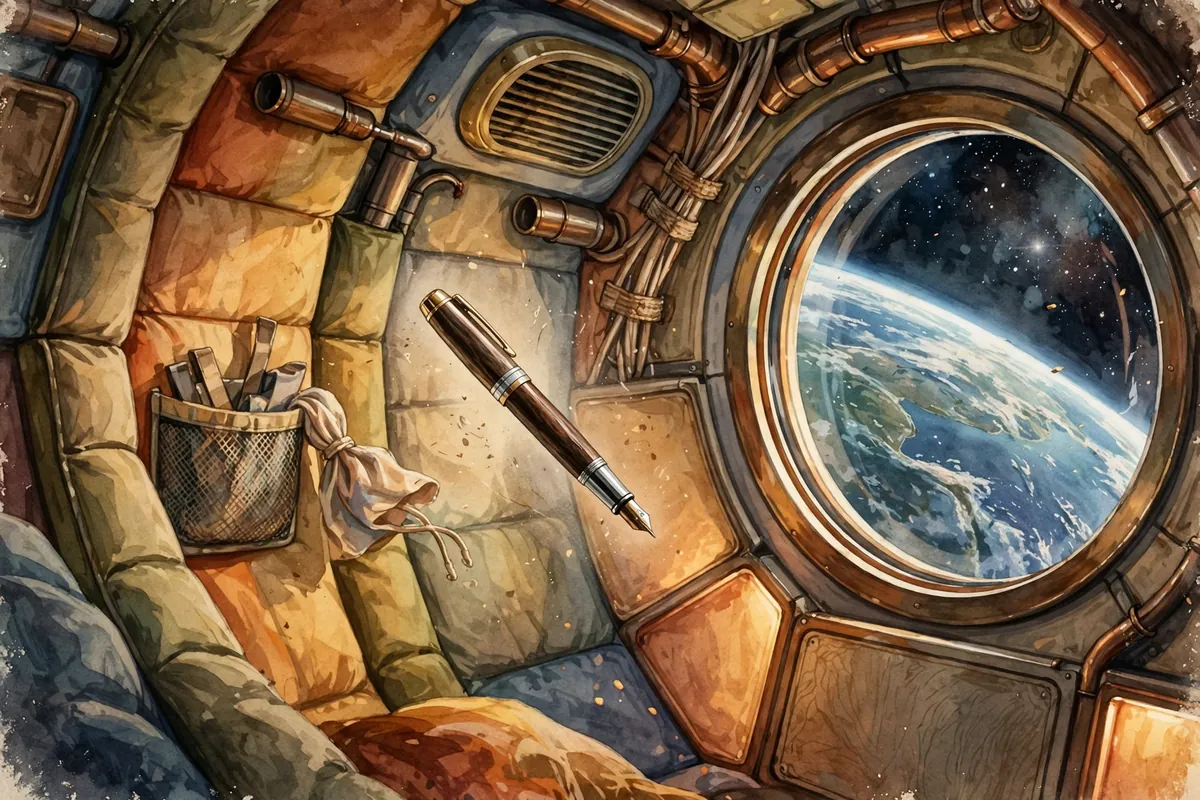
It's one of the most-repeated stories about the space race. American engineers supposedly spent years and millions of taxpayer dollars designing a pen that could write in zero gravity. The Soviets, the story goes, solved the same problem by using a pencil.
It's a great joke, but it's a myth. NASA didn't pay to develop the famous Fisher Space Pen. Inventor Paul C. Fisher developed it with his own private money, then offered it to NASA. After testing, NASA bought the pens for a few dollars each, and the Soviets eventually started using them too.
Yes, Astronauts Used Pencils at First
The myth has a grain of truth. Early on, NASA did use pencils, including mechanical pencils ordered in 1965. NASA had also started work on its own space pen at one point, but when the costs climbed too high, the project was dropped and astronauts went back to pencils.
Soviet cosmonauts used pencils as well, along with grease pencils on plastic slates. So for a while, both sides were in the same boat, writing with the same humble tool.
Why Pencils Were a Problem
Pencils turned out to be a poor fit for spacecraft. In weightlessness, a snapped pencil tip doesn't fall to the floor. It floats, and so does graphite dust. Bits of conductive graphite drifting around delicate electronics are a real hazard.
Wooden pencils can also burn, which is a serious worry in a closed cabin. And pencil marks can smudge or fade, which isn't ideal when you need clear, permanent records of a mission.
The Inventor Who Didn't Wait to Be Asked
Paul Fisher was already in the pen business. NASA never asked him to build a space pen, and he received no government funding for it. Developing his special ink reportedly cost him around $1 million.
His design is clever. The ink sits in a sealed cartridge, pushed out by compressed nitrogen at about 45 pounds per square inch. A sliding float keeps the gas and the ink apart. The ink stays thick until the ball rolls, then flows smoothly. The tip is made from tungsten carbide, fitted tightly to avoid leaks. The sealed cartridge can also write about three times longer than a standard ballpoint.
That means the pen doesn't need gravity at all. It can write upside down, underwater, on wet or greasy paper, and in temperatures from about minus 29 to 250 degrees Fahrenheit.
Fisher patented his anti-gravity pen in 1965 and asked NASA to try it that year. After extensive testing, NASA decided to use it on Apollo missions. In 1967, it was reported that NASA bought about 400 of them for $2.95 apiece. The Soviets bought 100 for their own future missions in 1969.
Still Writing After All These Years
The space pen became a pop culture star. It played a big role in a famous episode of Seinfeld called "The Pen," and it has popped up in shows like Mad Men and Gilmore Girls.
As of 2021, Fisher space pens were still being used on the International Space Station. One pen that flew on Apollo 17 with astronaut Gene Cernan sold at auction in 2008 for $23,900. Not bad for a pen once sold to NASA for under three dollars, and a nice reminder that the best-sounding stories aren't always the true ones.