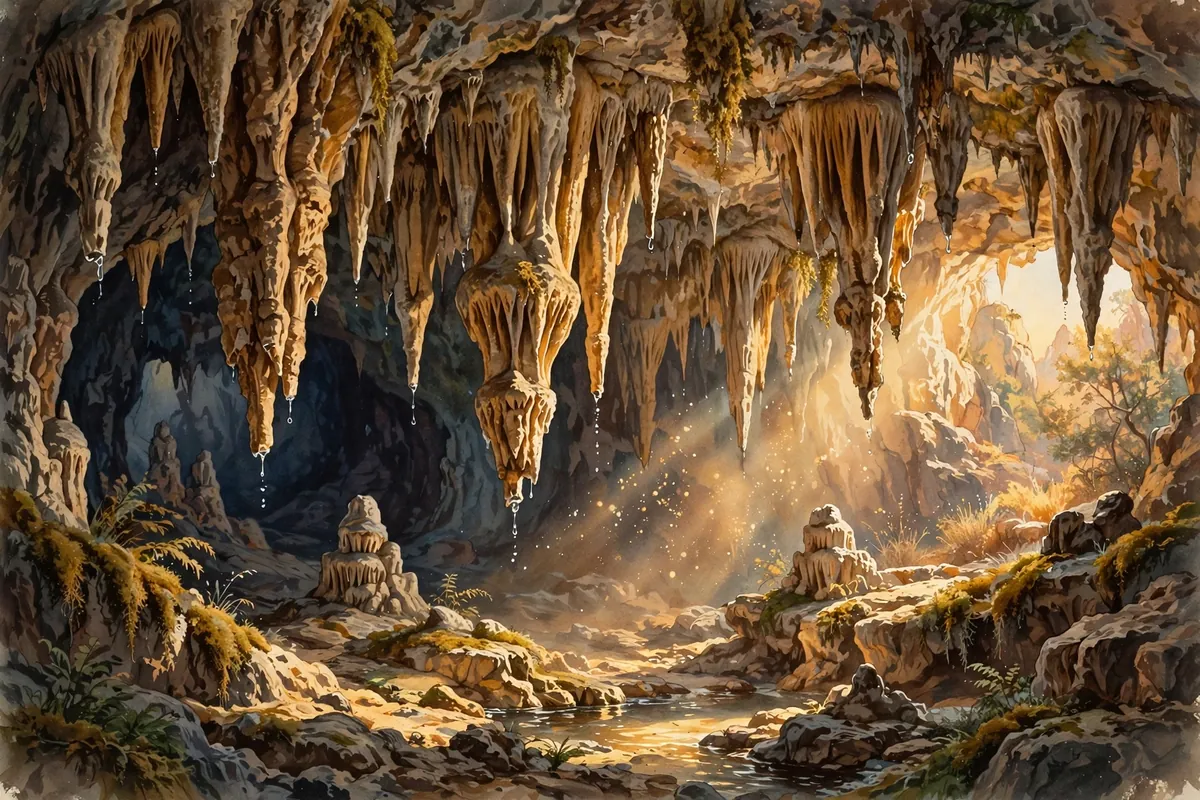
Step into a cave with a flashlight and you might feel like you've entered another world. Stone spikes hang from the ceiling like frozen chandeliers, and others rise from the floor to meet them. It looks like a sculptor spent ages carving the place. In a way, one did: water.
Here's the short answer. Stalactites form when water seeps through limestone, dissolving some of the rock along the way. When that mineral-rich water drips from a cave ceiling and meets the air, it leaves behind a tiny bit of calcium carbonate. Drop after drop, over many years, those deposits build into the stone icicles we call stalactites.
A Little Chemistry Overhead
Rainwater picks up carbon dioxide, and water with carbon dioxide can slowly dissolve limestone. As it trickles through the rock, it carries the dissolved minerals along with it.
When the water reaches the cave ceiling and hangs there as a drop, it touches the cave air. Carbon dioxide escapes from the water, the chemical reaction reverses, and solid calcium carbonate is left behind. It's the same material as the limestone it came from, just moved a little and reshaped.
It All Starts With a Straw
Every limestone stalactite begins with a single mineral-laden drop of water. When the drop falls, it leaves behind the thinnest ring of the mineral calcite. The next drop adds another ring, and the next adds another.
Eventually, those rings form a narrow, hollow tube only about 4 to 5 millimeters wide, a bit less than a quarter inch. Cavers call these soda straws. They can grow quite long but are very fragile. If a straw gets plugged with debris, water starts flowing down the outside instead, coating it with more calcite and building the familiar cone shape.
Patience Required
Stalactites grow incredibly slowly. The average growth rate is about 0.13 millimeters a year. At that pace, adding a single inch would take nearly two centuries. The fastest-growing ones, fed by a steady, slow drip of mineral-rich water, can manage about 3 millimeters a year.
The speed of the drip matters. If water drips slowly, carbon dioxide has time to escape, and minerals are left on the stalactite. If it drips too fast, the water carries most of its minerals down to the floor, where they build up instead.
Stalagmites and Columns
That's how stalactites get their partners. The water that falls from a stalactite's tip deposits minerals on the cave floor, slowly building a rounded or cone-shaped stalagmite. A handy way to remember the difference: stalactites hold tight to the ceiling, and stalagmites might grow up from the ground.
Unlike stalactites, stalagmites never start out as hollow soda straws. Given enough time, a stalactite and stalagmite can meet in the middle and fuse into a single pillar called a column.
Stalactites aren't limited to limestone caves, either. In lava tubes, dripping molten rock can form stalactites in hours, days, or weeks. Icicles in caves are stalactites made of ice. They even form under concrete bridges and buildings, where water leaches minerals from the cement.
So the next time you see a stalactite on a cave tour, take a moment to appreciate it. You're looking at centuries of patient dripping, frozen in stone. At about an inch every two centuries, even a modest one may have started growing long before your great-great-grandparents were born.