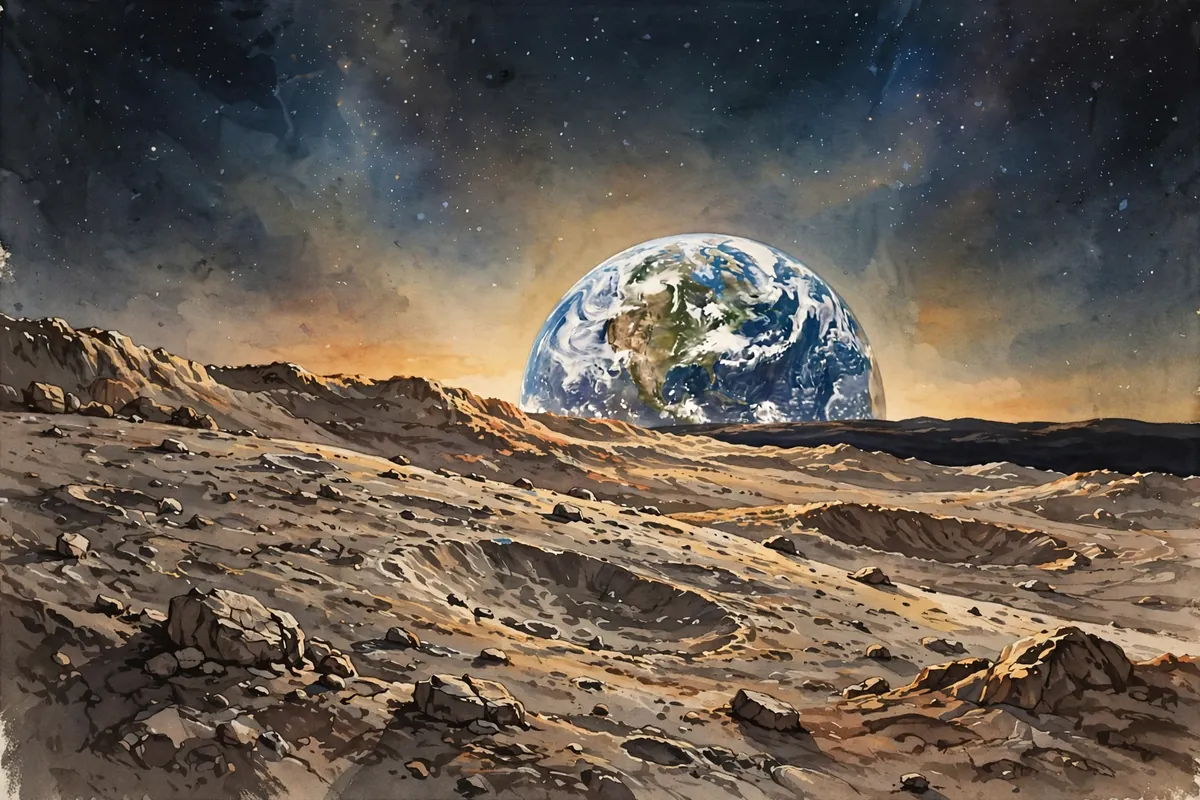
You've almost certainly seen it: a blue-and-white Earth, half in shadow, floating above the gray, cratered edge of the Moon. It's often described as the first photo that showed humanity its home from space. The real story is a little different, and even better.
The picture is called Earthrise, and astronaut William Anders took it from lunar orbit on December 24, 1968, during Apollo 8. It wasn't the first photo of Earth from space. That honor goes to a rocket launched in New Mexico in 1946, and a robotic probe had photographed Earth above the Moon in black and white two years before Apollo 8. But Earthrise was the first picture of its kind, and its impact was enormous.
The Very First Photo of Earth From Space
On October 24, 1946, a modified V-2 rocket, built from captured German parts and newly made ones, launched from White Sands in New Mexico. It climbed about 65 miles high, and a 35 mm black-and-white movie camera attached to it captured the first photograph of Earth from outer space.
Two decades later, in 1966, a robotic Lunar Orbiter probe took the first image of Earth hanging above the Moon. It looked a lot like Earthrise, but it was taken by a machine, in black and white.
Hand Me That Color Film, Quick
Apollo 8 was the first crewed voyage to orbit the Moon. On Christmas Eve, as the spacecraft circled, Anders suddenly spotted Earth climbing over the lunar horizon. The cabin recording caught his reaction: “Oh my God! Look at that picture over there! There's the Earth coming up.”
Commander Frank Borman joked that the shot wasn't on the schedule. Anders laughed and asked crewmate Jim Lovell to hand him a roll of color film, quick. He snapped the first color shot, then took another. He had been photographing the lunar surface with a 250 mm lens, and that same lens captured Earthrise.
For years, Borman said he had taken one of the famous images himself. He later took that back after a NASA visualization specialist matched the photos to the crew's recorded conversation. Anders took all three pictures.
A Photo That Changed the Conversation
Earthrise spread quickly. In 1969, the U.S. Postal Service put it on a stamp, and it appeared on the cover of the Whole Earth Catalog.
Wilderness photographer Galen Rowell called it “the most influential environmental photograph ever taken,” and another writer called its appearance the beginning of the environmental movement. Fifty years later, Anders summed it up: “We set out to explore the moon and instead discovered the Earth.”
Four years after Earthrise, Apollo 17's crew captured The Blue Marble, a sunlit view of Earth from about 18,300 miles away. A cropped and processed version has become one of the most reproduced images in history.
Still Inspiring Today
The photo keeps finding new life. In 2018, two craters visible in the image were named Anders' Earthrise and 8 Homeward. In 2026, the Artemis II mission patch was based on Earthrise, down to the cloud patterns, and astronaut Christina Koch took a new photo called Earthset during the lunar flyby.
So Earthrise wasn't the first photo of our planet from space. But it may be the one that mattered most: a single snapshot that helped people everywhere see their home as one small, beautiful world.