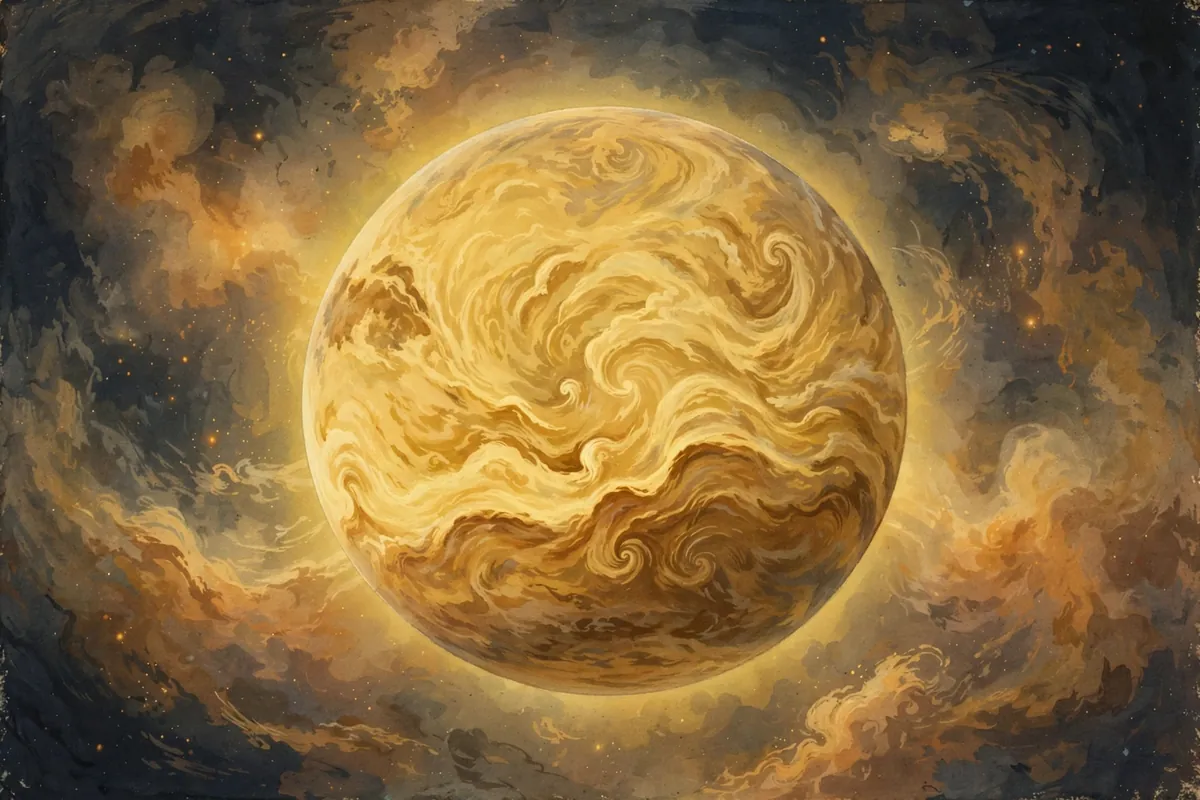
Venus is the brilliant "evening star" that shines low in the sky after sunset, brighter than any other natural point of light. It's about the same size as Earth and is often called our planet's twin. From a distance, it looks lovely. Up close, it's a nightmare.
Here's the short answer: Venus is the hottest planet because its atmosphere traps heat like no other. The air there is about 96.5 percent carbon dioxide and incredibly thick, creating the strongest greenhouse effect in the solar system. The average surface temperature is about 867°F, hotter than Mercury, even though Mercury is much closer to the Sun.
A Blanket That Won't Come Off
A greenhouse effect happens when gases in the air let sunlight in but keep heat from escaping back to space. Earth has a gentle version that keeps our planet livable. On Venus, the effect has run wild.
Venus is nearly twice as far from the Sun as Mercury and gets only about a quarter as much sunlight. But Mercury has almost no air to hold heat. Venus, on the other hand, is wrapped in a crushing blanket of carbon dioxide, topped by a planet-wide layer of sulfuric acid clouds.
The Pressure Is Crushing Too
The heat is only part of the problem. Venus's atmosphere has about 92 times the mass of Earth's. Standing on the surface would feel like being nearly two-thirds of a mile under the ocean.
The air at the surface is so dense and hot that it isn't really a normal gas anymore. Scientists call it a supercritical fluid, a strange state that's partway between a gas and a liquid. Even the gentle surface breezes, moving just a few miles an hour, push hard enough to roll dust and small stones along the ground.
And there's no relief at night. Thanks to the thick atmosphere and the way winds spread heat around, the temperature barely changes between the sunny side and the dark side of the planet.
Was Venus Once Like Earth?
Here's the haunting part. Studies suggest that billions of years ago, Venus may have had an atmosphere more like early Earth's, and possibly plenty of liquid water on its surface. As the Sun grew brighter over time, and possibly with help from massive volcanic activity, that water evaporated.
Water vapor is a greenhouse gas too. Once enough heat-trapping gases built up, a runaway greenhouse effect took over, and the planet kept heating until it reached the oven we see today. Scientists, including Carl Sagan, have pointed to Venus as a warning and a natural laboratory for understanding climate change.
A Strange Planet in Other Ways
Venus spins very slowly, and backward compared to most planets. One Venus day lasts about 117 Earth days. Its atmosphere, however, races around the planet much faster, with winds of about 185 miles per hour at the cloud tops. Venus also has no magnetic field of its own, which surprised scientists, given how similar it is to Earth in size.
Surprisingly, about 30 miles above the surface, temperature and pressure are similar to those on Earth. That's why some scientists have even dreamed up floating research stations in the Venus sky. So next time you spot that bright evening star, give a little wave to our fiery twin and be glad our own blanket is a gentler one.