In New York's Central Park there's a bronze statue of a sled dog named Balto, and it's a popular stop for visitors. Many of us also know him from the 1995 animated movie. The story goes that Balto saved an entire town in Alaska. It's a great story, but it leaves out most of the heroes.
Balto did lead the final team into Nome in 1925, carrying medicine to stop a deadly diphtheria outbreak. But the delivery was a relay of about 20 mushers and roughly 150 dogs. The team that covered the longest and most dangerous stretch was led by a different dog named Togo, who ran about 261 miles to Balto's 55 or so.
A Town Cut Off by Ice
In the winter of 1924 to 1925, Nome was the largest town in northern Alaska, but from November to July its port was locked in by ice. Curtis Welch, the only doctor in town, discovered that the hospital's supply of diphtheria antitoxin had expired. The replacement didn't arrive before the ice closed the port.
By January 1925, children were dying, and Welch knew an epidemic was coming. He sent urgent radio telegrams asking for help. A supply of 300,000 units was found at a hospital in Anchorage, packed in glass vials, quilts, and a metal cylinder weighing a little over 20 pounds, and sent by train to Nenana, the closest railroad stop.
674 Miles of Snow and Wind
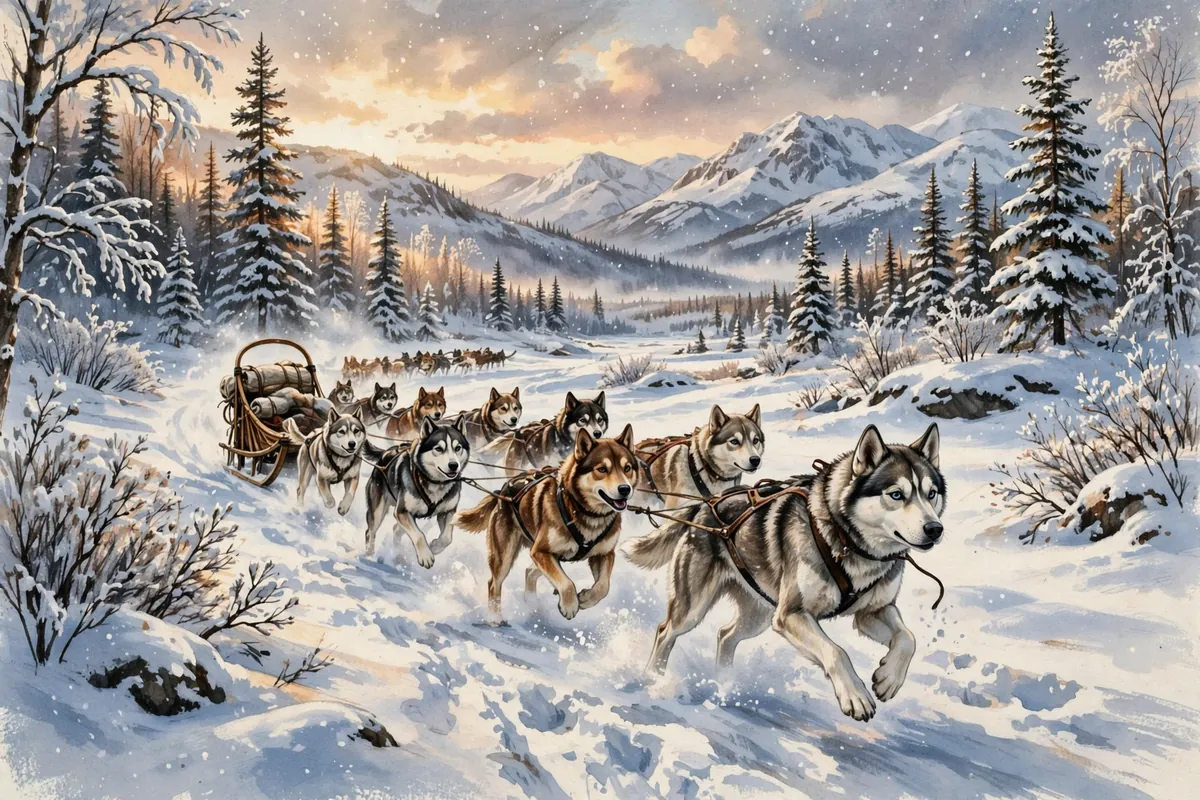
Planes were still too unreliable for an Alaskan winter, so officials turned to the old mail route. From Nenana to Nome was 674 miles, a trip that normally took weeks. Relay teams carried the serum along frozen rivers and across open coastline battered by gales.
The whole run took about five and a half days. Mushers faced brutal conditions. One driver was blown off the trail and suffered severe frostbite while putting blankets on his dogs, with a wind chill of 70 degrees below zero.
Togo, the Dog Who Ran the Hardest Miles
The star musher of the run was Leonhard Seppala. His team, led by a veteran lead dog named Togo, raced out from Nome to meet the serum, then turned around and carried it back. In total they covered more than 261 miles, including the stretch across the shifting sea ice of Norton Sound.
Togo had been a troublemaker as a puppy. Seppala once gave him away as a pet, and Togo jumped through a closed window and ran miles back to the kennel. He grew into a brilliant leader who, according to Seppala, saved his team more than once on the dangerous ice.
Balto's Big Finish
Seppala handed the serum on, and it eventually reached musher Gunnar Kaasen, with Balto in the lead. They set off into a howling storm, crossed a 600-foot mountain, and pushed through visibility so poor that Kaasen couldn't always see his own dogs. His sled flipped and he nearly lost the serum in the snow. They reached Nome at 5:30 in the morning on February 2, and not a single vial was broken.
Because Balto's team arrived last, newspapers made him the face of the story. Interestingly, Balto also belonged to Seppala, who considered him an ordinary freight dog. Seppala later said Balto was never in a winning team before 1925.
Every Dog Deserves a Pat
None of this takes away from Balto, who really did lead his team through a terrible night. Today the famous Iditarod Trail Sled Dog Race from Anchorage to Nome carries traditions that honor the serum run, especially Seppala and Togo. Maybe the best way to remember 1925 is as a team effort, with Balto as the dog who carried it over the finish line.