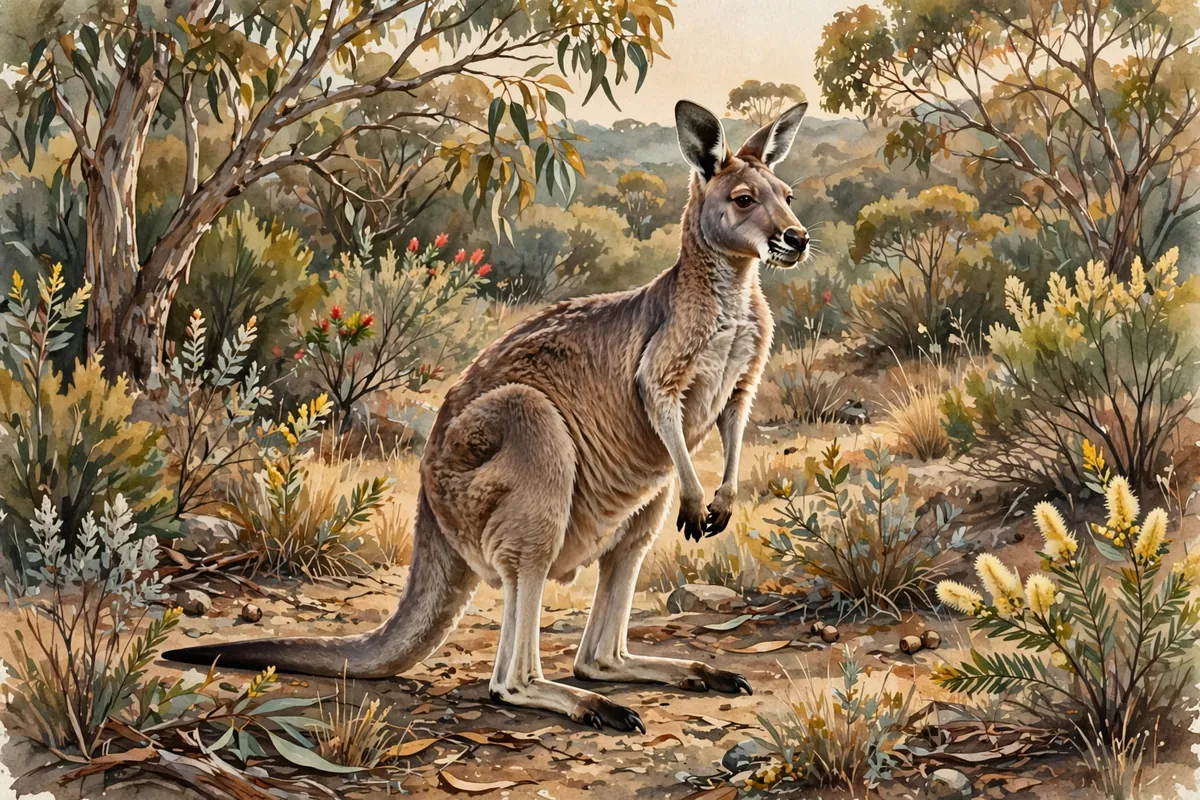
Watch a kangaroo for a while and you'll notice something. It hops forward, it grazes forward, it bounds off into the bush forward. What you almost never see is a kangaroo politely stepping backward out of the way.
The short answer is that a kangaroo's body is built for going forward, and backing up is not something it can easily do. Its huge hind legs, long feet made for leaping, and heavy tail all point one way. The idea is so well known that it's part of the official explanation for the animals on Australia's coat of arms: the kangaroo and emu stand for a nation moving forward, because neither animal can easily walk backwards.
A Body Made for Hopping
Kangaroos have large, powerful hind legs, big feet adapted for leaping, a long muscular tail for balance, and a small head. They are the only large mammals that use hopping on two legs as their main way to get around.
And they're very good at it. A red kangaroo's comfortable hopping speed is about 12 to 16 miles per hour. Over short distances it can hit around 43 miles per hour, and it can keep up about 25 miles per hour for well over a mile. A lot of that bounce comes for free: about 70 percent of the energy is stored in springy tendons, a bit like a pogo stick.
All that design works beautifully in one direction. Long feet and powerful legs that launch the body forward aren't much help when the goal is to shuffle back a few steps.
The Five-Legged Walk
When a kangaroo moves slowly, while grazing for example, it doesn't hop at all. Instead it uses something scientists call pentapedal locomotion, meaning five-legged walking.
Here's how it works. The kangaroo plants its two front paws and its tail on the ground, forming a tripod. Then it swings both hind feet forward together. The tail is acting as a fifth leg. Notice the direction again: the whole move is about bringing those big back feet forward.
Interestingly, both this slow walk and very fast hopping take a lot of energy. Hopping at a moderate speed is the most efficient way for a kangaroo to travel.
A Symbol of Moving Forward
Australia's coat of arms shows a shield held up by a red kangaroo on one side and an emu on the other. The current version was granted by King George V in 1912. Not everyone loved it at first. One member of Parliament grumbled that the emu and kangaroo hardly fit into the world of heraldry.
The two animals have never been officially named national emblems. They were likely chosen because they're found only in Australia and are big enough to hold up a shield side by side. Their forward-only reputation made the symbolism easy: a young nation that only goes ahead.
More Kangaroo Surprises
A newborn kangaroo, called a joey, is about the size of a lima bean. Only its front limbs are somewhat developed at birth, just enough to let it climb to its mother's pouch. It usually stays in the pouch for about nine months before venturing out for short trips.
Male kangaroos also box. Rival males sometimes square off in long, ritual fights, and the winner is often the one who pushes his opponent backward. Fittingly, the kangaroo who retreats is the one who loses.
So the next time you see a kangaroo on a nature show, watch its feet. Whether it's grazing on five legs or flying across the grass at top speed, it's almost always headed the same way. For an animal on a national crest, that's a pretty good motto.