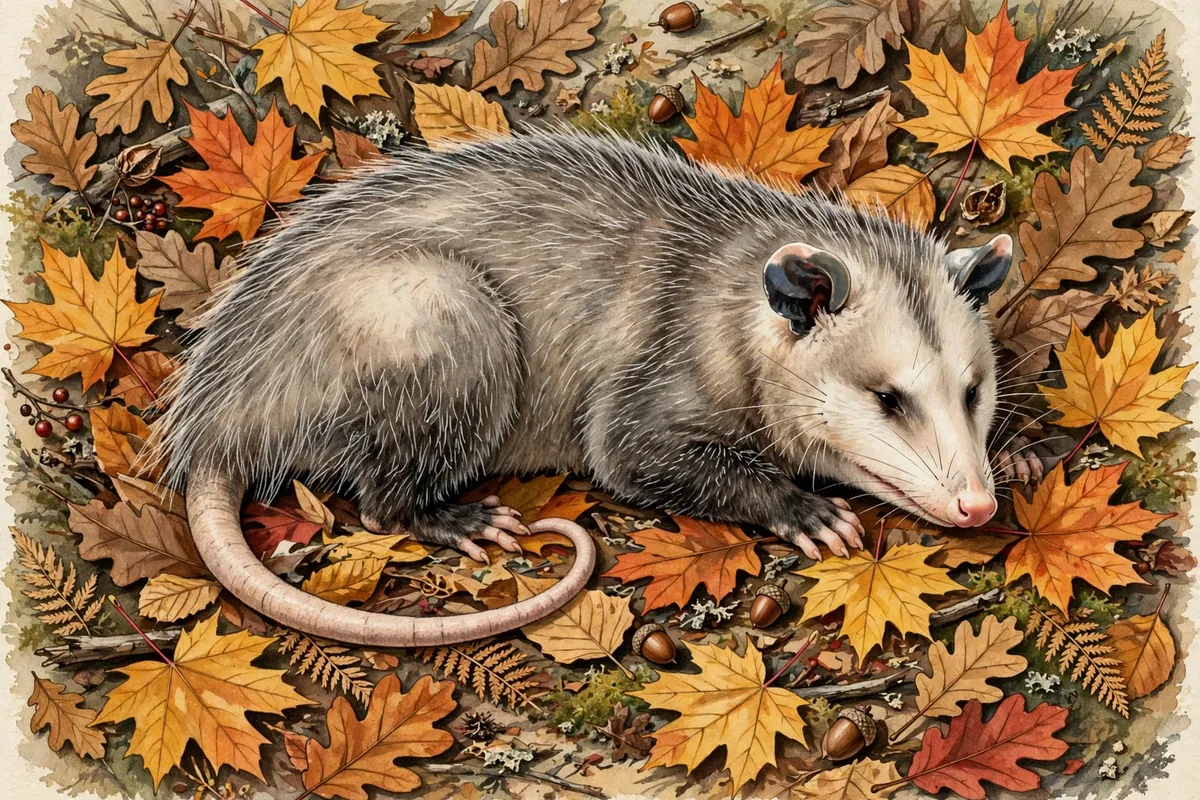
You step onto the back porch at night and there it is: an opossum, frozen in the flashlight beam. Then, instead of running, it tips over. Mouth open, eyes half shut, body stiff. It looks so convincingly dead that you might go looking for a shovel, and come back to find it has quietly wandered off.
Here's the short answer: opossums "play dead" as a last-ditch defense against predators, but it isn't a performance. When an opossum is terrified, its body goes into a death-like state on its own. The response is involuntary, a lot like fainting, rather than a decision the animal makes. That's where the phrase "playing possum" comes from.
First, the Tough-Guy Routine
Fainting isn't the Virginia opossum's first move. When threatened, an opossum will usually either run away or try to scare off the threat. It bares its teeth, all 50 of them, snaps its jaws, hisses, drools, and puffs up its fur to look bigger.
That open-mouthed hissing often gets mistaken for rabies, but opossums are naturally resistant to the disease, although a few rabid ones do turn up each year. When the bluff doesn't work and the fear becomes extreme, the opossum moves on to its most famous trick.
What Playing Possum Looks Like
The details are almost theatrical. The lips pull back, the teeth show, saliva foams around the mouth, and the eyes close or half close. Glands near the tail release a foul-smelling fluid, so the opossum not only looks dead but smells like it too.
The curled, stiff body can be poked, rolled over, and even carried off without any reaction. Many predators prefer fresh prey and lose interest in something that seems sick or rotting. After a few minutes, or as long as four hours, the opossum comes back around. The first sign is usually a little twitch of the ears.
The curled, stiff body can be poked, rolled over, and even carried off without any reaction. The whole display mimics the look and smell of a sick or dead animal. After a few minutes, or as long as four hours, the opossum comes back around. The first sign is usually a little twitch of the ears.
Researchers have a more neutral name for this: tonic immobility, also called thanatosis. It shows up across the animal kingdom, from beetles, crickets, and spiders to bees and ants. It usually kicks in after a predator has already spotted or grabbed its prey, when running is no longer an option.
It's different from simply freezing in place. A deer in the headlights is freezing, staying upright and still in hopes of not being noticed. An opossum playing dead changes its whole posture and goes limp or rigid. The heart rate can slow, and breathing often slows down too.
It's different from simply freezing in place. A deer in the headlights is freezing, staying upright and still in hopes of not being noticed. An opossum playing dead goes rigid and changes its whole posture. In this state the heart rate can slow, and breathing often slows down too.
Unfortunately, this ancient defense isn't built for modern life. Opossums are drawn to roadkill along highways, and when headlights come at them, some react by dropping into their death pose instead of fleeing. Too often, they end up as roadkill themselves.
Baby opossums have their own problem. Their brains don't always trigger the response at the right moment, so young ones often fail to play dead when threatened.
So if you find a motionless opossum in your yard, the kindest thing is often just to give it space. Odds are it isn't gone at all, just waiting for its nerves to settle before it shuffles off into the night.