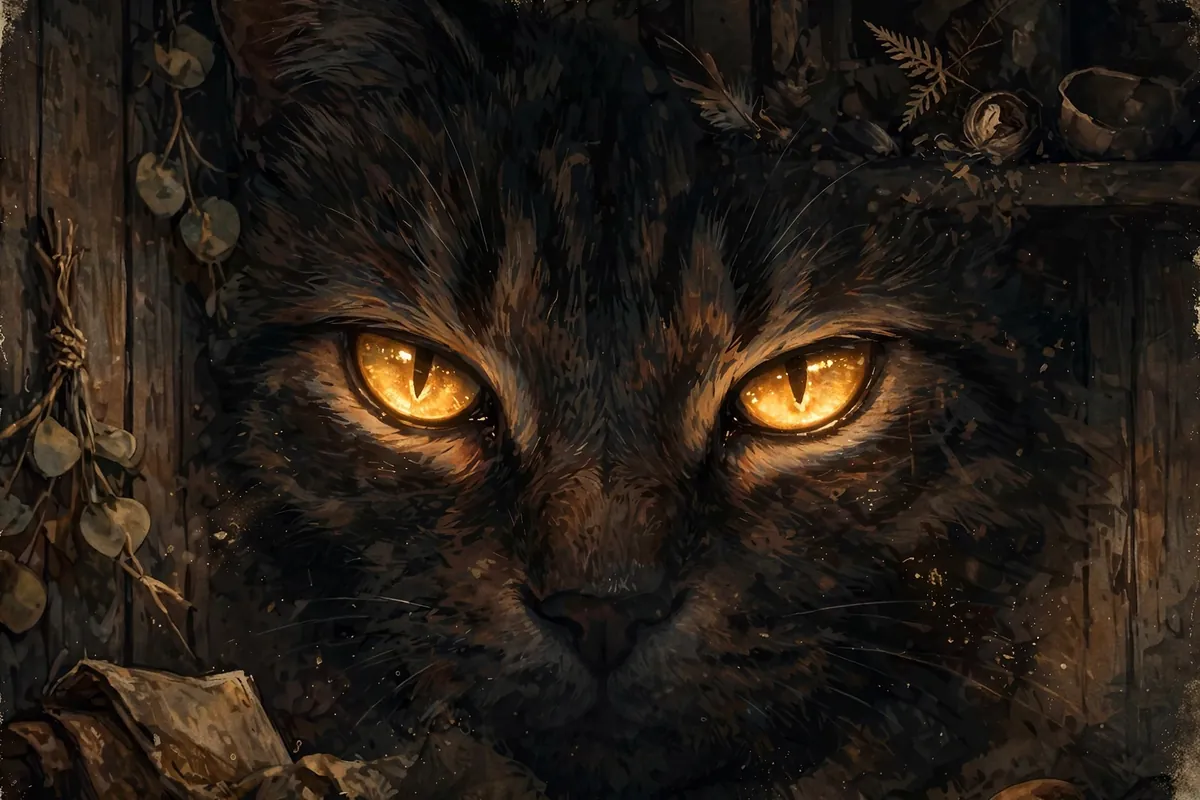
You stumble through the house at night, feeling for the light switch, while your cat glides past without bumping into a thing. Shine a flashlight its way and two eyes glow back at you. It's no wonder so many people believe cats can see in the dark.
The truth is a little different. Cats can't see in complete darkness, because no eye can work without at least some light. What they can do is see in very dim light. Cats can see at one sixth the light level that human vision requires, thanks in part to a mirror-like layer at the back of their eyes.
A Mirror Behind the Eye
That layer is called the tapetum lucidum, and it sits just behind the retina, the part of the eye that senses light. Normally, some light passes straight through the retina without being caught. The tapetum lucidum reflects that light back through the retina for a second chance, which makes the eye more sensitive in dim conditions.
There is a small trade-off. Bouncing the light back slightly blurs the image. For a hunter that's most active near dawn and dusk, a little blur is a fair price for seeing when other animals can't.
Why Their Eyes Glow
That same mirror explains the spooky glow. A cat's eyes don't make their own light. When a flashlight or car headlight hits them, the tapetum lucidum reflects the beam straight back toward the source, and you see it as eyeshine.
Cats aren't alone. Many animals have a tapetum lucidum, especially nocturnal carnivores and deep-sea creatures. Humans, like other monkeys and apes in our branch of the primate family, don't have one at all, which is why our eyes don't glow back at a flashlight.
Pupils That Open Wide
Cats have another trick for low light: huge pupils. In bright sunshine, a house cat's pupils narrow to thin vertical slits. In dim light, they can expand until they cover most of the visible surface of the eye, letting in as much light as possible.
Those slit-shaped pupils are useful during the day, too. They help a cat focus bright light without the color fringes that can blur an image.
What Cats Give Up, and What Helps Them
Night vision comes at a cost to color. Cats have rather poor color vision, with only two types of cone cells, tuned to blue and yellowish green. They have a hard time telling red from green, so that bright red toy may not look as exciting to them as it does to you.
When light is really scarce, cats lean on their whiskers. Those dozens of movable whiskers help them judge the width of gaps and locate objects in the dark, both by touching things directly and by sensing air currents. So a cat moving confidently through a dark room is using more than just its eyes.
Cats also have a third eyelid, called a nictitating membrane, which lets them blink without blocking their vision. It's one more small advantage for an animal built to hunt in the shadows.
So your cat doesn't have magic night-vision goggles. It has a mirror, big pupils, and a face full of sensitive whiskers. In a room that seems pitch black to you, there's usually just enough light for a cat to get by beautifully.