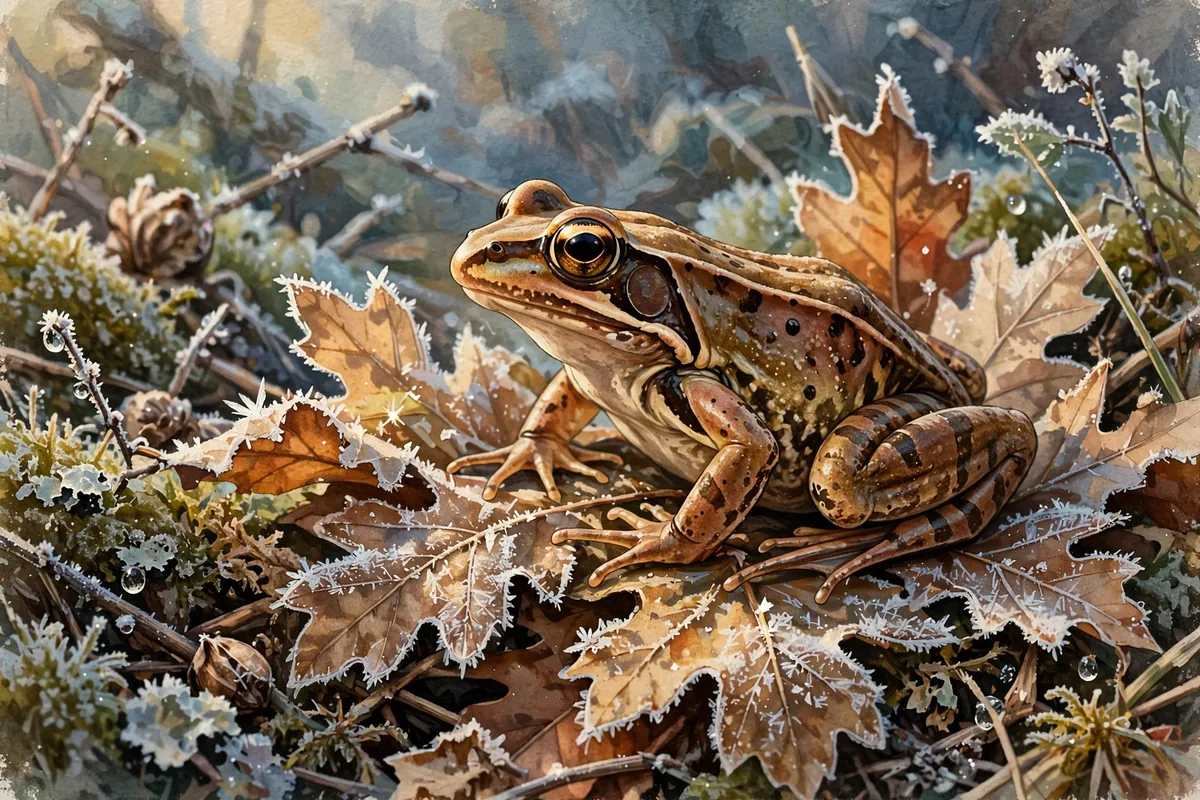
Most animals have to escape the cold. Birds fly south, bears den up, and plenty of creatures burrow deep where frost can't reach. But one small frog in the forests of North America takes a far stranger approach to winter. It simply lets itself freeze.
The animal is the wood frog. It spends the winter under fallen leaves near the soil surface, where ice forms in its body. While frozen, it has no detectable heartbeat, breathing, blood circulation, or brain activity. When spring warms the forest, the frog thaws and goes back to living, often heading straight to a pond to breed.
Frozen, but Not Completely
You'll often hear that wood frogs freeze solid. That's close, but not quite. A wood frog can survive when about 65 to 70 percent of its total body water turns to ice. If much more than that freezes, it's in trouble.
That's still an enormous amount of ice for a living animal. In natural hibernation, wood frogs have been found to stay frozen for around 193 days in a row. Frogs in southern Canada and the Midwest can handle temperatures of roughly 27 to 21 degrees Fahrenheit. Wood frogs in Interior Alaska are even tougher, surviving average winter lows of about 6 degrees Fahrenheit.
A Built-In Antifreeze Made of Sugar
Freezing is usually deadly because ice crystals tear cells apart, and as water gets pulled out of cells to freeze, they shrivel. The wood frog has a clever defense. As ice starts forming inside its body, its liver converts stored glycogen into huge amounts of glucose, a sugar.
That glucose, along with a waste product called urea that the frog stockpiles in the fall, works as a cryoprotectant. These substances limit how much ice forms and reduce the shrinking of cells. The frog's tissues also have to survive long stretches without oxygen, and they've evolved ways to cope.
Even the frog's proteins are tuned for the cold. One key enzyme pump in its muscles has small changes in its structure that let it keep working at lower temperatures than in frogs that can't handle the cold as well.
Alaskan wood frogs appear to be the champions. Studies found they carry bigger stores of liver glycogen and make more urea than wood frogs farther south, which helps explain how they survive harsher winters.
A Frog of the Far North
Wood frogs live across a huge part of North America, from the northern boreal forest down to the southern Appalachians. They are the only North American frog found north of the Arctic Circle.
They're small, about 2 to 2.8 inches long, and usually brown, tan, or rust-colored with a dark mask across the eyes. Females are larger than males. They spend most of their time on the forest floor, blending in with the leaves.
Racing to Breed After the Thaw
Once the snow melts, wood frogs waste no time. Along with spring peepers, they're among the first amphibians to emerge and breed. They usually overwinter close to their breeding pools, so the trip is short.
They prefer temporary woodland pools, sometimes called vernal pools, which have no fish to eat their eggs. The males gather and call with a sound often compared to ducks quacking. Many populations finish all their mating in about a week, and the race is on for tadpoles to grow up before the pools dry out.
So if you hear what sounds like ducks quacking in the woods on an early spring day, it might be wood frogs. Not long before, many of them were frozen under the leaves.