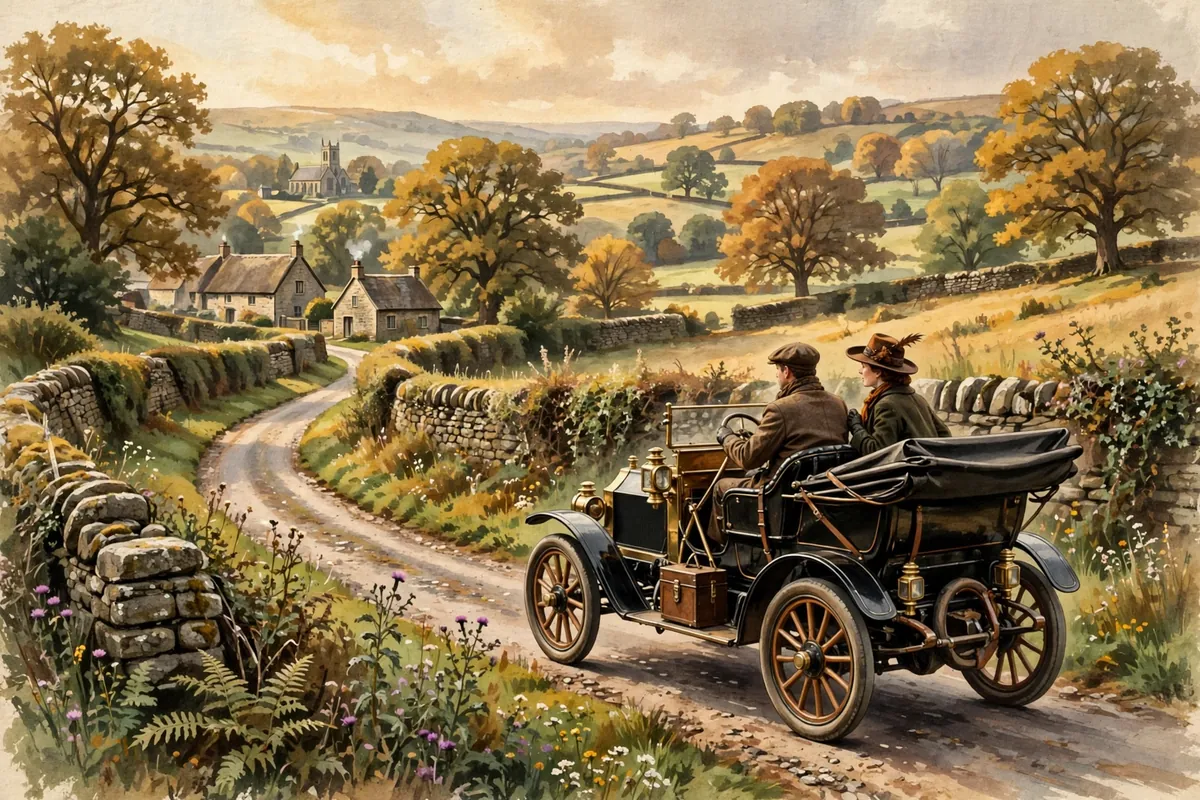
Picture a quiet village in Kent, England, in the winter of 1896. Horses clop along the road, and then a strange machine comes rattling past with no horse at all. A local policeman hops onto his bicycle and pedals after it. History is about to be made, very slowly.
The driver was Walter Arnold of East Peckham, Kent. On January 28, 1896, he was summonsed for driving at 8 miles per hour in a town where the speed limit was just 2 miles per hour. He was fined 1 shilling plus costs, making him the first person convicted of speeding in the United Kingdom, and he's usually cited as the earliest claim to the world's first speeding ticket.
A Speed Limit Slower Than Walking
Two miles per hour sounds ridiculous today. It's slower than most people walk. But the rules were written for heavy steam-powered road machines, long before anyone imagined a family car.
Britain's Locomotives Act of 1865, nicknamed the Red Flag Act, set a limit of 2 mph in towns and 4 mph in the countryside. It also required a crew of three, with one person walking 60 yards ahead carrying a red flag to warn people with horses and carriages. A later law dropped the flag, but someone still had to walk ahead of the vehicle.
So when Walter Arnold rolled through at 8 mph, he was going four times the legal limit. A policeman could catch him on a bicycle, which tells you just how different the roads of 1896 were.
A Family of Car Pioneers
Arnold wasn't just any driver. His family's firm, an agricultural engineering company in East Peckham, had acquired a license to build Benz cars in 1895. Between 1896 and 1898, they produced their own cars, called Arnolds, based on the Benz design but fitted with their own engines.
They built only about twelve of them, making the Arnold one of the very first cars made in Britain. One was fitted with one of the world's earliest self-starters. Two Arnold cars still survive today.
Freedom Arrives at 14 MPH
Arnold's timing was a little unlucky. Later that same year, Britain passed the Locomotives on Highways Act 1896. It freed lighter vehicles from the old rules and raised the speed limit to a breathtaking 14 mph.
Drivers celebrated on November 14, 1896, with a drive from London to Brighton called the Emancipation Run. One of the cars taking part was an Arnold. The event lives on as the London to Brighton Veteran Car Run, the world's longest-running motoring event, open only to cars built before 1905.
Other Contenders for the Title
Who got the first speeding ticket depends on how you count. In the United States, a New York City cab driver named Jacob German was arrested on May 20, 1899, for driving 12 miles per hour on Lexington Avenue in Manhattan.
And if you want an actual paper ticket, that honor may go to Dayton, Ohio. In 1904, police there handed a ticket to Harry Myers for going 12 miles per hour on West Third Street.
So the next time you get flagged for going a little too fast, remember Walter Arnold. He was fined a shilling for doing 8 mph, chased down by a cop on a bike. Somewhere in heaven, he's probably still insisting he was only keeping up with traffic.