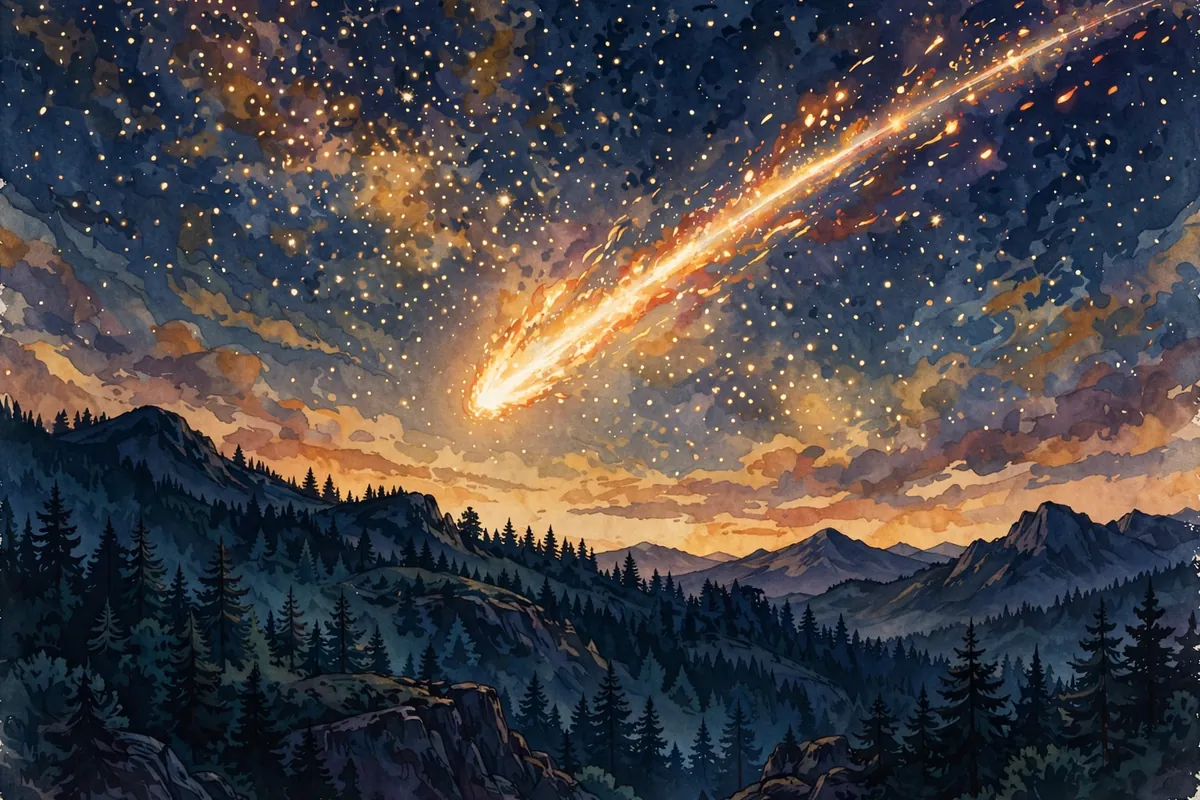
You're out on a dark night, looking up, and suddenly a streak of light flashes across the sky and vanishes. If you're like most people, you made a wish. But what exactly did you just see?
Despite the name, a shooting star isn't a star at all. Scientists call it a meteor. It's the glowing streak made by a small piece of space rock or dust, called a meteoroid, as it plunges into Earth's atmosphere and heats up so much that it glows. And the object behind most shooting stars is tiny, usually about the size of a grain of sand.
Tiny Pebbles, Huge Speeds
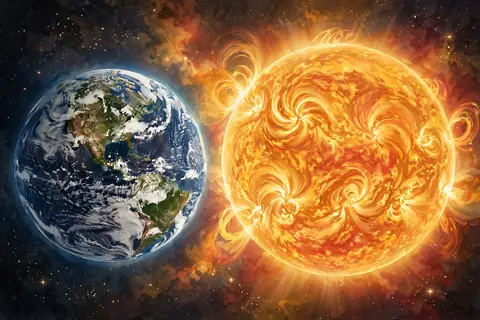
So how does a speck of dust make such a brilliant light? The answer is speed. Earth moves around the Sun at about 67,000 miles per hour, and meteoroids have their own fast orbits. When the two meet, the meteoroid slams into the upper atmosphere at tremendous speed.
At those speeds, it collides with air molecules and heats up until it glows. For larger objects, the heating comes mainly from the air being violently compressed in front of the object, not from simple friction. The result is a shining trail of hot gases and melted particles.
All of this happens surprisingly high up. Meteors usually become visible somewhere between about 47 and 75 miles above the ground. Most glow for only about a second before they burn up.
It Happens All the Time
Shooting stars aren't rare. Millions of meteors happen in Earth's atmosphere every day. An estimated 25 million meteoroids, tiny micrometeoroids, and other bits of space debris enter the atmosphere daily, adding up to about 15,000 tonnes of material a year.
About half of them arrive during daylight, when they're too faint to see against the bright sky. That's why we mostly notice them at night, when darkness lets even faint ones stand out.
Once in a while, a piece survives the fiery trip and lands on the ground. That surviving rock is called a meteorite. So the meteoroid is the object in space, the meteor is the streak of light, and the meteorite is what's left if anything reaches the ground.
Meteor Showers and Storms
Sometimes Earth passes through a trail of debris left behind by a comet. When that happens, we see a meteor shower, with many shooting stars that seem to fly out from the same point in the sky.
Every so often, a shower becomes a full-blown meteor storm, with at least 1,000 meteors an hour. The Leonids are the best-known source of these storms, returning roughly every 33 years along with their parent comet, Tempel-Tuttle. Observers have compared these storms to stars falling from the sky.
The Storm That Changed Science
Believe it or not, people didn't understand that meteors came from space until the early 1800s. Before then, many in the West thought they were a weather event, like lightning.
That changed after a spectacular meteor storm in November 1833. People across the eastern United States saw thousands of meteors streaming from a single point in the constellation Leo. The astronomer Denison Olmsted studied the storm closely and concluded it came from space.
So go ahead and make your wish the next time you see one. Just know that you're watching a speck of ancient space dust put on a dazzling one-second show, high above the clouds.