Walk into any big museum and you'll find them: marble gods and athletes, gleaming white and perfectly calm. For centuries, that clean white look has stood for the elegance of ancient Greece and Rome. That pale look has shaped how generations of people picture the ancient world.
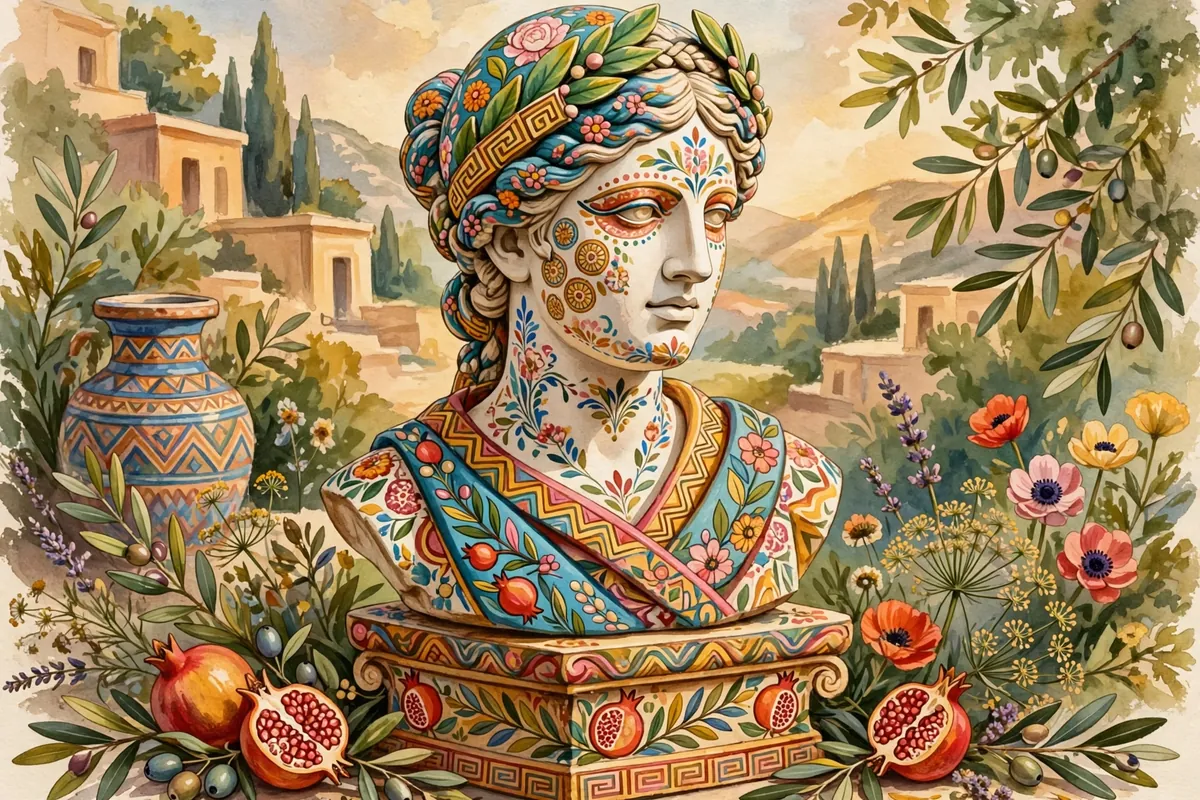
Here's the surprise: that's not how they looked originally. Ancient Greek sculptures were painted in multiple colors. They look colorless today mainly because the original pigments have worn away over the centuries. Some statues still carry faint traces of paint, which lets archaeologists reconstruct how they once appeared.
How We Know They Were Painted
The ancient Greeks left clues in their writing. In Euripides's play Helen, the title character wishes she could shed her beauty "the way you would wipe colour off a statue." The line only makes sense if painted statues were a normal sight.
The stones themselves offer more evidence. Take the Peplos Kore, a marble statue of a young woman made around 530 BC and found in pieces on the Acropolis of Athens in 1886. It was originally colorfully painted, and traces of that paint remain today.
In 1975, a museum in Cambridge, England, painted a cast of the Peplos Kore and displayed it next to an unpainted cast. The side-by-side comparison showed how different the familiar white version is from the brightly painted one, which is probably closer to the truth.
What the Painting Looked Like
Greek and Roman sculptors didn't always paint every inch. Often the color covered clothing, hair, and similar details, while the skin was left in the natural color of the stone. But many sculptures were painted from head to toe.
The patterns could be bold and elaborate. Sculptures from the Temple of Aphaia on the Greek island of Aegina were shown to have been painted with detailed designs, including patterned clothing. Bronze statues got the same kind of attention, with different metals used for features like the lips.
Experts point out that the paint wasn't just decoration added at the end. It was an art style in its own right, as important as the carving.
Color Was Everywhere
Greece wasn't alone. Gothic cathedrals that look gray or beige today were once painted in many colors too. Chinese temples, Maya ceramic vases, and other artworks around the world were also decorated with color.
Egypt's dry climate helped preserve original colors on many sculptures and tomb walls. Egyptian artists used black, red, yellow, brown, blue, and green, and colors carried meaning. Black was linked to fertile soil and rebirth, while green and blue suggested plants and renewal. That's why the god Osiris was often shown with green skin.
Bringing the Colors Back
Today, researchers are rebuilding that lost color. Archaeologist Vinzenz Brinkmann has studied ancient painted sculpture since the early 1980s. His work led to a touring exhibition called Gods in Color, which opened in Munich in 2003 and has since visited museums from Rome and Athens to Harvard and Los Angeles.
Modern digital tools have also made it possible to reconstruct and visualize ancient colors in a scientific way, and many projects are exploring what statues and temples really looked like.
As the French writer André Malraux put it, "Athens was never white." The next time you stand in front of a pale marble statue, try picturing it covered in bold color. You'll be seeing it a little more the way its makers did.