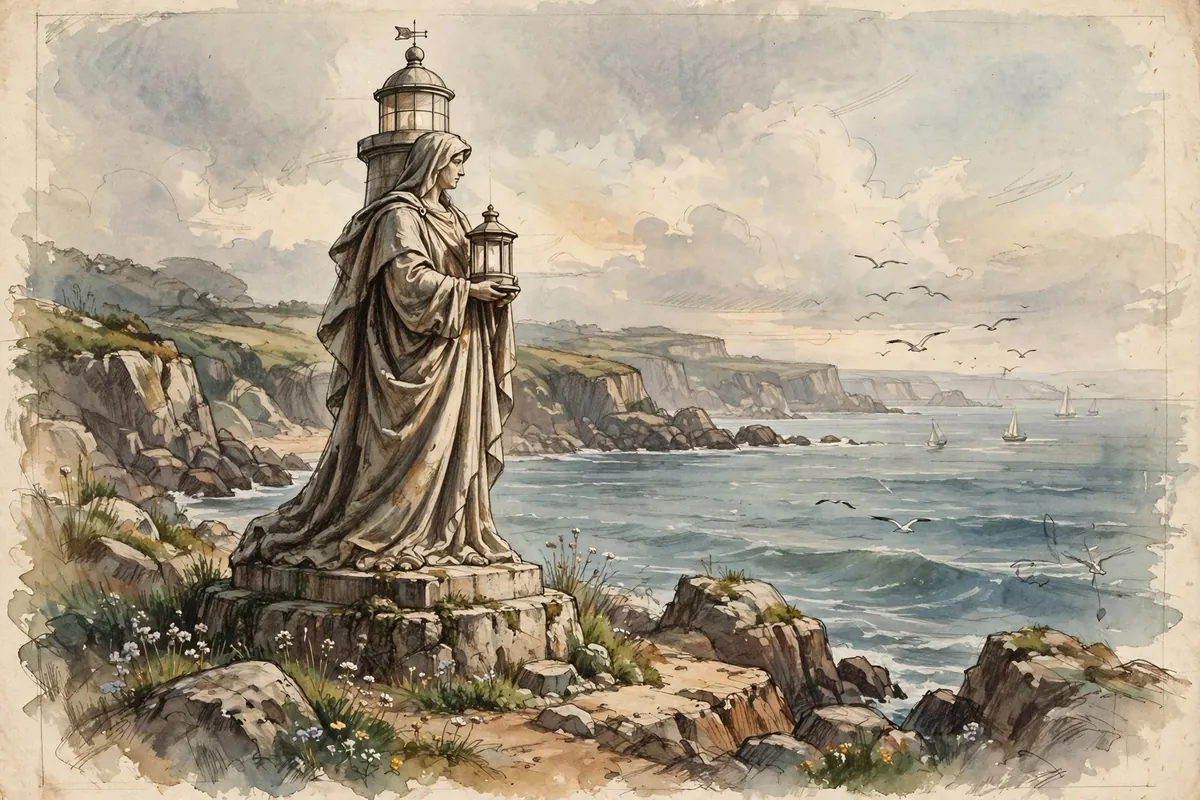
Few things feel more American than the Statue of Liberty, torch raised high over New York Harbor. But the idea of a giant robed woman holding a light over the water didn't start in New York. One version of it was first meant for the other side of the world.
Here's the short answer: sort of. In the late 1860s, French sculptor Frédéric Auguste Bartholdi proposed a colossal lighthouse statue for the northern entrance of Egypt's Suez Canal. It was to be a robed Egyptian peasant woman holding a torch aloft. Egypt's ruler declined because of the cost. Bartholdi then reworked his design, and it evolved into Liberty Enlightening the World, dedicated in New York in 1886. It wasn't the identical statue, but it was a very close ancestor.
A Sculptor Inspired by Egypt
Bartholdi traveled to Egypt in 1856 to study its ancient works. The giant statues at Abu Simbel made a deep impression on him. He began to dream of building something on that massive scale himself.
He also looked to the Colossus of Rhodes, one of the Seven Wonders of the Ancient World. That giant statue of the Greek sun god Helios stood at the entrance of a harbor and, it's believed, carried a light to guide ships. A towering figure at the mouth of a great new canal seemed a perfect modern echo.
The Statue That Never Was
Bartholdi called his project Egypt Carrying the Light to Asia, also known as Progress Carrying the Light to Asia. The statue was to stand 86 feet tall on a 48-foot pedestal at Port Said. He presented the plan to Isma'il Pasha, the Khedive of Egypt, and made sketches and models.
Both the Khedive and Ferdinand de Lesseps, the developer of the Suez Canal, turned it down, citing the high cost. In 1869, the Port Said Lighthouse, designed by François Coignet, was built on the spot instead.
From Suez to New York
Meanwhile, the French historian and abolitionist Édouard de Laboulaye wanted a monument honoring American independence and the end of slavery. A popular story says the idea came up at a dinner party in 1865, though the National Park Service has called that a legend and suggested the statue was most likely conceived around 1870.
As Bartholdi developed the new project, his robed peasant woman evolved into a classical goddess based on Libertas, the Roman goddess of freedom. She holds a tablet marked with the date of the Declaration of Independence, and at her feet lies a broken chain. Gustave Eiffel designed her iron framework, and Bartholdi chose copper because it was cheaper, lighter, and easier to ship than bronze or stone.
A Long Road to the Harbor
Building her took years. The torch-bearing arm was shown at the 1876 Centennial Exposition in Philadelphia to drum up support, then stood in Manhattan's Madison Square Park until 1882. Fundraising for the pedestal was so hard that publisher Joseph Pulitzer launched a donation drive in his newspaper. The statue itself was built in France, shipped across the ocean in crates, and reassembled on the finished pedestal.
Finally, on October 28, 1886, the statue was dedicated in a ceremony led by President Grover Cleveland, and New York celebrated with its first ticker-tape parade. So Egypt never got its giant torch-bearer, but America did, and she's been lighting the way ever since.