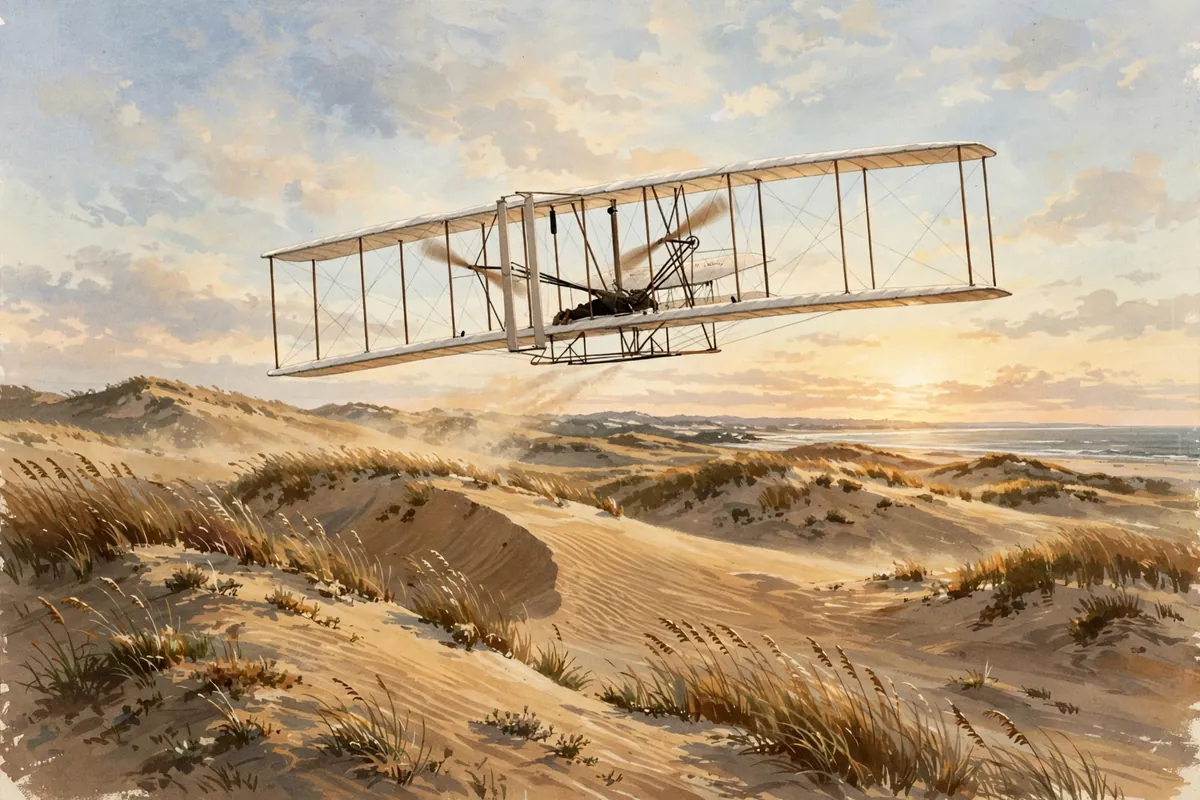
We've all seen the famous black-and-white photo: a fragile, kite-like machine lifting off over the sand while a man watches nearby. It's one of the most important moments in history. But the full story of that day in 1903 is full of surprises, from a coin toss to a sudden disaster.
Here's the short version. On December 17, 1903, Orville and Wilbur Wright made the first sustained flights in a powered, controlled, heavier-than-air machine. Orville's first flight lasted 12 seconds and covered 120 feet. The brothers took turns and flew four times that day. After the longest flight, a strong gust flipped the plane over and wrecked it. It never flew again.
A Coin Toss and a False Start
The flights took place near Kitty Hawk, North Carolina, in an area that's now part of the town of Kill Devil Hills. Their first try actually came three days earlier, on December 14. With help from men at a nearby government life-saving station, the brothers set up on the slope of a large sand dune.
They tossed a coin to decide who would pilot first, and Wilbur won. But he pulled up too sharply, stalled, and came down after just three and a half seconds. The damage was minor, but repairs took three days.
December 17: Four Flights
On December 17, the wind was blowing more than 20 miles per hour. This time the brothers laid their launching rail on level ground, pointed into the wind. Since Wilbur had already had his chance, it was Orville's turn.
His flight, captured in that famous photograph, lasted 12 seconds and covered 120 feet. That's shorter than the wingspan of a Boeing 747. The second and third flights covered 175 and 200 feet. Then Wilbur took the fourth flight, staying up 59 seconds and covering 852 feet.
None of the flights went higher than about ten feet, and none involved turns. Every landing was bumpy. After the fourth flight, the brothers hoped to fix the damage and try a four-mile flight to Kitty Hawk village. Minutes later, a heavy gust picked up the Flyer and tumbled it end over end. Its flying days were over.
Built Like a Bicycle
The Wrights couldn't find a suitable car engine, so their employee Charlie Taylor built one from scratch in six weeks. It weighed 180 pounds and made just 12 horsepower. Bicycle-style chains drove two hand-made propellers. One chain was crossed so the propellers spun in opposite directions.
A Long Road to Credit
Surprisingly, the world didn't celebrate right away. The Wrights kept quiet for years, and the press believed others had flown first. Only after public demonstrations in France in 1908 were they widely accepted as pioneers.
The Flyer had its own odd journey. Orville feuded with the Smithsonian, which had credited a rival's aircraft. In 1928, he shipped the plane to the Science Museum in London instead. The Smithsonian finally acknowledged the Wrights in 1942, and the Flyer went on display there on December 17, 1948, 45 years to the day after its flights. Orville had died that January.
It still hangs in the National Air and Space Museum. And in 1969, small pieces of its fabric and wood traveled to the Moon with Neil Armstrong. From 12 seconds over the sand to the surface of the Moon in just 66 years. Not a bad flight plan.