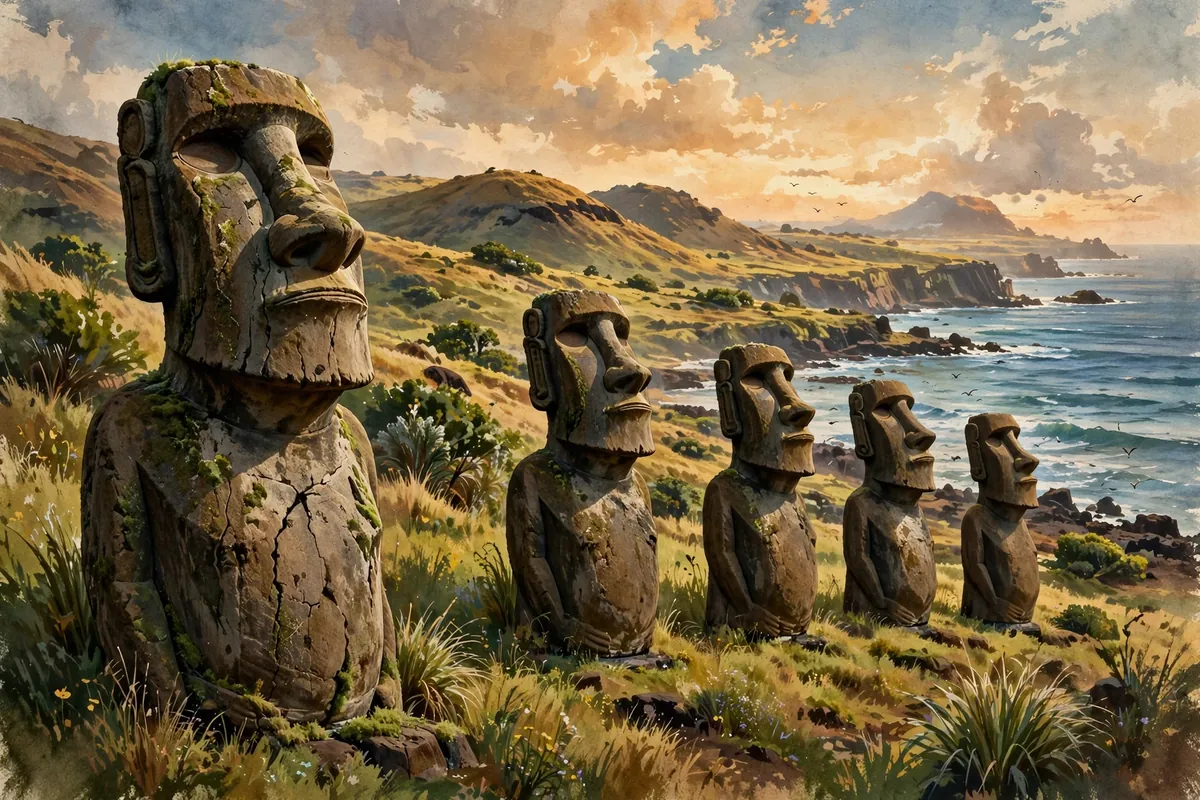
They're among the most recognizable sights on Earth. Giant stone faces with heavy brows and long noses stare out from a grassy slope on a remote Pacific island. Many people know them simply as the Easter Island heads.
But the moai aren't just heads. They're whole-body statues. Many of the most photographed ones stand on the slopes of the quarry at Rano Raraku, buried up to their shoulders by centuries of soil. When archaeologists excavated some of them, they found full torsos underneath, along with carved markings that the burial had protected from erosion.
Faces of the Ancestors
The moai were carved by the Rapa Nui people on Rapa Nui, also known as Easter Island, between about 1250 and 1500. They are mainly the living faces of honored ancestors.
The heads really are oversized, making up about three-eighths of a statue's height. That fits the Polynesian belief that the head is especially sacred. The statues have no legs, but their arms are carved against their bodies, with long, slender fingers resting near the hips.
Some moai once had eyes. In 1979, archaeologists discovered that eye sockets on certain statues held coral eyes with pupils of black obsidian or red stone. Some statues also wore red stone cylinders called pukao on their heads.
Carved From a Volcano
The moai were carved from volcanic tuff, a rock made of hardened volcanic ash. Carvers outlined each figure in the quarry wall, then chipped away until only the statue was left.
More than 900 moai are known, and nearly half are still at Rano Raraku. The tallest one ever raised, called Paro, was almost 33 feet high and weighed about 82 tonnes. One unfinished statue still in the quarry would have been about 69 feet tall if completed. New statues were still being found as recently as 2023.
How Do You Move a Giant?
Nobody knows exactly how the moai were moved, but there are plenty of theories. Earlier researchers imagined sledges, rollers, and many hundreds of workers. In 1999, archaeologist Jo Anne Van Tilburg had about 60 people tow a nine-tonne replica on a wooden sledge over rollers.
Island stories say the statues walked to their places, commanded by divine power. Surprisingly, many scholars now think there's some truth to that. The leading theory is that the moai were moved upright, tied with ropes on two sides and rocked from side to side while being pulled forward, so they seemed to walk.
In 1986, explorer Thor Heyerdahl and colleagues tested a version of this, walking statues forward by swiveling and rocking them. The experiment ended early because the bases started chipping, but it showed the idea could work.
Toppled and Raised Again
In the years after Dutch explorer Jacob Roggeveen arrived in 1722, every moai standing on the island's stone platforms was eventually toppled. By 1868, none remained upright except the partly buried statues at Rano Raraku. Oral histories tell of a clan pushing one down at night, while other stories describe the earth shaking, and there are signs that earthquakes toppled at least some. Many fell forward, hiding their faces, and often broke at the neck.
Today, about 50 moai have been raised again on their platforms or in museums, and those on the island still gaze over the island as they did centuries ago. Just remember, next time you see those famous faces, there's a whole lot more statue below the surface.