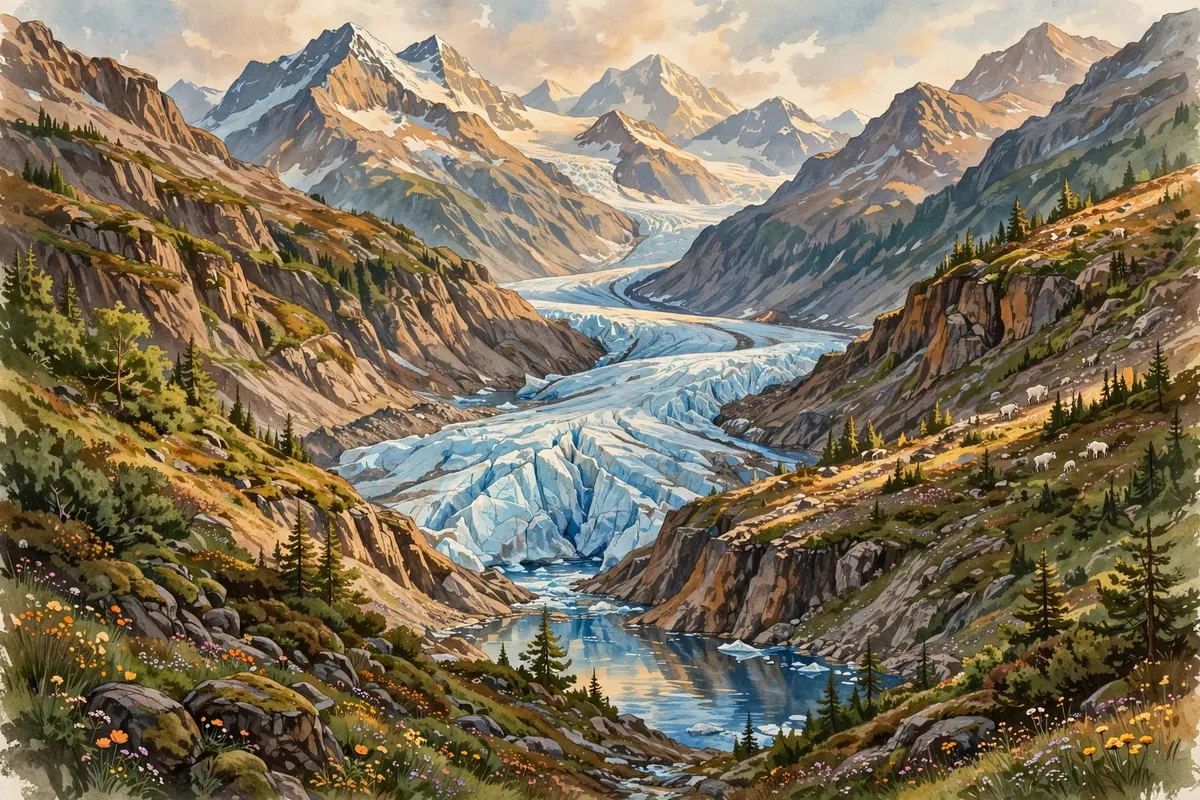
Stand on the floor of Yosemite Valley or a Norwegian fjord and look up. The walls rise almost straight up on both sides, and the floor between them is wide and flat. It's a shape that seems too neat to be an accident. And it isn't.
Valleys like these were carved by glaciers. Rivers tend to cut narrow, V-shaped valleys. But when a thick glacier squeezes down a mountain valley, it scrapes and plucks away rock on the bottom and sides, widening and deepening the valley into a U shape. When the ice finally melts, that U-shaped valley is left behind.
The Glacier's Two Tools
Glaciers wear away rock in two main ways. The first is called plucking. Meltwater seeps into cracks in the bedrock under the glacier, then freezes and expands. The ice acts like a lever, prying blocks of rock loose and lifting them into the moving glacier.
The second is abrasion. All that rock frozen into the bottom of the glacier turns it into a giant sheet of sandpaper. As the ice slides along, it grinds and polishes the bedrock underneath. The fine powder this makes is called rock flour.
Big boulders caught in the ice can leave long scratches in the rock, called glacial striations. Geologists map those scratches to figure out which way an ancient glacier was moving.
From V to U
Before an ice age, many mountain valleys were V-shaped, carved by rivers. When a glacier fills one of these valleys, it doesn't just follow the old path. It widens it, deepens it, and smooths it out. The finished valley has very steep sides and a broad, flat floor.
This takes time, lots of it. Turning a V-shaped valley into a U-shaped one can take anywhere from 10,000 to 100,000 years. The results can be several thousand feet deep and tens of miles long. The thicker the ice, the deeper the carving.
What the Ice Leaves Behind
When a glacier melts away, it leaves plenty of clues. Valley floors are often scattered with boulders that the ice carried in from somewhere else. Ridges of rock and dirt called moraines can stretch across a valley like natural dams.
Smaller side glaciers don't carve as deeply as the big main glacier. When the ice is gone, those side valleys are left hanging high on the walls of the main valley, and their streams tumble over the edge as waterfalls.
Some glacial valleys fill with water. Long, deep basins become lakes, sometimes strung together like beads. And when a U-shaped valley runs down into the sea, it becomes a fjord, a word that comes from Norway, where they're common.
Where to See Them
U-shaped valleys show up in mountain ranges around the world, including the Rockies, the Alps, the Andes, and the Himalayas. A classic example in the U.S. is the valley in Glacier National Park in Montana where the St. Mary River runs. Yosemite Valley in California is another famous glacier-shaped valley, and across the Atlantic, the Nant Ffrancon valley in Wales is a textbook example.
The next time you drive through the mountains, look at the shape of the valleys. If you see a wide floor and towering walls, you may be standing where a river of ice once ground its way through, one slow inch at a time.