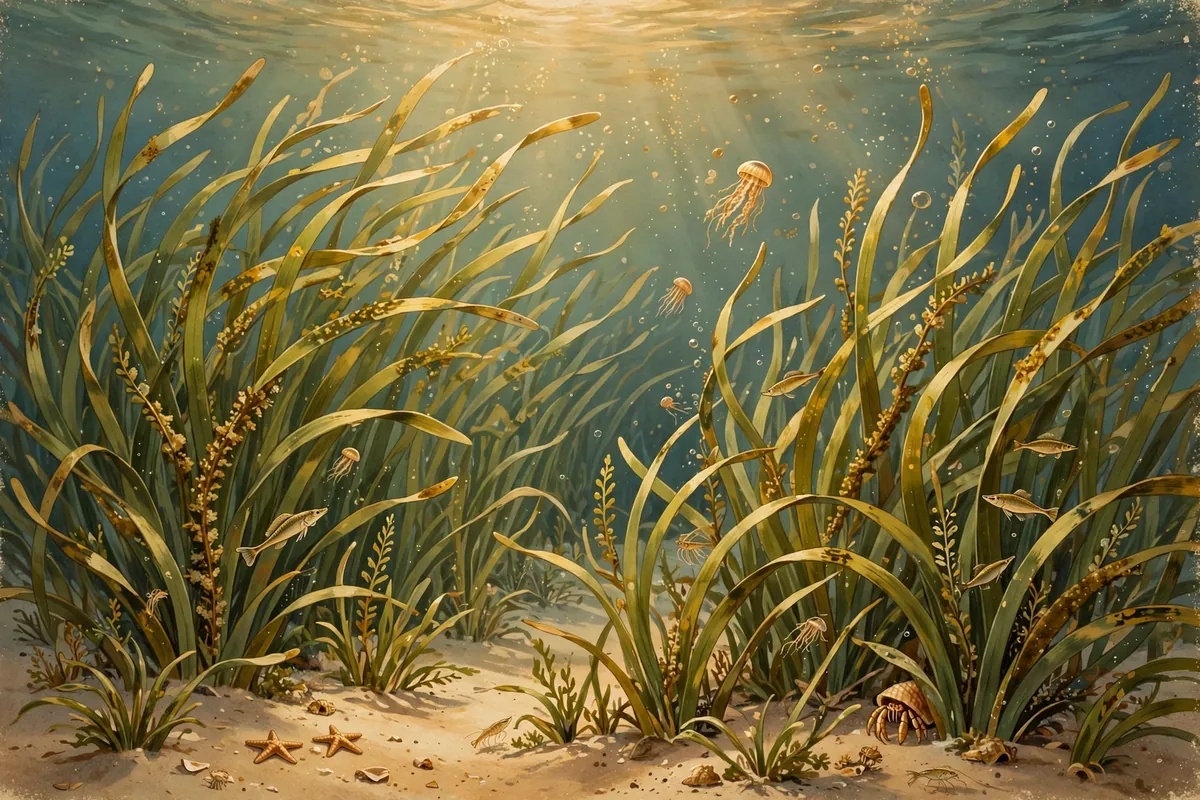
When we think of ancient living things, we usually picture giant trees with gnarled trunks. But one of the strongest candidates for the oldest living thing on Earth doesn't look old at all. It's a meadow of grass swaying gently on the seafloor of the Mediterranean.
So is a seagrass meadow really the oldest living thing? It might be, but nobody can say for sure. A huge colony of seagrass near the Spanish island of Ibiza is estimated to be anywhere from 12,000 to 200,000 years old. The low end of that range would put it behind other contenders, while the high end would make it astonishingly ancient. Scientists consider it a possible candidate, not a confirmed champion.
One Plant, Many Blades
The plant is called Posidonia oceanica, also known as Neptune grass. It grows only in the Mediterranean Sea, where it forms large underwater meadows. Its long, ribbon-like leaves can reach about 5 feet.
Despite living in salt water, Neptune grass isn't a seaweed. It's a true flowering plant with roots, stems, leaves, flowers, and fruit. Its roots anchor it in the sand, which lets it settle in places where seaweeds, which lack roots, can hardly take hold.
How can a meadow be one living thing? Neptune grass can spread by sending out underground stems that sprout new shoots. Over time, a single plant can copy itself again and again, creating what's called a clonal colony. Every blade is genetically the same individual, even if the meadow stretches for miles.
The colony near Ibiza was discovered in 2006. It stretches south toward the neighboring island of Formentera and measures about 5 miles across. That makes it one of the largest clonal colonies on Earth, as well as one of the oldest.
Why the Age Is So Uncertain
Estimating the age of a plant like this isn't as simple as counting tree rings. Scientists work from how fast the plant spreads and how big it has become. Some put the colony at around 100,000 years old.
There's a catch for the very highest estimate. The area where the meadow grows today was dry land at some point between 10,000 and 80,000 years ago. Seagrass can't grow on dry land, so the maximum age of 200,000 years is considered theoretical.
The Competition
Neptune grass isn't the only contender. In Utah, a grove of about 47,000 quaking aspen trees nicknamed Pando turned out to be a single clone connected by its roots. It's estimated to be about 14,000 years old and is sometimes called the world's largest organism by mass.
Another seagrass holds a different record. In Shark Bay, off Western Australia, a meadow of Posidonia australis was found in 2022 to be a single plant stretching about 110 miles and covering roughly 49,000 acres of seafloor. It's the largest known plant in the world and is estimated to be more than 4,500 years old.
Small Plant, Big Job
Neptune grass matters for more than records. Its meadows are an important part of the Mediterranean ecosystem, and the plant absorbs carbon dioxide at an impressive rate, by some estimates 15 times more each year than a similar-sized patch of the Amazon rainforest.
So the title of world's oldest living thing is still up for debate. But it's a lovely thought that somewhere beneath the waves, a quiet meadow may have been growing since long before the first cities were built.