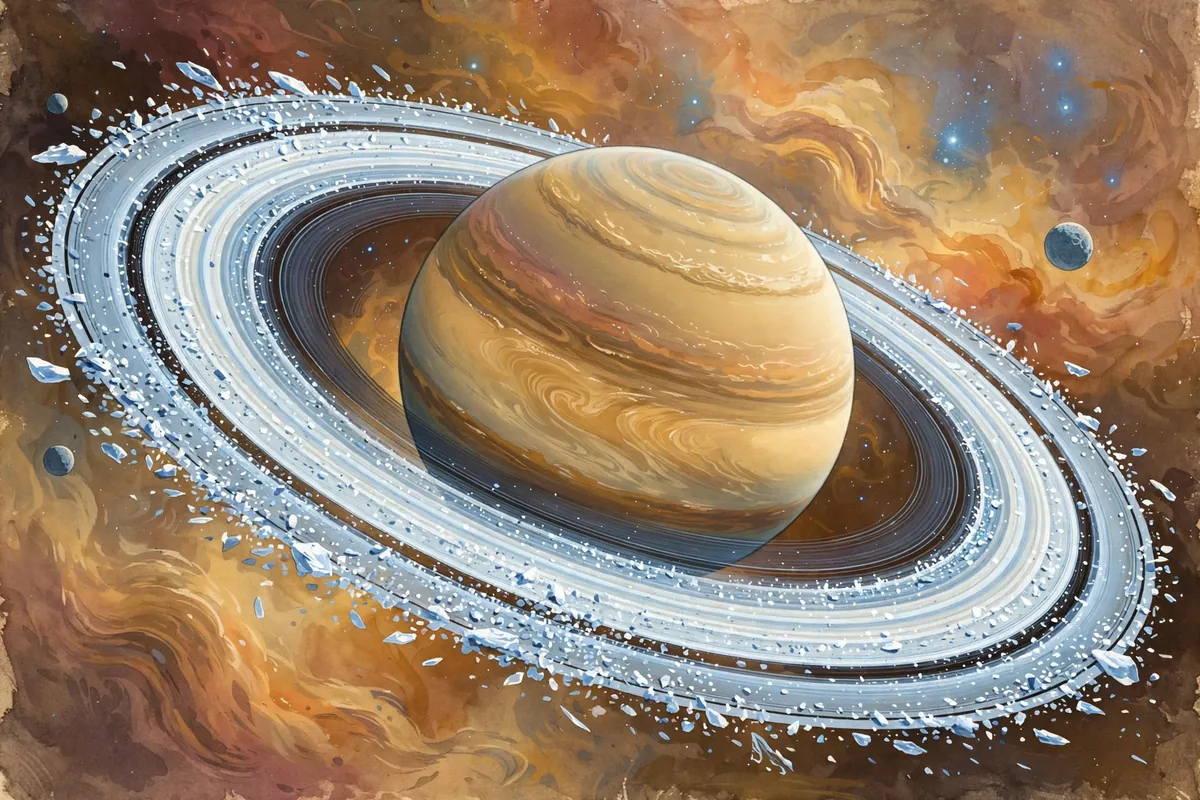
Saturn's rings are probably the most recognizable sight in the solar system. Bright, wide, and perfectly round, they look like they've been there forever. So it's startling to hear that they're disappearing.
It's true, in two very different ways. Every 13 to 15 years, the rings seem to vanish from Earth's view for a while, because we see them exactly edge-on and they're incredibly thin. And over a much longer stretch, the rings really are draining away, slowly raining down onto Saturn. At current rates, they may be gone in a few hundred million years, or possibly sooner.
Now You See Them, Now You Don't
Saturn is tilted by about 27 degrees, so the angle we see the rings from keeps changing as it orbits the Sun. About every 13 to 15 years, Earth passes through the plane of the rings and sees them edge-on. The most recent crossing came on March 23, 2025, and the next ones are due in 2038 and 2039.
Edge-on, the rings nearly disappear. The main rings stretch out to about 50,000 miles from Saturn, yet in many places they're only about 30 feet thick, and at most roughly half a mile. From Earth, that's like trying to spot a sheet of paper turned sideways.
Galileo Was Baffled
This vanishing act once stumped one of history's great scientists. Galileo first saw something odd around Saturn in 1610, but his telescope couldn't show what it was. He described the planet as having three parts and called the side pieces Saturn's “ears.”
Then, in 1612, Earth passed through the ring plane and the ears vanished. A mystified Galileo wondered, “Has Saturn swallowed his children?” The rings came back into view in 1613, confusing him even more. It took until 1655 for Christiaan Huygens to describe them as a disk surrounding the planet.
The Rings Are Raining Away
The other kind of disappearing is permanent. Saturn's rings are made almost entirely of water ice, in pieces ranging from tiny specks to chunks several yards across. That material is constantly spiraling down into the planet.
One process, called ring rain, happens when electrically charged ice grains are pulled down along Saturn's magnetic field lines. Based on ring rain alone, telescope observations suggest the rings could be gone in roughly 300 million years.
Then the Cassini spacecraft added a twist. In September 2017, while flying through the gap between the rings and the planet, it detected even more material flowing from the rings into Saturn. If that rate holds steady, the rings may be gone in under 100 million years.
Rings With a Short Life
The rings may be young, too. Data from Cassini suggest they most likely formed within the last 100 million years, which would make them somewhere between 10 million and 100 million years old. Not everyone agrees, though. Some models suggest they formed early in the solar system's history, and there's still no consensus.
Either way, the rings are losing material, which means they were likely more massive in the past than they are today.
So there's no need to rush to a telescope before the rings are gone. Even the fastest estimates leave millions of years to enjoy the view. Still, it's humbling to realize that one of the most beautiful sights in the sky is just passing through.