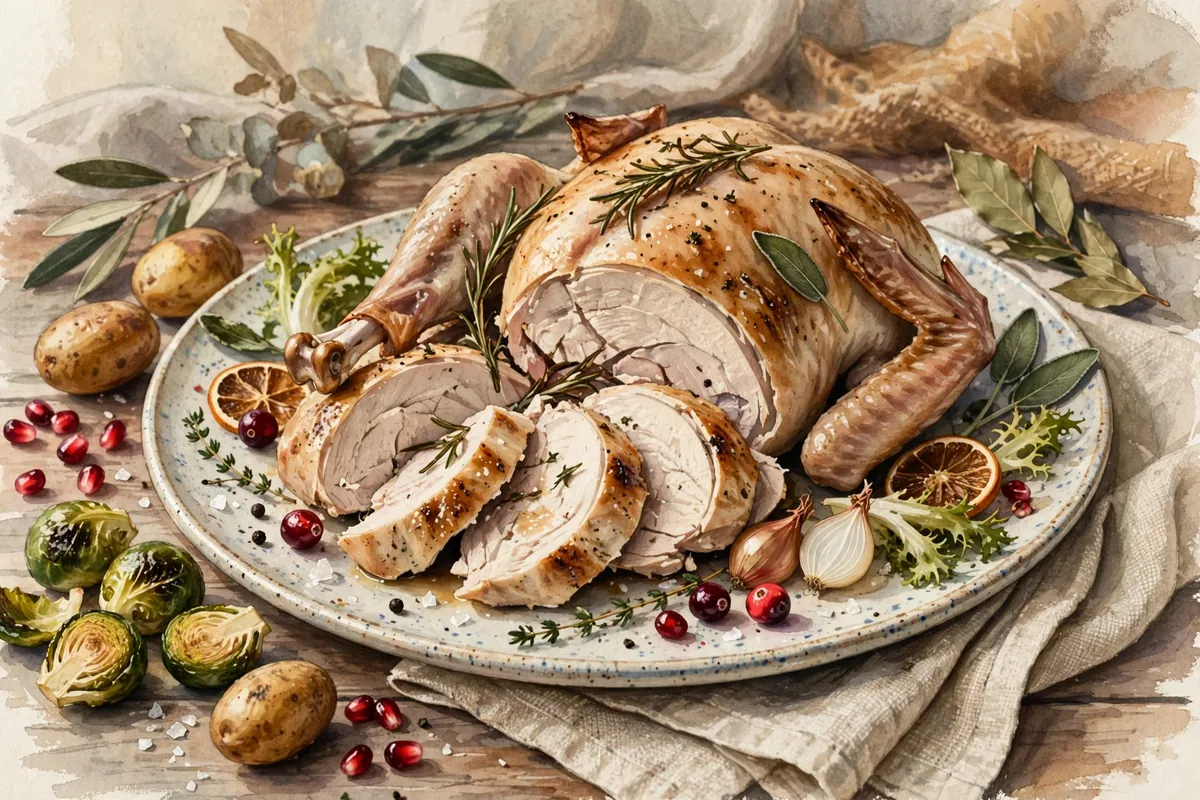
It's a phrase you've probably heard a hundred times. Someone throws out their cigarettes, swears off sweets, or gives up coffee overnight, and says they quit cold turkey. It means stopping all at once, with no gradual cutting back. But where on earth does a cold turkey come into it?
The truth is, nobody knows for certain. The origin of cold turkey in the sense of a sudden, unpleasant withdrawal is still debated. There are a few leading theories, involving a Victorian comedy, the phrase talk turkey, and the goosebumps people can get when they suddenly stop using certain drugs.
The Miser Who Got Cold Turkey
One theory traces the phrase to a British satirical magazine called Judy. Its issue of January 3, 1877, featured the made-up diary of John Hume, a Scrooge-like grump who disapproved of Christmas.
When Hume visited his cousin Clara for the holidays, he was shocked to be served slices of cold turkey instead of a proper roasted bird. Day after day, out came the cold turkey again. Fed up, Hume finally cut Clara out of his will.
Scholars of old British magazines have pointed to this story. One possible explanation is that this kind of harsh, exclusionary treatment came to be known as the cold turkey treatment, and that the phrase spread from London to the rest of Britain and on to the United States. By 1910, the Canadian poet Robert W. Service used the phrase in a novel, with a gambler who'd lost five thousand dollars saying he'd been handed out cold turkey.
Talking Turkey
Another idea links it to the American expression talk turkey, which means to speak bluntly, without much preparation.
The phrase picked up other meanings too. In the 1920s, taking cold turkey was also reported as slang for pleading guilty.
Goosebumps and Plucked Birds
A third theory is more physical. People who suddenly stop taking opioids can develop goosebumps. Their skin, the theory goes, looked like the skin of a plucked, refrigerated turkey.
That same theory has a cousin. The phrase kick the habit is said to refer to the muscle spasms that can come with withdrawal, along with the goosebumps.
The modern meaning was clearly in place by 1920. A New York City medical bulletin that December described people who stopped taking opiates without medical help, saying they called the process taking cold turkey. In 1969, John Lennon and Yoko Ono's Plastic Ono Band even released a song called Cold Turkey.
A year later, in 1921, a newspaper in British Columbia wrote about people who voluntarily turned themselves in to a doctor to give up drugs. They were given what the paper called the cold turkey treatment.
A Serious Note
For some habits, quitting cold turkey isn't just hard, it can be dangerous. Suddenly stopping alcohol after long-term heavy use, or certain medications such as benzodiazepines and barbiturates, can lead to seizures and other life-threatening problems, including a severe condition called delirium tremens in long-term drinkers. If you're thinking about stopping a substance or a prescription, talk to your doctor first.
As for the phrase itself, it's a fine example of how English picks up words from the strangest places. A cold holiday leftover, a blunt way of talking, or a bit of goosebumpy skin: any one of them may be the reason we talk turkey about quitting today.