Ask people to name the longest-living animal and many will guess a giant tortoise. That's a good guess, but the real record holders live in cold, dark seas. They grow so slowly that their age is almost hard to picture.
The longest-living animal with a backbone is the Greenland shark. Scientists estimate these sharks live at least 272 years, and the oldest one studied was estimated at about 392 years, give or take 120. If you count animals without backbones, a clam from Iceland reached 507 years, and some sponges may be far older still.
The Slowest Shark in the Sea
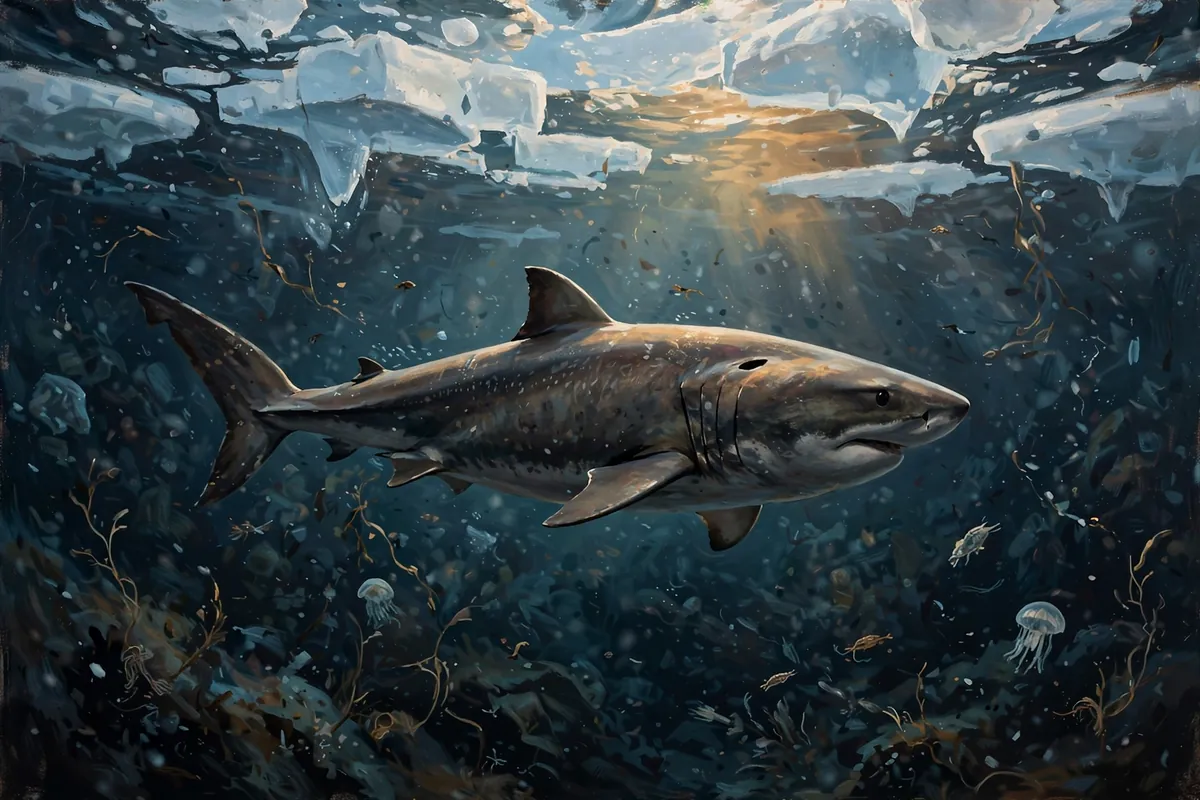
Greenland sharks live deep in the cold waters of the far north. Adults usually grow to about 13 to 16 feet long, and the largest confirmed one was about 21 feet and weighed more than 2,200 pounds.
Everything about them happens in slow motion. They have the lowest swim speed for their size of any fish, cruising at about a foot per second. They grow only about a quarter to half an inch each year. Scientists think their cold home and very slow metabolism are linked to their extremely long lives.
That sluggish pace raises a puzzle. Seals swim much faster than these sharks, yet seals are a regular part of their diet. Biologists aren't sure how the sharks manage it, but one leading idea is that they sneak up on seals while the seals are asleep.
Their family life is just as unhurried. Females reach adulthood around 150 years of age, and pups are born alive after an estimated pregnancy of 8 to 18 years.
Reading Age in a Shark's Eyes
Sharks don't have growth rings you can count, so how do scientists know their age? The answer is in their eyes. Researchers used radiocarbon dating on crystals inside the lenses of the sharks' eyes, which form early in life and stay put.
An older clue supports the idea too. One Greenland shark was tagged off Greenland in 1936 and caught again in 1952. Its measurements showed just how slowly these animals grow.
The 507-Year-Old Clam
The oldest individual animal whose age has been precisely determined is a clam. It was an ocean quahog dredged up off the north coast of Iceland in 2006. Journalists nicknamed it Ming, after the Chinese dynasty that was ruling when it was born. Icelandic researchers called it Hafrún, roughly meaning mystery of the ocean.
Scientists counted the yearly growth lines in its shell, much like tree rings. They first said it was 405 years old, but a more careful count in 2013 found it was 507. Sadly, the clam died when researchers froze it, not knowing how old it was.
Could Sponges Beat Them All?
Sponges are animals too, and some grow incredibly slowly. Giant barrel sponges in the Caribbean are thought to be more than 2,300 years old. Glass sponges in the East China Sea and the Southern Ocean have been estimated at more than 10,000 years, though that figure may be too high.
Those ages are rough estimates, which is why the shark and the clam get most of the attention. Their ages come from careful measurements, not guesswork.
There's a lesson in all this that feels oddly comforting. The animals that last the longest are the ones that never rush. Take it slow, stay cool, and you might just outlast everyone.