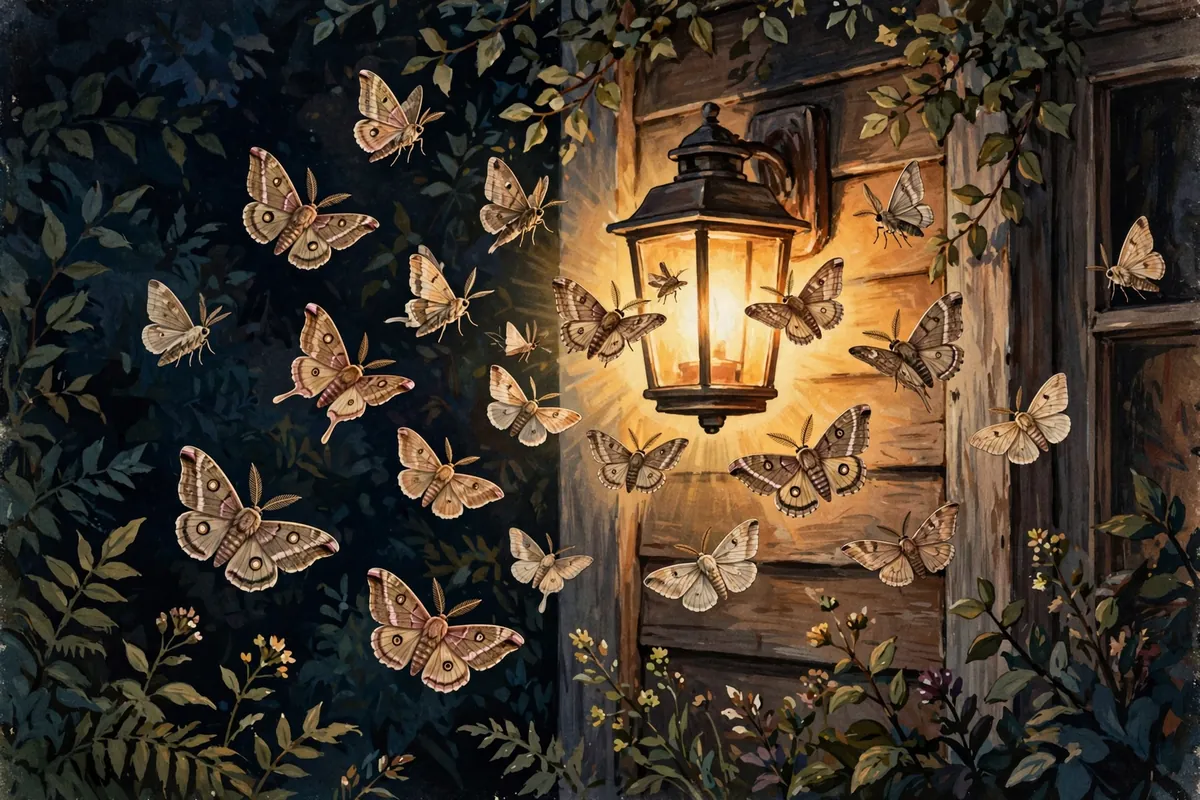
Turn on a porch light on a warm summer evening and the visitors arrive fast. Moths flutter in from the darkness, loop around the bulb, bump into it, and keep circling as if they can't break free. It's one of the most familiar sights of summer. So what are they doing?
Surprisingly, the mystery has not been fully solved. The most popular explanation is that moths use bright lights in the sky, like the moon, to fly in a straight line. A nearby lamp tricks that built-in navigation system and sends them spiraling in. It's a strong idea, but scientists still treat it as a theory, not a settled fact.
Steering by the Moon
The leading idea is called transverse or celestial orientation. A moth flying at night can keep a straight course by holding a bright light, like the moon, at a constant angle to its body. If the moon stays at the same spot in its field of view, the moth knows it's flying straight.
This works beautifully with the moon because it is so far away. Even after a moth has flown a long distance, the angle to the moon barely changes. The moon also always sits in the upper part of the moth's view or on the horizon, never below it.
Why a Porch Light Breaks the System
A light bulb is a different story. Because it's so close, the angle between the moth and the light changes quickly with every bit of flying. The moth keeps correcting by turning toward the light to hold that angle steady. The result is a spiral path that curls closer and closer to the bulb.
A nearby lamp can also sit below the moth, unlike the moon. Trying to keep it in the expected spot can send an airborne moth tumbling downward. Biologists call this pull toward light positive phototaxis, and it shows up in many other flying insects too, including flies and grasshoppers.
Another suggestion is that the urge to fly upward toward the moon may help moths spread out to new areas. Whatever the reason, the instinct that serves them well under a natural night sky becomes a trap around artificial lights.
Why It Matters More Than You Might Think
Moths aren't just porch-light pests. They are important pollinators, visiting flowers at night much as bees and butterflies do during the day. One study in the United Kingdom found moths dusted with pollen from 47 different plant species, including seven that bees largely ignore.
That's why researchers worry about light pollution. Studies have linked the spread of artificial lighting to severe declines in moth numbers in some parts of the world, and to disrupted nighttime pollination. Night-blooming flowers that rely on moths may suffer when the moths are distracted by lamps.
A Huge, Mostly Nocturnal Family
There are roughly 160,000 species of moth, and many have never been formally described. Most fly at night, though some are active at dusk and others during the day. Together with butterflies, they belong to the insect order Lepidoptera.
Night flying comes with dangers beyond porch lights. Bats hunt moths using echolocation, and some moths can hear those calls. Certain moths react by suddenly dropping a few inches in flight, while tiger moths can make clicks that interfere with a bat's sonar.
So the next time you see moths dancing around your porch light, think of them as tiny navigators who mistook your bulb for the moon. Switching the light off when you don't need it might just help them find their way again.