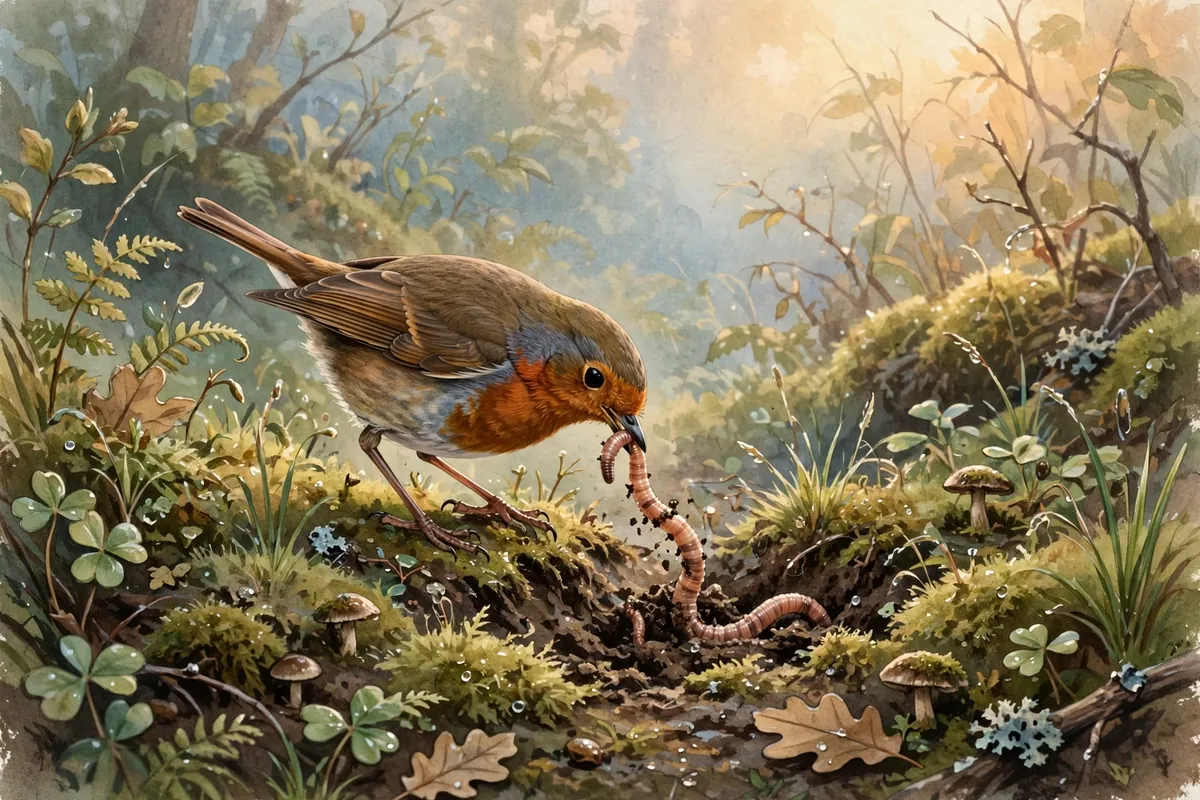
It's the kind of thing a parent says while flipping on the bedroom light at 6 a.m. The early bird gets the worm. Get moving, and you'll beat everyone else to the good stuff. It's one of the best-known proverbs in English, and it shows up in versions like the early bird catches the worm.
The meaning is simple: people who start early get the best opportunities. And the picture behind it comes from real life. Many birds, like the American robin, are up at first light, and earthworms are often near the surface after a night of activity. A bird that's out early has a good chance of finding a meal before the worms head back underground.
The Robin, the Classic Early Bird
If any bird fits the saying, it's the American robin. It's among the earliest birds to sing at dawn, and it's often seen running across lawns, stopping, and then darting down to grab an earthworm.
Robins hunt mostly by sight, though they sometimes use hearing too. That run-and-stop routine is so distinctive that birders use it to recognize them. Once they spot a worm, they pounce and pull it up out of the ground. Their babies are fed mainly on earthworms and other soft-bodied creatures. Robins are early in another way, too. They're one of the first bird species to lay eggs each year, starting soon after returning to their summer range.
Worms aren't the robin's whole diet, though. Around 60 percent of what robins eat is fruit and berries. That flexibility lets them spend winters farther north than most other North American thrushes.
Why Worms Are Easier to Catch Early
Earthworms spend most of their lives in the soil, but they do come up to the surface. Their mating, for example, takes place on the surface, most often at night. Some of their nicknames say a lot: nightcrawler, dew-worm, and rainworm.
So a bird that's out hunting while the grass is still damp with dew may find more worms close to the surface. Wait until the sun is high, and that easy breakfast may have already wriggled back down.
Are You an Early Bird?
The phrase has also come to describe people. An early bird, or lark, is someone who naturally wakes early, goes to bed early, and feels most energetic in the morning. The opposite is a night owl, who feels most awake in the evening.
Scientists call these patterns chronotypes. German chronobiologist Till Roenneberg has mapped the daily rhythms of more than 200,000 people. He found that chronotypes range from very early to very late, a little like how height varies from short to tall.
Early birds often can't sleep in, even after a late night. That suits a world of morning jobs, but it can make late-evening parties a struggle. Night owls have the opposite problem.
An Early Bird in Space
The proverb even made it into orbit. In 1965, the first commercial communications satellite placed in geosynchronous orbit, Intelsat I, was nicknamed Early Bird after the saying. It helped provide the first live TV coverage of a spacecraft splashdown, Gemini 6, later that year.
So whether you're a robin on a dewy lawn or a person reaching for the alarm clock, the old saying holds a bit of truth. Just don't feel too guilty if you're a night owl. Some of us simply run on a later clock.