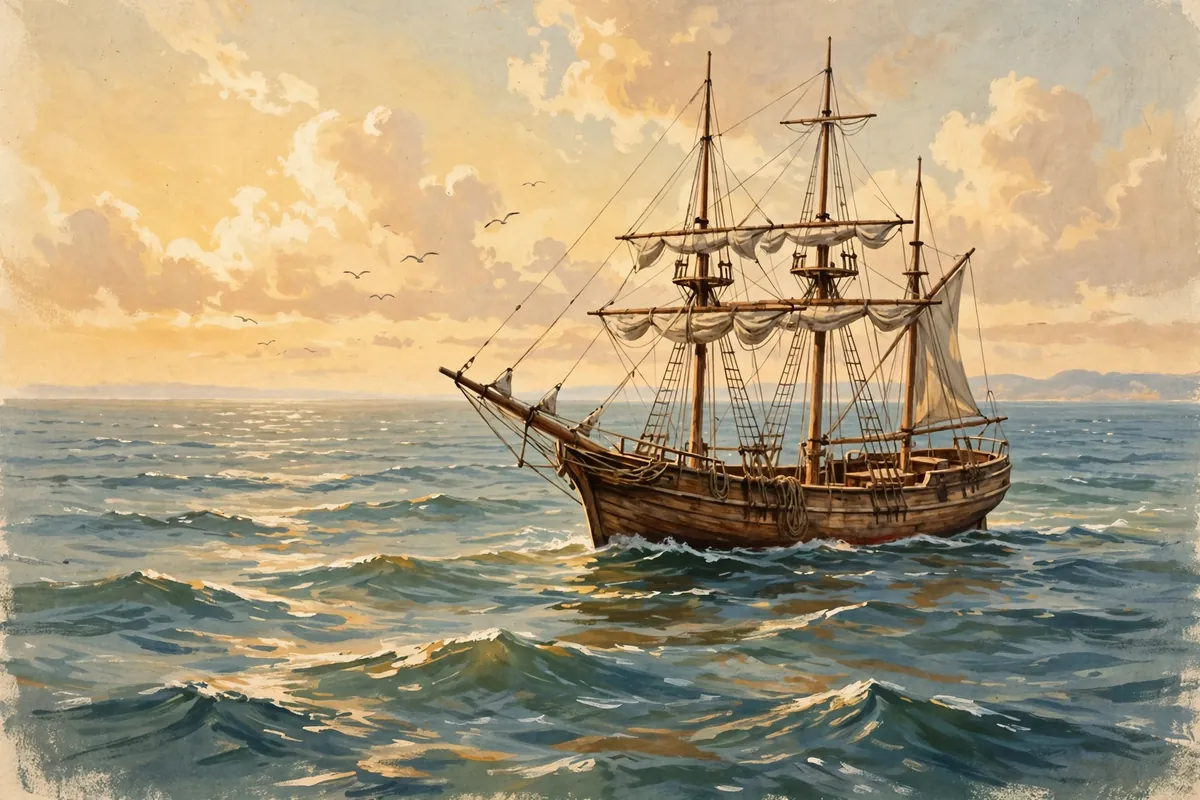
On a December afternoon in 1872, the crew of a ship called the Dei Gratia spotted another vessel heading unsteadily toward them in the Atlantic. Its sails looked odd, and its movements were erratic. When they drew near and signaled, nobody answered. Nobody was even on deck.
That ship was the Mary Celeste, and its story has puzzled people for more than 150 years. Everyone who had been aboard, the captain, his wife, their young daughter, and seven crewmen, had disappeared. The ship's lifeboat was missing, and none of them were ever seen or heard from again. To this day, no one knows for certain what happened.
What the Boarding Party Found
Two men from the Dei Gratia rowed over and climbed aboard. The ship was damp and messy but still seaworthy, sailing under partial sail. It was still well stocked with provisions. Its cargo of 1,701 barrels of alcohol was intact, and the crew's personal belongings were undisturbed.
There were no obvious signs of fire or violence. The evidence pointed to an orderly departure in the missing lifeboat. But most of the ship's papers were gone, along with the captain's navigation instruments. Two hatches were open, and a sounding rod, used to measure water in the hold, lay on deck.
The ship's log had a final entry dated November 25, nine days before the Mary Celeste was found. It placed the ship off Santa Maria Island in the Azores, nearly 400 nautical miles from where it was discovered. The ship had sailed on, empty, for all that distance.
The Captain and His Family
The captain was Benjamin Briggs, a respected and experienced mariner who had invested his own savings in a share of the ship. The Mary Celeste had left New York in November 1872, bound for Genoa, Italy. Briggs brought along his wife, Sarah, and their two-year-old daughter, while their school-aged son stayed home with his grandmother.
Before leaving, Briggs wrote to his mother that the vessel was "in beautiful trim" and that he hoped for "a fine passage."
So What Happened?
A court hearing in Gibraltar looked at possible foul play, including mutiny, piracy, and insurance fraud. No convincing evidence supported any of them. Over the years, people have proposed everything from earthquakes under the sea to a giant squid, along with plenty of supernatural ideas.
Most commentators agree that something sudden and alarming must have convinced everyone to leave a sound ship. One theory focuses on the cargo: alcohol fumes leaking from a few barrels could have made the crew fear an explosion. Another suggests that a malfunction or a waterspout made it seem as though the ship was taking on water fast, prompting a hurried escape. Either way, the lifeboat may have drifted away from the ship, and the Mary Celeste sailed on without them.
How Sherlock Holmes's Creator Changed the Story
In 1884, a young Arthur Conan Doyle, years before he became famous, wrote a short story inspired by the mystery. He changed many facts and renamed the ship the Marie Celeste. His story became so popular that the misspelling is still widely used today.
As for the real ship, her end was far less mysterious. In 1885, her captain deliberately wrecked her off the coast of Haiti in an attempted insurance fraud. The fate of the people who vanished from her decks in 1872, though, remains one of the sea's most enduring puzzles.