Mount Everest is the tallest mountain on Earth above sea level, and climbing it is the adventure of a lifetime. Now imagine a mountain about two and a half times taller, so wide it would cover a country, and sitting on another planet. That's Olympus Mons, the giant volcano of Mars.
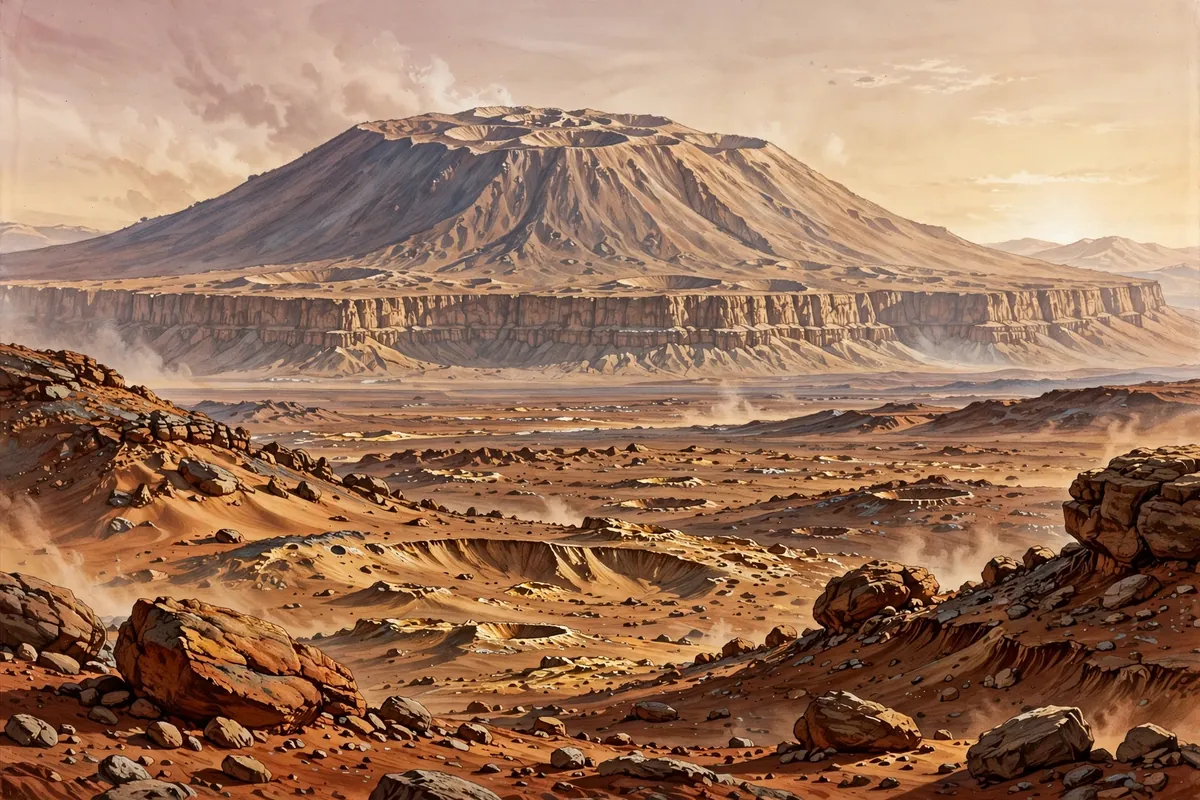
Here's the short answer. Olympus Mons is a shield volcano roughly 13 miles high by one measure, and it stands nearly 14 miles above the surrounding Martian surface. It's the tallest volcano on Mars and is roughly tied with a peak on the asteroid Vesta as the tallest mountain yet discovered in the solar system. It's about 370 miles wide and covers an area about the size of Italy.
Why It Grew So Big
On Earth, volcanoes like the ones in Hawaii form over hot spots deep underground. But Earth's crust is broken into plates that slowly drift. As a plate moves, the old volcano slides away from the hot spot and a new one starts, which is why Hawaii is a chain of islands.
Mars doesn't have moving plates. Its crust stays fixed over the hot spot, so the same volcano can keep pouring out lava for ages, getting taller and taller. Weaker gravity and gentler weather, which means less erosion, also helped Olympus Mons reach its enormous size. Scientists think it last erupted about 25 million years ago.
A Mountain You Couldn't See All at Once
Here's the strangest part. Olympus Mons is so wide and its slopes are so gentle, averaging only about 5 percent, that you couldn't see the whole thing from the ground. Even from far away, the curve of the planet would hide much of it.
And if you stood near the top, you might not even realize you were on a mountain. The slope would stretch on past the horizon, which is only about 2 miles away. Scientists have compared its shape to a circus tent held up by a single pole set slightly off center.
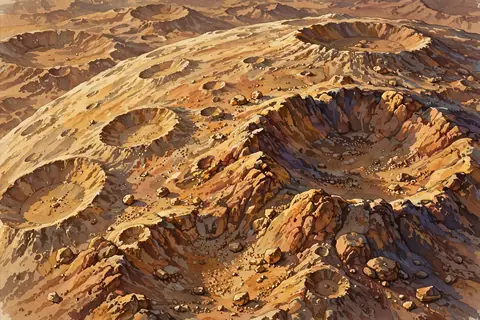
The top holds a cluster of six overlapping craters called calderas, formed when the ground collapsed after eruptions. Together they make a depression about 37 by 50 miles across and up to 2 miles deep. Around the volcano's outer edge runs a cliff up to 5 miles tall.
Tallest, But Not the Widest
Is it truly the biggest volcano around? That depends on how you measure. Another Martian volcano, Alba Mons, covers more ground, with lava flows reaching at least 840 miles from its summit. But it rises only about 4 miles high, roughly a third of Olympus Mons.
Its rival for the tallest mountain title isn't a volcano at all. It's the central peak of Rheasilvia, a giant impact crater on the asteroid Vesta, which rises somewhere between 12 and 14 miles.
From Snowy Spot to Giant Volcano
Astronomers spotted Olympus Mons through telescopes in the late 1800s, long before anyone knew what it was. They saw a bright patch and named it Nix Olympica, Latin for Olympic Snow.
Then, in 1971, NASA's Mariner 9 spacecraft arrived at Mars during a planet-wide dust storm. As the dust settled, the first things to poke through were the tops of giant volcanoes. Mariner 9 confirmed that Nix Olympica was a volcano, and it was renamed Olympus Mons, meaning Mount Olympus.
The air at the summit is incredibly thin, yet clouds still drift over it. It's a fitting home for a mountain named after the mythical home of the Greek gods. Someday, perhaps, a human will stand on its gentle slopes and look out at a horizon that just keeps going.