It's one of those stories that gets passed around at dinner parties and in business books. In 1894, the tale goes, The Times of London warned that within 50 years every street in the city would be buried under nine feet of horse manure. Then the automobile came along and saved the day.
The trouble is, that famous warning probably never happened. The great horse manure crisis of 1894 is considered an urban myth. No such article has been found, and The Times itself refuted the attribution in 2018. Horse manure really was a messy problem in big cities, but there's no evidence of the looming catastrophe the story describes.
Where the Story Came From
The phrase traces back to a 2004 article by Stephen Davies titled “The Great Horse-Manure Crisis of 1894.” It said a writer in The Times had estimated that in 50 years every London street would lie under nine feet of manure.
Nobody has been able to find that piece. The closest match is an article from June 8, 1894, which complained about dust and mud, not manure, and didn't predict any crisis at all.
The story often adds a dramatic 1898 urban planning conference that supposedly broke up early because no one could solve the manure problem. There's no known record of that, either.
The Mess Was Real
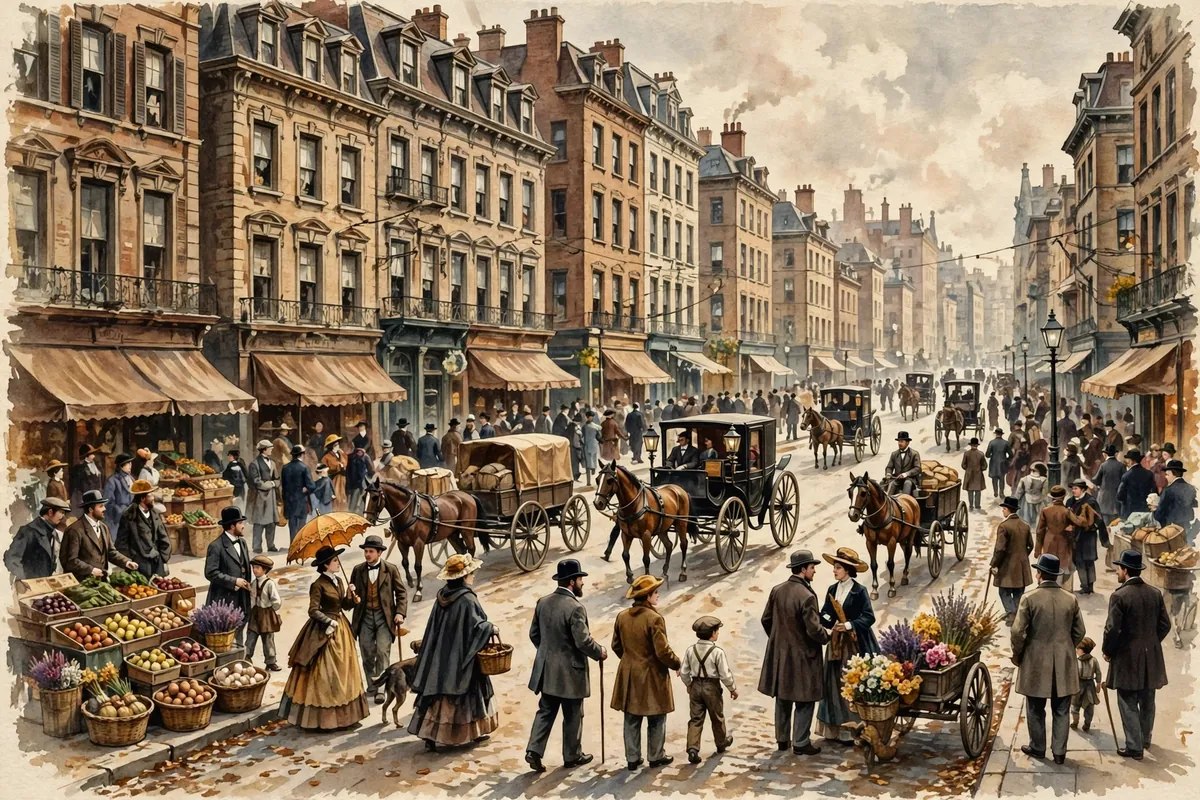
None of this means the streets were clean. In the 1800s, horse-drawn vehicles dominated big cities, and streets were often filthy. Crossing sweepers, usually poor workers, would sweep a path ahead of pedestrians for a tip, sparing long dresses from horse droppings and other refuse.
Horse-drawn streetcars added to the load. A typical streetcar horse pulled for about a dozen miles a day over four or five hours, so many systems needed ten or more horses for every car. Those horses produced prodigious amounts of manure that the companies had to store and dispose of.
Manure even went from asset to burden. Street cleaners once collected horse droppings to sell as fertilizer to nearby farms. But in 1893 London, there was a complaint that manure, once something that could be sold, had become a disposal problem.
The scale of horse travel was enormous. By the mid-1880s, 415 street railway companies in the United States were carrying 188 million passengers a year on horsecars.
How the Horses Were Replaced
The problem largely took care of itself as cars, buses, and electric trams replaced horses in big cities. In Toronto, electric streetcars took over from horsecars between 1892 and 1894. London retired its last horse-drawn tram in 1915.
Some people saw the change coming. In 1896, the Italian newspaper Corriere della Sera predicted that cars would revolutionize daily habits, including making manure disappear from the streets.
Why the Myth Lives On
Today the story survives mostly as a handy analogy. People use it to describe a problem that looks impossible to solve, until a new technology comes along and makes it beside the point. The worriers, the lesson goes, were looking at it from the wrong direction.
So the next time someone tells you London nearly drowned in manure, you can smile and add a footnote. The streets were plenty smelly, and horses truly were everywhere. But the famous nine-foot prediction seems to be a tall tale that grew legs of its own.