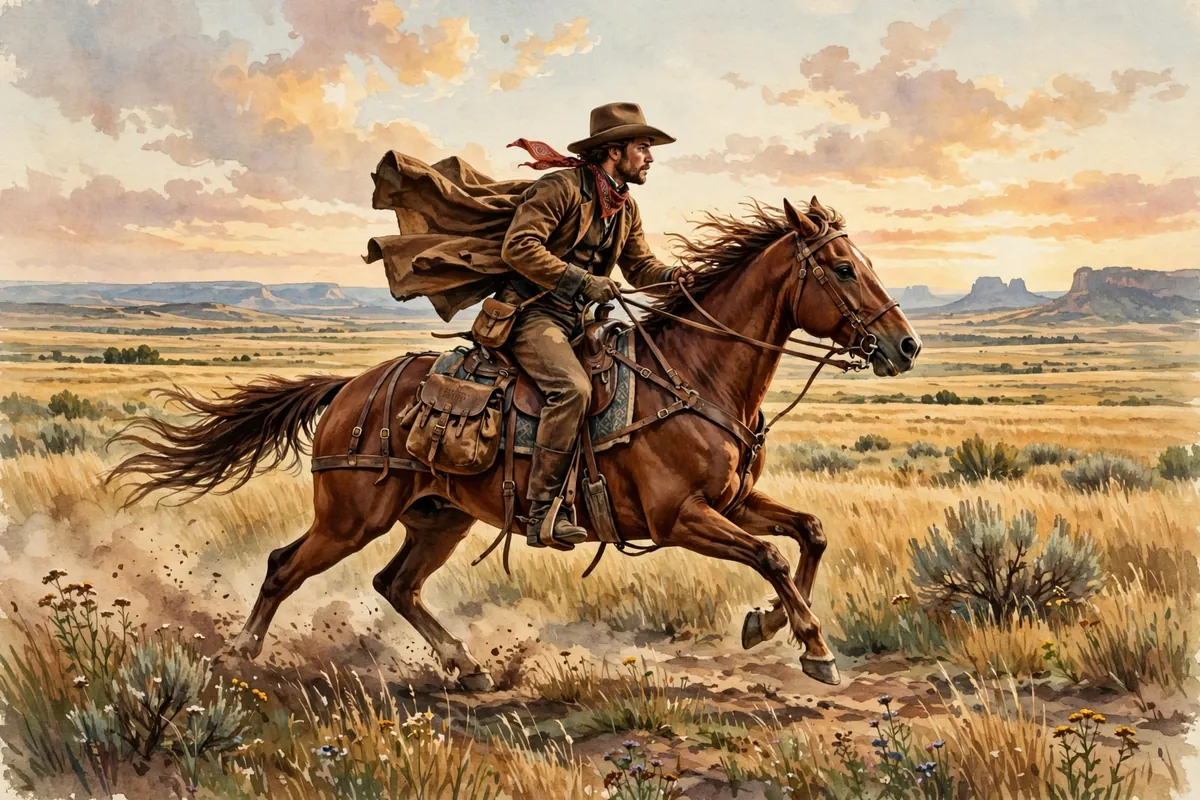
Few images say Old West quite like a lone rider galloping across the plains with a pouch of mail. The Pony Express has inspired books, movies, and more than a few childhood daydreams. It's easy to imagine it as a fixture of frontier life for a generation or more.
Here's the short answer: the Pony Express ran for only about 18 months, from April 1860 to October 1861. It was fast, but it never made money, even with heavy financial backing. When the first transcontinental telegraph line was completed in October 1861, messages could cross the country almost instantly. Two days later, the Pony Express announced it was closing.
Ten Days, Coast to Coast
Before the Pony Express, news from the East could take months to reach California. Word of James Buchanan's election win in 1856 took that long. The new service promised to cut that to about 10 days. Many people said it couldn't be done.
The route ran about 1,900 miles, from St. Joseph, Missouri, to Sacramento, California. Riders followed the Oregon and California trails, passed through Salt Lake City, and crossed the Sierra Nevada. Along the way stood roughly 186 stations, about 10 to 15 miles apart, where riders swapped to fresh horses and grabbed a bite to eat.
The very first westbound ride left St. Joseph on April 3, 1860, after speeches and a cannon blast. Around midnight on April 14, the first pouch reached San Francisco, carrying a congratulatory letter from President Buchanan and 85 pieces of mail in all.
Tough Riders, Light Loads
Riders couldn't weigh more than 125 pounds, and they rode day and night, changing about every 75 to 100 miles. The mail traveled in a cover called a mochila, Spanish for backpack, which slipped over the saddle and was held in place by the rider sitting on it. Its pockets were padlocked.
The pay was good for the time: $125 a month, when unskilled laborers earned about 43 cents to a dollar a day. Sending a letter wasn't cheap, though. The original price was $5 for a half ounce, about 250 times the cost of regular mail. It later dropped to $1, which was still considered expensive.
The service proved its worth in November 1860, carrying news of Abraham Lincoln's election west. California newspapers got the word just 7 days and 17 hours after papers on the East Coast.
Beaten by a Wire
The Pony Express went bankrupt despite its subsidy, and its owners never won the exclusive government mail contract they had hoped for. Then came the knockout punch. On October 24, 1861, the transcontinental telegraph was completed, and the service announced its closure on October 26.
How a Short Run Became a Legend
Once it was gone, the Pony Express was quickly romanticized. Buffalo Bill Cody did more than anyone to keep the story alive. He claimed in an 1879 autobiography that he had been a rider, though that claim has since been disputed, and his Wild West Show made the Pony Express a crowd favorite.
Even the famous job ad, "Orphans preferred," may be a later hoax, since no one has found it in newspapers of the time. But the real story is impressive enough. For a year and a half, ordinary young riders proved that mail could cross a continent in days, and that's a legacy worth tipping your hat to.