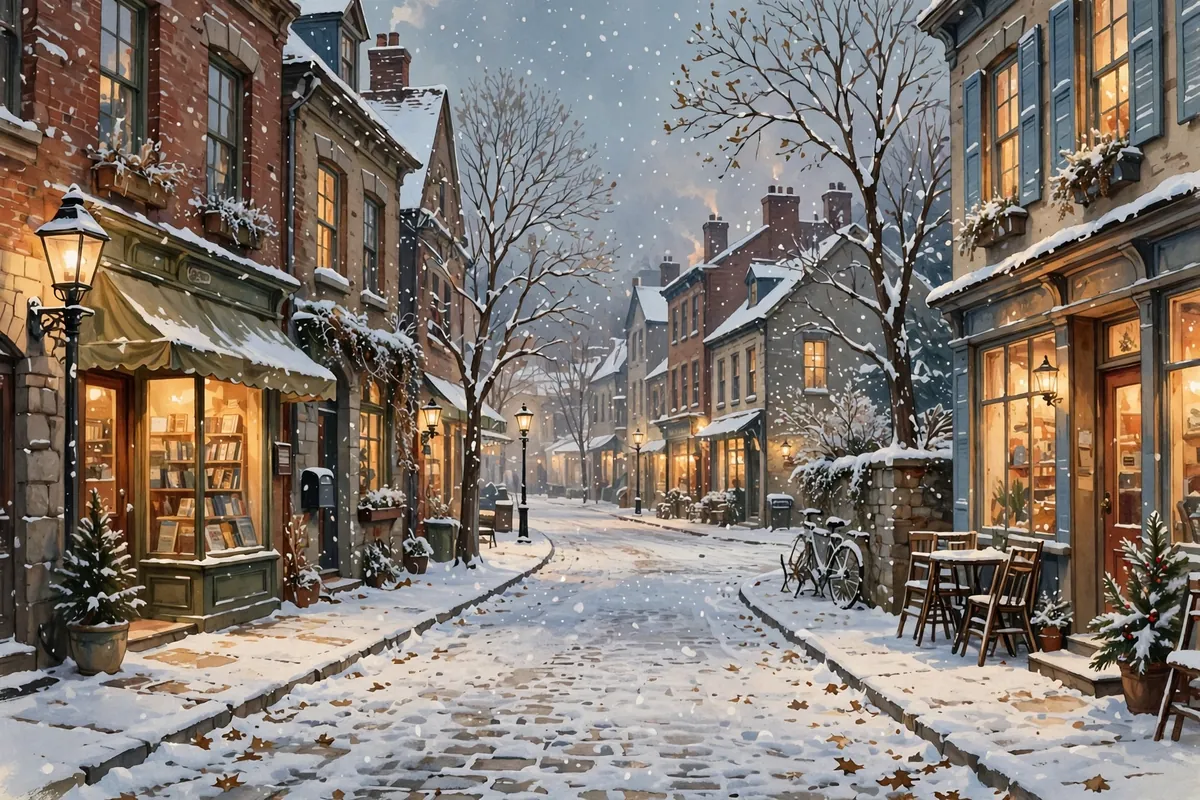
You wake up, pull back the curtain, and the whole world has changed overnight. The lawn, the rooftops, the car in the driveway, all tucked under a clean white blanket. Even grown-ups feel a little spark of excitement at the first snow of the season. What is it about fresh snow that feels so special?
Part of the answer is just how bright and new everything looks. Fresh snow reflects about 90 to 95 percent of the sunlight that hits it, more than almost any natural surface. And every flake in that blanket is a tiny ice crystal that grew its own way on the trip down, which makes it very unlikely that any two are exactly alike. Science can't measure magic, but it can explain the sparkle.
Why Clear Ice Looks White
Here's a puzzle. A single ice crystal is clear, like a window. So why is snow white? The answer is in all those tiny surfaces. Each snowflake has many small crystal faces, and together they scatter sunlight in every direction.
Because all colors of light get bounced around equally, the result looks white. That's also why a snowy field is so dazzling on a sunny morning. Scientists measure this reflectiveness with a number called albedo, and fresh snow sits near the very top of the scale. Charcoal, for comparison, reflects only about 4 percent.
The Life Story of a Snowflake
A snowflake begins high in a cold cloud, forming around a speck of mineral dust or other tiny particle. It starts as a minute hexagon, because ice naturally forms six-sided crystals. Then six arms grow out from the corners.
As the flake tumbles down, it passes through changing temperatures and humidity, and those tiny changes shape how it grows. A typical snowflake contains around 10 quintillion water molecules. With so many molecules and so many possible paths, it's very unlikely that two snowflakes in nature are identical, though scientists have grown nearly identical ones in the lab.
Most real snowflakes aren't the perfect stars seen on holiday cards, either. Most snow particles are irregular in shape, and the beautifully symmetrical ones are relatively rare.
The Farmer Who Photographed Snow
Wilson Bentley of Jericho, Vermont, fell in love with snowflakes as a teenager. While other farm families dreaded winter, he said he was "supremely happy." Snowflakes melted too fast to draw, so he attached a camera to a microscope.
On January 15, 1885, he photographed his first snowflake. Over his lifetime, he captured more than 5,000 images of snow crystals, helping popularize the idea that no two are alike. Each crystal was caught on a blackboard before it could melt, then photographed.
Light, Fluffy, and Full of Air
Fresh snow is surprisingly airy. Scientists describe snow as a highly porous material, a web of ice with connected air spaces running through it. Even after a snowpack settles under its own weight, it's only about 30 percent as dense as water.
Snowflakes have become a symbol of the season in Europe and North America, often standing for purity and linked to the hope of a white Christmas. So the next time the first flakes drift past your window, go ahead and enjoy the wonder. Each one really is a tiny, one-of-a-kind crystal that traveled a long way to land at your door.