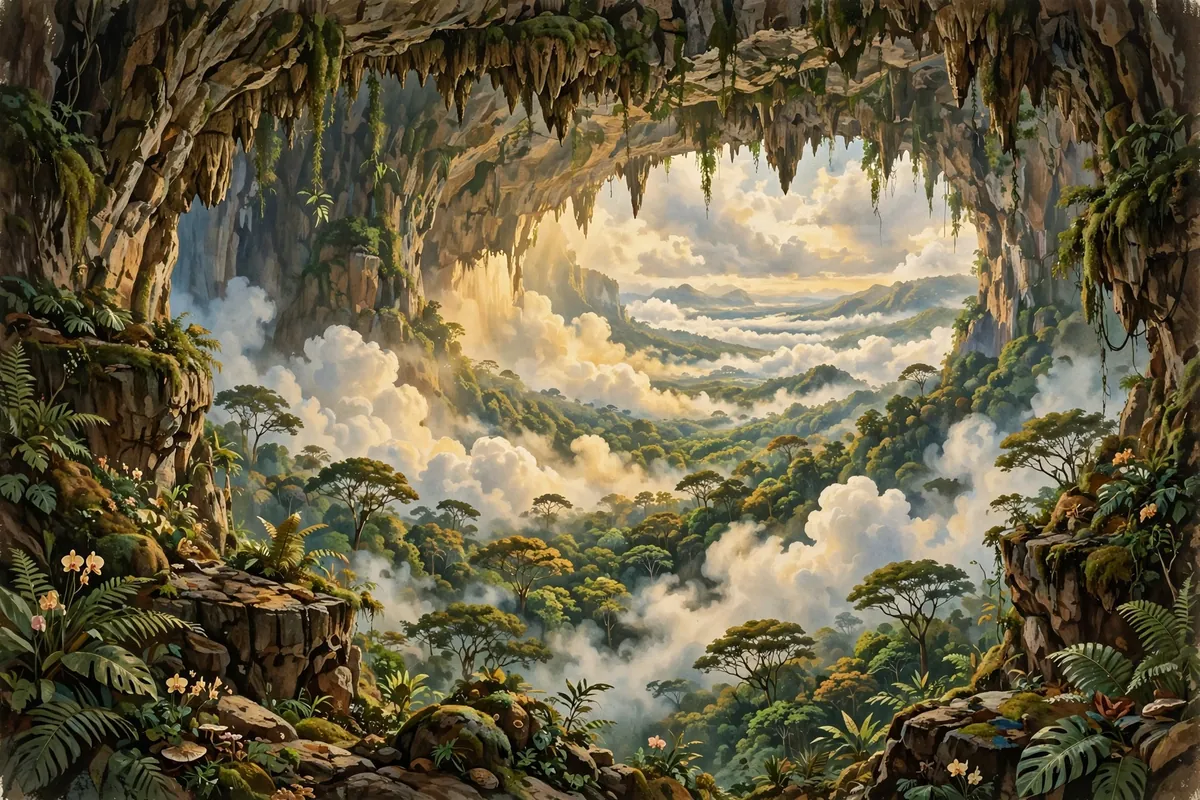
Caves usually seem like quiet places, cool and still, tucked away from the wind and rain. But a few caves on Earth are so gigantic that the usual rules stop applying. Inside them, there's room for fog to roll, wind to blow, and even trees to grow.
One of the most remarkable is Er Wang Dong, a huge cave in the Wulong Karst region of Chongqing, China. It's large enough to contain its own weather system. People who live nearby even use it as a weather forecast: if fog comes drifting out of one of its giant openings, they expect rain.
A Cave Bigger Than Some Towns
Er Wang Dong is enormous. Its known passages stretch about 42 kilometers, or roughly 26 miles, and it reaches a maximum depth of about 1,447 feet. The cave formed in ancient limestone, rock that slowly dissolves in water over vast stretches of time.
The cave begins in a huge sinkhole called the Niubizi tiankeng, whose name means ox nose sinkhole. It's about 640 feet deep. The cave also contains a second giant sinkhole, the Qingkou tiankeng, which plunges around 968 feet. A tiankeng is a type of giant sinkhole, the kind that forms when limestone is slowly dissolved by water.
Er Wang Dong sits close to another very large cave system called San Wang Dong. Both were explored by a caving group called the Hong Meigui Cave Exploration Society. The surrounding Wulong Karst is part of the South China Karst, a UNESCO World Heritage Site.
The World's Largest Cave Has a Forest
Farther south, in Vietnam, lies another underground giant, Son Doong Cave, considered the world's largest natural cave. Its main passage is more than 3 miles long, about 660 feet high, and about 490 feet wide. It's so roomy that, by one comparison, a Boeing 747 could fly through it without its wings touching either side.
In two places, the cave's ceiling has collapsed, forming openings called dolines. Sunlight pours in through those gaps, and trees and other plants grow on the cave floor below. Imagine a jungle thriving inside a cave.
Son Doong also has a fast-flowing underground river and some of the tallest known stalagmites in the world, up to about 260 feet tall. Explorers also found cave pearls the size of baseballs.
Found, Lost, and Found Again
Son Doong's discovery is a story in itself. In 1990, a local man named Ho Khanh stumbled upon its entrance while searching for valuable agarwood. The roar of rushing water and the strong wind pouring out of the opening discouraged him from going in. By the time he got home, he had forgotten exactly where it was.
Years later, he mentioned it to members of the British Cave Research Association. He finally relocated the entrance in 2008 and led an expedition there in 2009. Their progress was blocked by a 200-foot wall of flowstone they nicknamed the Great Wall of Vietnam. They returned in 2010, got over it, and reached the end of the passage.
Worlds Beneath Our Feet
Visiting Son Doong isn't easy. Permits are limited, and the cave closes to tourism from September to December, when heavy rains raise the river levels. The first tourist group explored it in 2013.
Caves like these are a humbling reminder that our planet still holds hidden wonders. Somewhere beneath the hills of China and Vietnam, fog is drifting, wind is blowing, and trees are reaching for a patch of sky, all inside a cave.