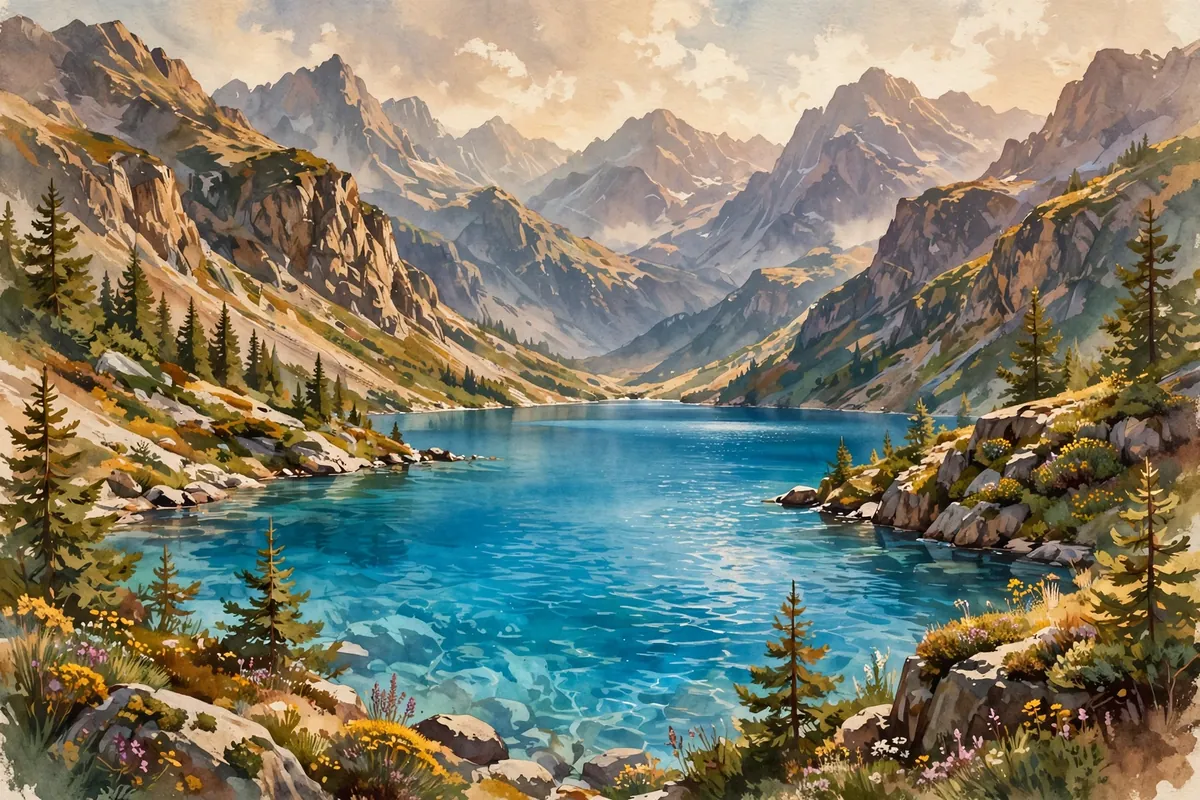
If you've ever seen a photo of Lake Louise or Moraine Lake in the Canadian Rockies, you probably did a double take. The water is a milky, glowing turquoise that looks almost like it was poured from a paint can. It's hard to believe a color that bright could be natural.
It is natural, and the main ingredient is rock. Glaciers grind the rock beneath them into an extremely fine powder called rock flour. Meltwater carries that powder into the lakes, where the tiny particles float and scatter sunlight. That scattering, together with water's own blue tint, creates the brilliant turquoise.
Water Really Is a Little Blue
First, a surprise: pure water isn't completely colorless. A glass of it looks clear, but water has a slight blue color that gets deeper the more of it you look through. Scientists have shown this by shining white light through a long pipe filled with purified water.
The reason is that water absorbs a little bit of red light. When sunlight goes deep into a lake or the ocean, the red, orange, and yellow parts are soaked up, and what's left is mostly blue and green.
Many people think lakes are blue only because they reflect the sky. The sky does play a part, but it's not the whole story. A swimming pool with white sides looks blue even indoors, where there's no sky to reflect at all.
The Glacier Recipe for Turquoise
Mountain lakes fed by glaciers get an extra boost. As a glacier slowly moves, it grinds against the rock underneath and along its sides, crushing it into rock flour. The freezing and thawing of water in cracks helps break up rock, too.
When that fine powder washes into a river, it can turn the water gray, milky white, or blue-green. When it flows into a glacial lake, the lake may glow turquoise. The blue color is most often caused by an effect where tiny suspended particles scatter light, and the exact shade depends on the size of the particles.
You can see this in Lake Louise, Moraine Lake, and Peyto Lake in Canada, Lake Tekapo in New Zealand, and in Washington State's Cascade Range, at places like Diablo Lake. Moraine Lake's view is one of the most photographed spots in Canada and was once featured on the back of the Canadian $20 bill.
Deep Blue Without the Glaciers
Not every brilliant lake gets help from glaciers. Crater Lake in Oregon is famous for its deep, intense blue. It fills the collapsed remains of an ancient volcano and is the deepest lake in the United States, at about 1,949 feet.
No rivers flow in or out, so the lake is fed by rain and snow and stays exceptionally clean. Scientists have measured its clarity at around 120 feet, and once recorded a clarity of 142 feet. All that deep, pure water lets the natural blue of water shine through.
When Lakes Turn Other Colors
What's floating in the water can change everything. Algae can make a lake look green, while dissolved natural compounds called tannins can turn water a dark, tea-like brown.
So that impossible turquoise in a mountain photo is real. It's simply sunlight, clean water, and a little ground-up mountain working together. If you ever get to see one in person, it's every bit as stunning as the pictures.