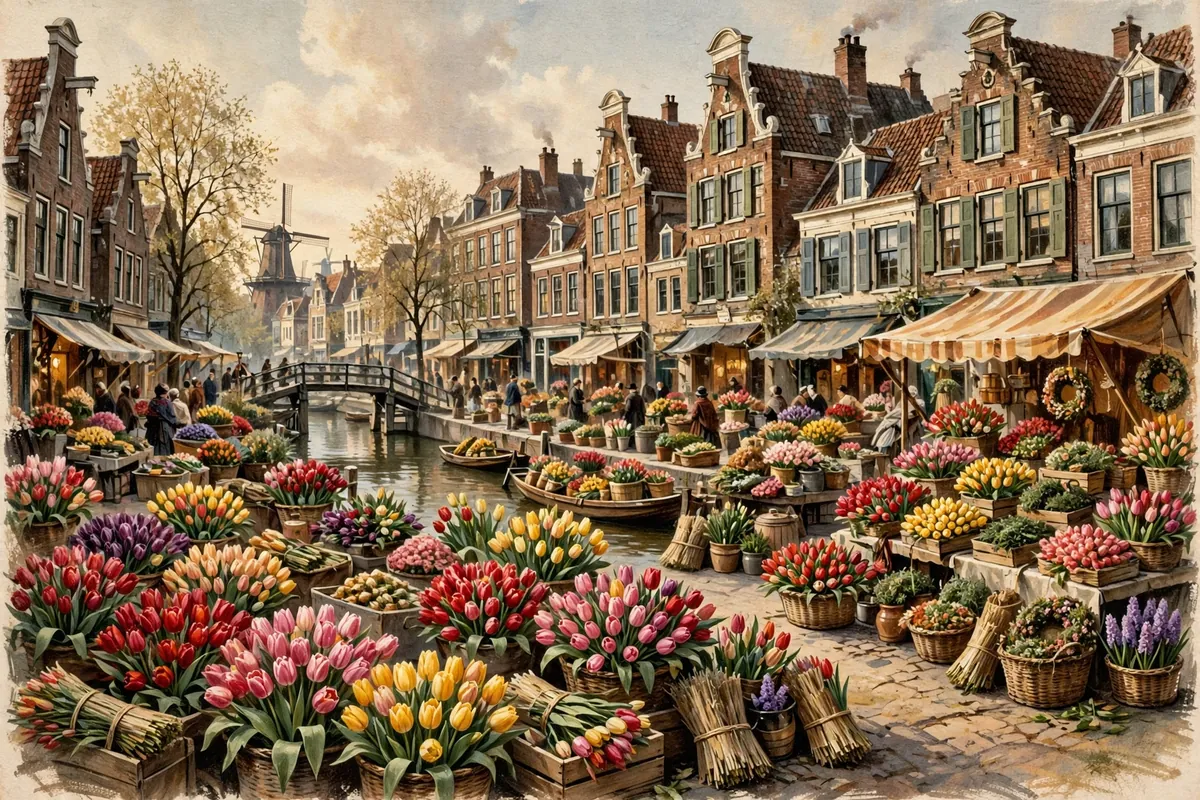
Today you can buy a bag of tulip bulbs at the garden center for a few dollars. But nearly 400 years ago, in the Netherlands, certain tulip bulbs were treated like gold. People bid against each other for flowers that hadn't even bloomed yet.
Here's the short answer. During the Dutch Golden Age, contract prices for some fashionable tulip bulbs soared, especially from 1634 onward. At the peak in February 1637, certain bulbs sold for more than 10 times the yearly income of a skilled craftsman. Then prices collapsed abruptly that same month. It's generally considered the first recorded speculative bubble in history.
How Tulips Got to Holland
Tulips came to Europe from the Ottoman Empire. Ogier de Busbecq, an ambassador to Sultan Suleiman the Magnificent, is often credited with sending the first bulbs and seeds to Vienna in 1554.
The botanist Carolus Clusius did much to spread them. After taking a post at Leiden University, he planted his collection there in 1593 and found tulips could handle the harsh Dutch climate. They caught on quickly. Clusius's garden was even raided twice, and more than a hundred bulbs were stolen.
The Secret Behind the Prettiest Petals
The most prized tulips had dramatic flame-like streaks of color across their petals. The Dutch sorted them into groups, and the rarest, with streaks on red, brown, or purple backgrounds, were called Bizarres.
Nobody knew it at the time, but those gorgeous streaks were caused by a virus, now called tulip breaking virus. It breaks a single petal color into two or more. The most expensive tulip of all, the Semper Augustus, wasn't really a variety at all, but a virus-infected tulip. At its peak, one sold for 10,000 guilders.
Trading Air in the Taverns
Much of the frenzy happened over the winter, and people traded contracts for future bulbs rather than the bulbs themselves. Traders met in taverns and paid a small fee called wine money on each deal. The Dutch called it windhandel, or air trade, because no bulbs actually changed hands.
By the winter of 1636 to 1637, some contracts were changing hands five times. Then, in early February 1637, prices collapsed. A satire from the time claims the crash began in Haarlem on February 3, when an auctioneer couldn't find buyers. The real circumstances aren't known. In the end, most contracts were simply never honored.
Was It Really a Disaster?
The famous version of this story comes largely from an 1841 book by Scottish journalist Charles Mackay, who described ruined investors and a severe shock to Dutch commerce. He also wrote that 12 acres of land were once offered for a single Semper Augustus bulb.
Modern historians have pushed back. In her 2007 study, historian Anne Goldgar found the trading involved a fairly small group, mostly wealthy merchants and craftsmen. Among the many buyers and sellers she identified, fewer than half a dozen had financial troubles, and even then it isn't clear tulips were to blame. Since little money had actually changed hands, few people really lost fortunes. The Dutch Republic stayed one of the richest nations in the world.
Still, the shock was real in another way. It shook people's sense of what anything was truly worth. So the next time you plant a few tulip bulbs, enjoy them for what they are: beautiful, cheerful, and thankfully a lot more affordable.