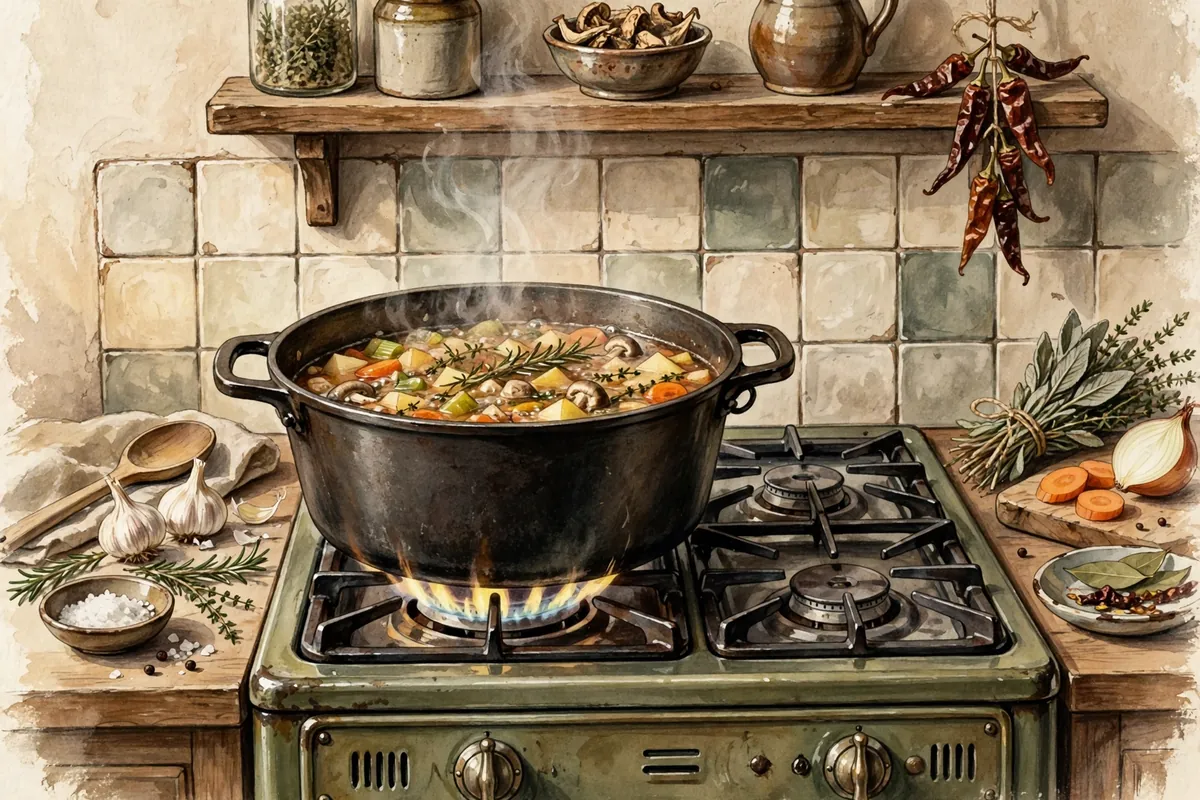
Everyone knows the old saying: a watched pot never boils. And anyone who has stood over the stove waiting for pasta water knows it sure feels true. The second you turn away, it seems to start bubbling.
Of course, a watched pot does boil, right on schedule. Two things make it feel slow. First, water really does take a lot of energy to heat up, so it's genuinely slower than you might expect. Second, staring and waiting is one of the best ways to make time feel like it's dragging.
Water Is a Slow Heater
Water has an unusually high specific heat capacity, a measure of how much energy it takes to warm something up. It takes about 4.2 joules to raise a single gram of water by one degree Celsius, more than most common liquids.
The reason lies in the molecules. Each water molecule can form up to four hydrogen bonds with its neighbors, and those bonds are about ten times stronger than the forces holding most other liquids together. Breaking them takes energy, and turning water into steam takes even more, about 2,257 joules per gram. That's great for Earth's climate, since oceans store huge amounts of heat, but not so great for a hungry cook.
What Happens Before the Boil
At sea level, water boils at 212 degrees Fahrenheit. At higher altitudes, where air pressure is lower, it boils at a lower temperature. So the wait depends a little on where you live.
As the pot heats, the first bubbles you see form at tiny spots on the bottom of the pan. Scientists call this nucleate boiling. The hotter the pan's surface gets, the more of these little bubble-making spots appear, until the whole pot is rolling. Bubbles can also form right in the middle of the water instead of on the pan, if the water is hotter in its center than at the edges. That can happen in a microwave, which heats the water rather than the container.
Why Waiting Feels So Long
Now for the brain. Boredom has long been tied to the feeling that time is moving slowly. The German word for boredom, Langeweile, literally combines the words for long and while, matching the common sense that time crawls when you're bored.
When you stand over a pot with nothing else to do, you're basically creating boredom on purpose. Every second gets noticed, and the minutes seem to stretch.
The Stopped-Clock Trick
Your brain plays other tricks with time, too. One famous example is called the stopped-clock illusion. When you suddenly glance at an analog clock, the second hand can seem to freeze for a moment before it starts moving again. That's because the brain stretches the first impression of something new, making it seem to last longer, by up to half a second.
Researchers also think the visual system waits about a tenth of a second to gather all its information before deciding what you're seeing. In other words, your sense of time isn't a perfect stopwatch. It's a best guess, and it changes depending on what you're doing and how you feel.
So the next time you're waiting on the pasta water, go ahead and set the table or start the sauce. The pot won't boil any faster, but it will certainly feel that way.