Watch a video from the International Space Station and everything floats. Astronauts drift from room to room, water forms wobbly balls, and pens hang in midair. It's easy to assume that's because there's no gravity in space. But that's one of the most common mix-ups in science.
Gravity is very much present where the space station flies. In fact, it's what keeps the station from flying off into deep space. Astronauts float because they and their spacecraft are in free fall, constantly falling toward Earth together. Since everything falls at the same rate, nothing presses against anything else, and they feel weightless.
Falling Around the World
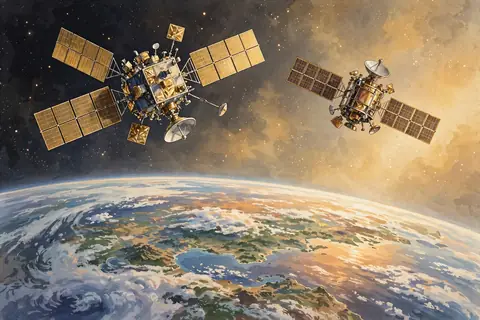
So why doesn't the station crash? Because it's also moving sideways incredibly fast. The ISS orbits about 250 miles up at roughly 17,200 miles per hour, circling Earth about every 93 minutes, or 15 and a half times a day.
At that speed, as the station falls toward Earth, the planet's curved surface drops away beneath it just as fast. It keeps falling over the horizon and never hits the ground. Speed, not a lack of gravity, is what keeps satellites in orbit.
Isaac Newton imagined this centuries ago. He pictured firing a cannonball from the top of a tall mountain with no air in the way. Fire it fast enough, he reasoned, and it would circle the whole Earth and come back to the mountain it was fired from.
Weight Is What Goes Missing
What astronauts lose isn't gravity, it's weight. On Earth, you feel your weight because the floor pushes back up on you. In free fall, there's nothing pushing back, because the floor is falling right along with you.
A falling elevator with a cut cable is the classic example. The people inside would feel almost weightless, even though gravity is pulling on them as hard as ever. Scientists call the near-weightless condition in orbit microgravity, because tiny forces never quite go to zero.
Practicing on the Vomit Comet
You don't have to go to space to float. Special airplanes fly up and down in huge arcs called parabolas. At the top of each arc, everyone on board falls together and floats for about 25 seconds.
Astronauts train this way, and a single flight often includes 40 to 60 of these swoops. About two-thirds of passengers get airsick, which is how the planes earned the nickname vomit comet. NASA's Project Mercury astronauts trained in one as far back as 1959.
On the ground, NASA has a 476-foot shaft in Cleveland where experiments can free-fall for just over five seconds. That's long enough to study how things behave without weight.
Floating Takes Getting Used To
Floating isn't always fun at first. Roughly 45 percent of people who have flown in space have had space sickness, with nausea, headaches, and dizziness. It never lasts more than 72 hours, after which the body adjusts.
NASA even jokes about it with the Garn scale, named after Senator Jake Garn, whose case of space sickness on a 1985 shuttle flight was the worst on record. One Garn is the most severe case possible.
So the next time you see astronauts doing somersaults in midair, remember what's really going on. They aren't escaping gravity at all. They're falling, beautifully and endlessly, all the way around the world.