Most roads don't last. Asphalt cracks, routes get rerouted, and highways are rebuilt every few decades. So it's a little mind-boggling that some ancient roads are still carrying travelers today. Which road holds the title of oldest still in use?
The honest answer is that nobody can crown a single winner. Ancient paths have been reused, rebuilt, and paved over so many times that the record is hard to pin down. But one of the most famous contenders is Rome's Appian Way. Its first section was built in 312 BC, and today the first three miles of the old road outside Rome are still heavily used by cars, buses, and coaches.
The Queen of the Long Roads
The Appian Way, or Via Appia, connected Rome to Brindisi in southeastern Italy. It was one of the earliest and most important Roman roads, and the Romans gave it a grand nickname: the queen of the long roads. It was named after Appius Claudius Caecus, the Roman official who began its first section as a military road during the Samnite Wars.
It was the first long road built specifically to move troops beyond the area around Rome. Its builders used layers of cemented stone over smaller stones, with a curved surface, drainage ditches on both sides, and dirt paths alongside for walkers. It's believed to be the first Roman road to use lime cement. One ancient writer said the surface was so smooth you couldn't see the joints between the stones.
Straight Through Swamps and Hills
The Romans built boldly. The road cut straight through the Alban Hills, with steep slopes. Then it crossed the Pontine Marshes, a malaria-ridden swamp, on a stone causeway about 19 miles long. Keeping it in repair was a constant struggle, and in 162 BC, a canal was dug alongside it to ease traffic.
The road also saw dark moments. In 71 BC, after the slave revolt led by Spartacus was crushed, 6,000 captured rebels were crucified along the stretch from Rome to Capua.
Lost, Then Restored
After the Western Roman Empire fell, the road fell out of use. Pope Pius VI later ordered it restored, and in 1784 a new road, the Via Appia Nuova, was built alongside the old one. The ancient stretch, now called the Via Appia Antica, became a free tourist attraction near Rome.
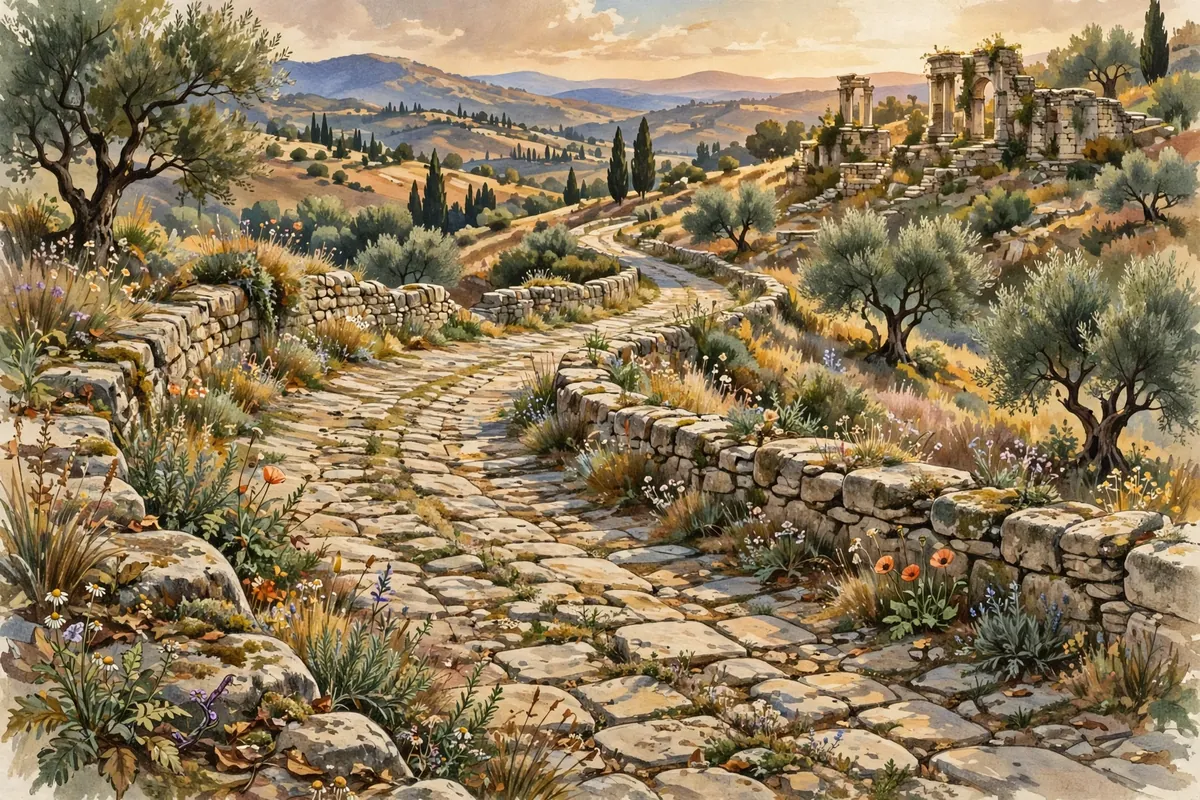
Beyond the busy first few miles, traffic gets light, and visitors can walk among the ruins in relative safety. The old Roman surface still exists, lined with monuments from many eras, though the cement has worn out of the joints, leaving a rough, bumpy ride. In July 2024, the Appian Way was added to the UNESCO World Heritage List.
Even Older Roads
The Appian Way is far from the oldest road ever built. In Egypt, an 11-kilometer roadway of basalt and petrified wood carried stone for pyramid temples about 4,500 years ago. It's recognized as the oldest surviving paved road in the world. In England, a wooden walkway called the Sweet Track was built across marshland in 3807 BC, and an even older trackway near London dates to about 4100 BC.
Those ancient routes are archaeological treasures rather than working roads. The Appian Way, on the other hand, still hums with daily life. So if you ever ride a bus out of Rome along the Via Appia Antica, take a moment to look down. You're rolling along a road that Roman soldiers marched more than 2,300 years ago.