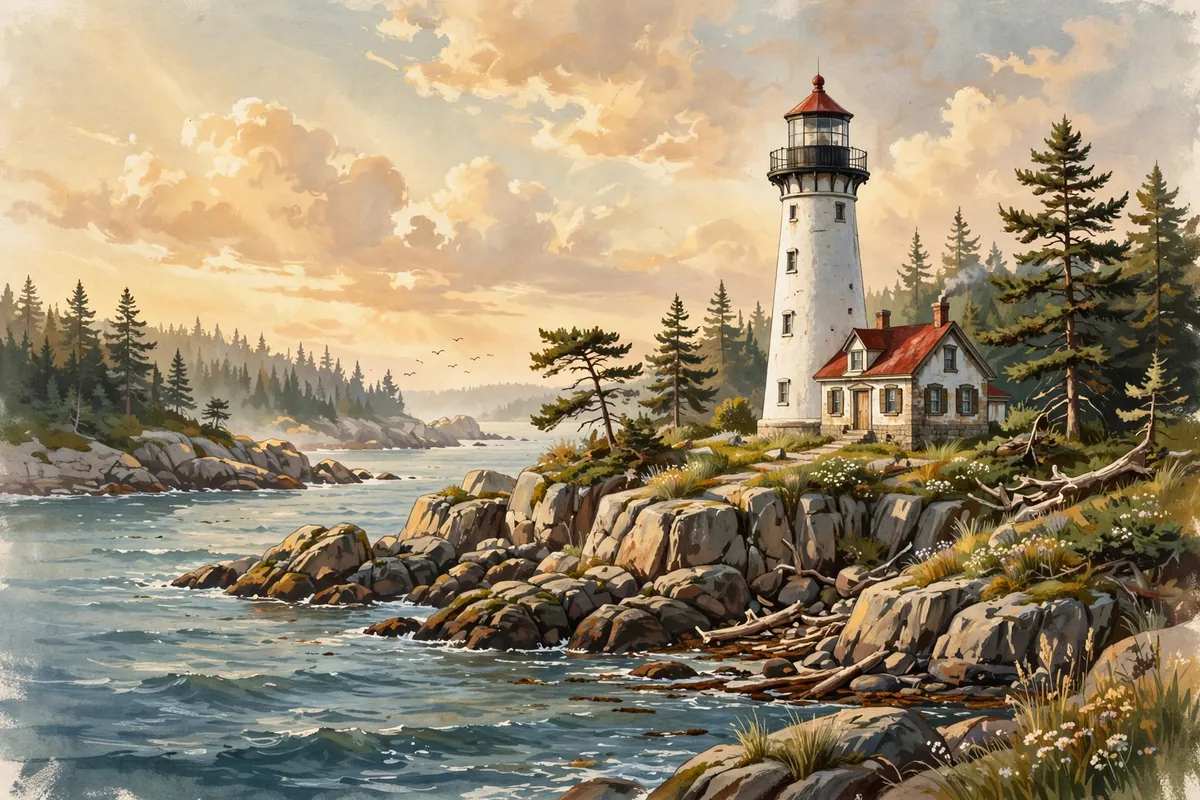
Try reciting the states and you'll hear a lot of syllables. Mis-sis-sip-pi. Mas-sa-chu-setts. Penn-syl-va-nia. Then, way up in the corner of the map, there's Maine. One syllable, said like the word "main," and done.
Here's the short answer: there's no grand plan behind it. Maine is simply the only state whose name happens to be a single syllable. Nearly half of state names come from Native American languages, and many of those, like Massachusetts and Mississippi, are long words. Maine's name has a different and still-debated origin, possibly from France.
Where State Names Come From
The 50 states got their names from a wide mix of languages. Twenty-four names come from Indigenous languages of the Americas, and one, Hawaii, comes from Hawaiian. Names like Massachusetts and Mississippi carry the long, flowing sounds of the languages they came from.
Twenty other states have names from European languages, including Latin, English, Spanish, and French. Several honor European royalty, like the two Carolinas, the two Virginias, Georgia, and Louisiana. Even those tend to stretch out, with Latin-style endings like "-ia" and "-ina."
The Mystery of Maine's Name
That leaves five states whose name origins are disputed or unclear: Arizona, Idaho, Oregon, Rhode Island, and Maine.
Long before any European name was attached, the land had been home to Indigenous peoples for about 12,000 years. When Europeans arrived, several Algonquian-speaking nations governed the area. Today they are known as the Wabanaki Confederacy.
One popular idea links Maine to France. French explorers made the first confirmed European settlement in the area in 1604, on Saint Croix Island, and France has a traditional province called Maine, whose capital was the city of Le Mans. It's possible the region was named after that province, but historians still debate it.
The English soon arrived too. The Popham Colony was founded in 1607, the same year as Jamestown, though its settlers went home after about 14 months. By 1622, the coastal area appeared in an English land patent as the Province of Maine.
Maine Was Once Part of Massachusetts
For a long time, Maine wasn't a state at all. It was part of Massachusetts until 1820, when it voted to break away. On March 15, 1820, Maine became the 23rd state as part of the Missouri Compromise, which kept a balance between free and slave states.
More Ways Maine Stands Apart
Maine has other one-of-a-kind traits. It's the only state that borders exactly one other state, New Hampshire. It's the northeasternmost state in the lower 48 and the largest state in New England, nearly as big as the other five New England states combined.
It's also the most rural state in the country and home to Acadia, the only national park in New England. And Maine has the highest share of French-speaking households of any state, even more than Louisiana, a nice nod to the French roots its name might share.
That short name has traveled far, too. Four U.S. Navy ships have been named USS Maine, including the armored cruiser whose sinking in an 1898 explosion set off the Spanish–American War.
So the next time you need a quick answer to a trivia question, remember the state that says it all in one breath. Short name, long history, and plenty of character. It's a state worth savoring, one syllable at a time.