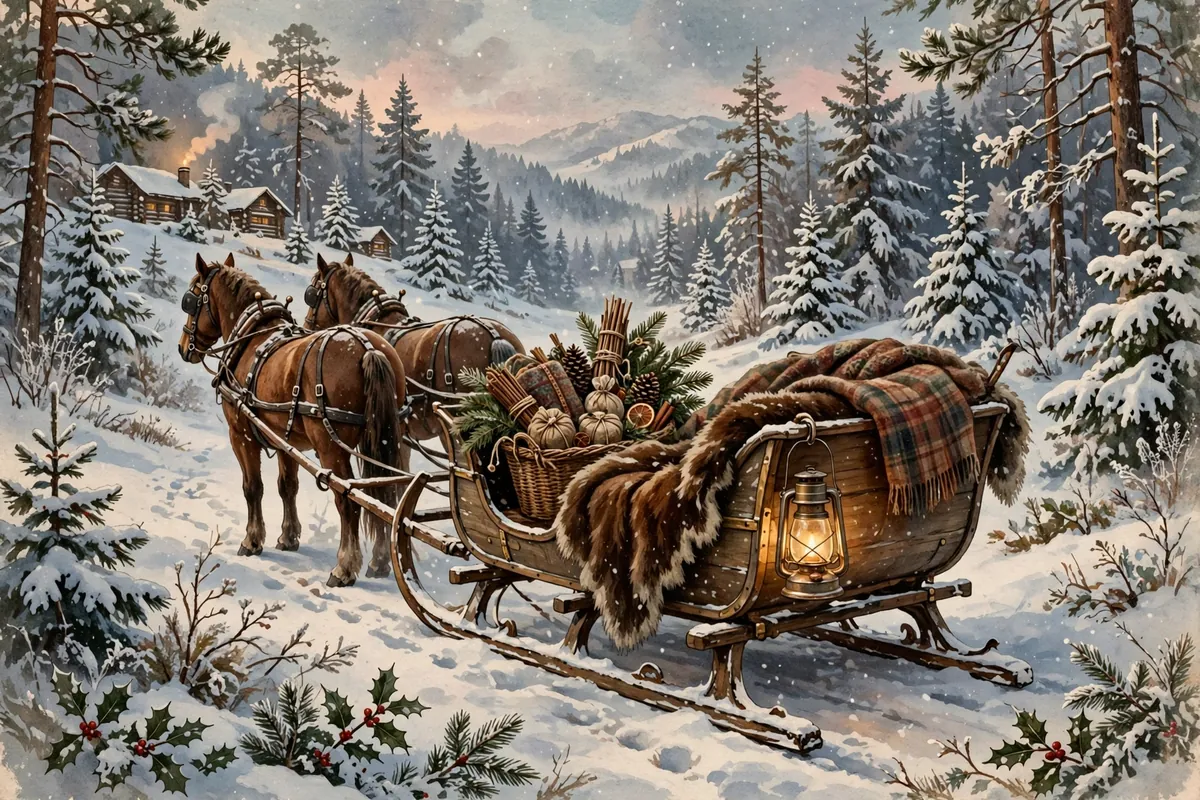
Every December, “Jingle Bells” rings out from shopping malls, school concerts, and car radios. It's practically the soundtrack of Christmas. But listen to the words and you'll notice something odd: there's no Santa, no presents, and not a single mention of Christmas.
So was it secretly a Thanksgiving song, as you may have heard? The documented history tells a different story. “Jingle Bells” was written by James Lord Pierpont and published in 1857 as “The One Horse Open Sleigh.” It was a sleigh-riding song with no original connection to any holiday, and it may even have been meant as a drinking song. It only became tied to winter and Christmas in the 1860s and 1870s.
A Song About Sleigh Rides
In the 1850s, “sleighing songs” were popular, and Pierpont's tune fit right into that style. Its lyrics are about dashing through the snow, racing sleighs, and having a little winter fun.
The bells were a practical thing, too. In New England before cars, people strapped bells across their horses' harnesses, because a sleigh gliding over snow makes almost no sound. The bells helped avoid collisions at blind corners. The song's rhythm even seems to copy the sound of a trotting horse's bells.
Where Was It Written?
Nobody knows for sure. A plaque in Medford, Massachusetts, claims Pierpont wrote it there in 1850 at what was then the Simpson Tavern, and local stories say the town's sleigh races inspired it. Researcher Kyna Hamill has argued instead that it was written in Boston, before Pierpont moved to Savannah, Georgia, in 1857.
The song was first performed on September 15, 1857, at Ordway Hall in Boston, by a minstrel performer named Johnny Pell. Pierpont copyrighted it the next day. A September debut is hardly a sign of a song written for a late-November holiday.
Hamill has also pointed out how much the lyrics resemble other sleigh songs of the day, suggesting Pierpont, who was often short of money, wrote it mainly to make a living. By the time it was published, Pierpont was living in Savannah, working as a church organist and music director, and newly married to the mayor's daughter. He never moved back north.
How It Became a Christmas Classic
In 1859, the song was republished as “Jingle Bells; or, The One Horse Open Sleigh,” with sleigh bells and snow drawn on the cover. Over the following decades, people began singing it in winter and at Christmastime, and it appeared in parlor song and college songbooks in the 1880s.
It was first recorded in 1889 on an Edison cylinder, believed to be the first Christmas record, though no copy survives. By the early 1900s it was a Christmas favorite. Later hits came from Benny Goodman, Glenn Miller, and Bing Crosby with the Andrews Sisters, whose version sold over a million copies.
Jingle Bells in Space
The song even made history off the planet. On December 16, 1965, Gemini 6 astronauts Wally Schirra and Tom Stafford jokingly reported spotting a mysterious object in a polar orbit, then played “Jingle Bells” on a smuggled tiny harmonica and sleigh bells. Schirra gave the harmonica to the Smithsonian in 1967.
So “Jingle Bells” wasn't a Thanksgiving song, and it wasn't a Christmas song at first either. It was a toe-tapping tune about winter fun that the holidays simply adopted. Not a bad fate for a sleigh song.