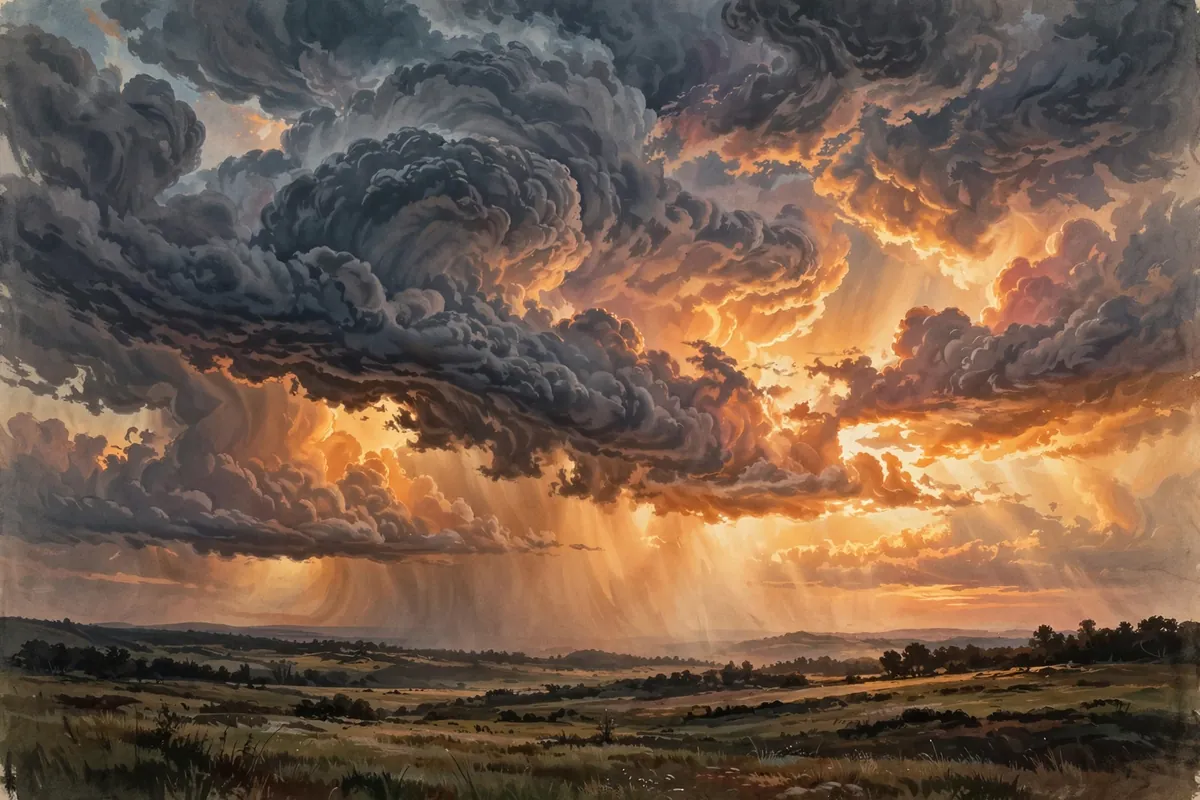
You've probably seen it. A storm has rumbled through all afternoon. Then, just before evening, the rain stops, the clouds start to break, and the sky lights up in fiery oranges, deep pinks, and glowing purples. It can be the most beautiful sunset of the year. Why does that happen so often after bad weather?
Here's the short answer. A sunset's colors come from sunlight traveling a long path through the air, which filters out blue and green light and leaves the warm oranges and reds. After a storm, broken clouds are left behind, and they act like a giant movie screen, catching that reddened light and glowing. As the storm moves away, the clearing sky lets the low sun shine in underneath the clouds to light them up.
Where Sunset Colors Come From
Sunlight looks white, but it's really a mix of colors. As it passes through the atmosphere, air molecules scatter some of it out of the beam. Shorter wavelengths, like blue and green, scatter most strongly. That's also why the daytime sky looks blue.
At sunrise and sunset, the sun is low, so its light travels through much more air to reach you. By the time it arrives, the blue and green have been almost completely removed. What's left are the longer wavelengths: orange and red.
Clouds as a Canvas
On a perfectly clear evening, you mostly see color right around the sun. Clouds change everything. Cloud droplets are large compared with light waves, so they scatter all colors fairly evenly. That's why clouds usually look white or gray. But at sunset, they scatter whatever light reaches them.
When the only light reaching them is red and orange, the clouds glow red and orange. Reddened sunlight bouncing off cloud droplets is what lights up the whole horizon in those rich colors. A sky full of scattered, broken clouds gives the sunset far more surface to paint.
Why Storms Set the Stage
Timing matters too. In much of the United States, weather systems tend to move from west to east. When a storm passes to the east at the end of the day, it often leaves clearer skies in the west, where the sun is setting. Sunlight can then slip in under the departing clouds and light them from below.
Rain may help as well. Falling raindrops sweep tiny particles out of the air, a process scientists call wet deposition. That can leave the air looking freshly washed after a storm.
Red Sky at Night
People have connected sunset colors with weather for a very long time. The old rhyme "Red sky at night, sailor's delight; red sky at morning, sailors take warning" has been used as a forecasting rule of thumb for some two thousand years. A version even appears in the Gospel of Matthew.
The idea behind it is that a red evening sky often means stable, high-pressure air coming in from the west, which usually brings calmer weather. It's not foolproof, but it's surprisingly sensible.
Interestingly, sunsets are usually more brilliant than sunrises, because evening air tends to hold more particles than morning air. So the next time a storm finally clears out near dusk, grab a chair and step outside. The sky may be about to put on its best show of the day.