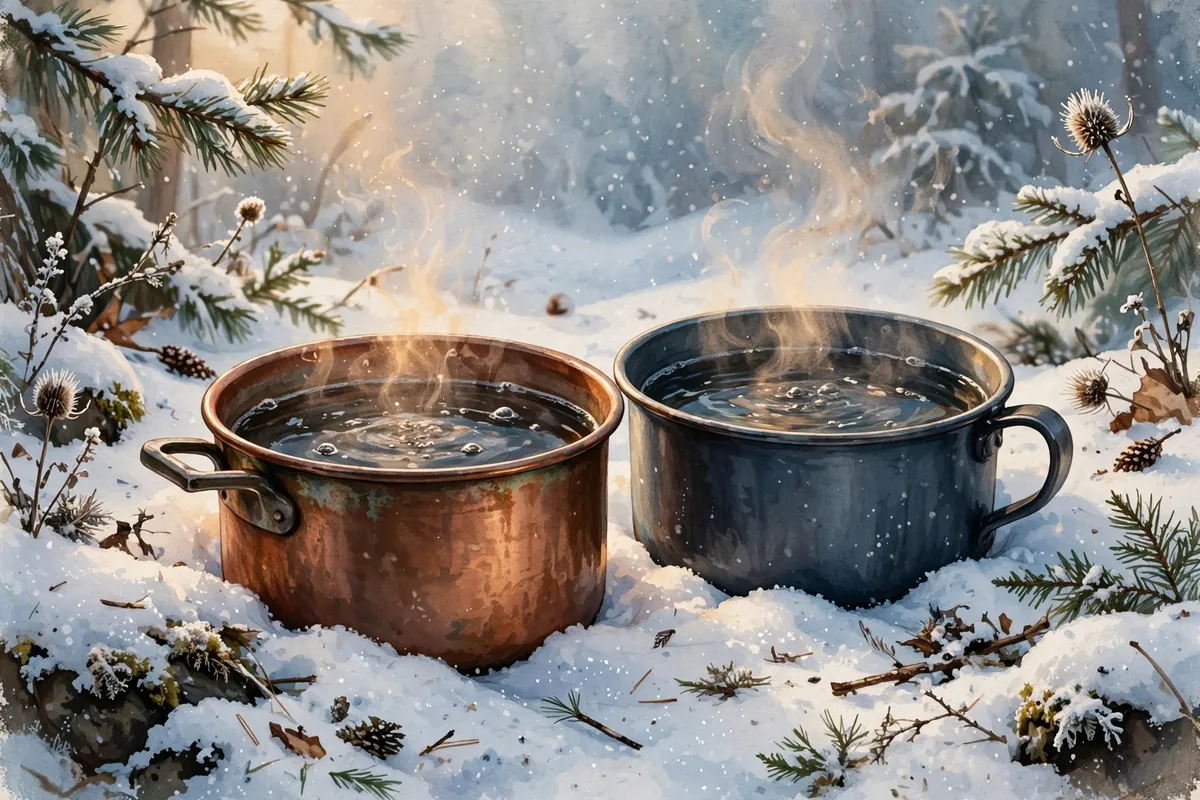
It sounds backward. If you put a cup of hot water and a cup of cold water in the freezer at the same time, surely the cold one freezes first, since it has less cooling to do. But for centuries, people have claimed the opposite sometimes happens.
The honest answer is: sometimes, maybe, and scientists don't agree on why. The idea is called the Mpemba effect. Some experiments have found hot water freezing first under certain conditions, but others couldn't reproduce it at all. A 2016 review concluded there was no evidence for meaningful observations of the effect, while other researchers keep finding it in special setups.
The Schoolboy Who Asked Why
The effect is named after Erasto Mpemba, a student in Tanganyika, now Tanzania. In 1963, while making ice cream in a cooking class, he noticed that a hot mixture froze before a cold one.
Later, a physicist named Denis Osborne visited his school to give a lecture. Mpemba asked him why water starting at boiling would freeze before water starting at 95 degrees Fahrenheit. Osborne thought the student was mistaken, but he was curious enough to test it. To his amusement, his experiments agreed with Mpemba. The two published their results together in 1969. In their tests, water starting near 194 degrees began freezing much sooner than water starting at room temperature, and they ruled out evaporation and dissolved air as major causes.
Aristotle Noticed It Too
Mpemba wasn't the first. The ancient Greek philosopher Aristotle wrote that water that has been warmed freezes more quickly, and that people who wanted to cool water quickly would first put it in the sun.
Centuries later, Francis Bacon wrote that slightly tepid water freezes more easily than very cold water, and René Descartes made a similar claim. In 1775, Scottish scientist Joseph Black found that water that had been boiled beforehand froze more quickly than unboiled water.
Possible Explanations
If hot water does sometimes win, how? Scientists have proposed several ideas, and none has settled the question.
One involves supercooling, when water drops below its normal freezing point without turning to ice. Some studies found that water starting out cooler tends to supercool further before freezing, which could slow it down. Other ideas involve dissolved gases, since cold water can hold more of them, or tiny bubbles left after boiling that might help move heat. Some researchers point to the way the water circulates as it cools.
Part of the problem is that people don't even agree on what counts. Does freezing mean the first skin of ice, or the moment the whole sample is solid? Small details, like where the thermometer sits or what container holds the water, can change the result.
Still an Open Question
The effect has since been studied in surprising places, including magnetic alloys, tiny mechanical systems, and quantum systems. In some mixtures, researchers have seen a strong version of the effect.
For water, though, the jury is still out. Physicists remain divided on how to define the effect and what causes it, and some experiments find nothing at all.
So if you want to settle a bet, try it in your own freezer, and don't be surprised if the results change from one try to the next. That unpredictability is exactly what has kept scientists arguing for more than 2,000 years.