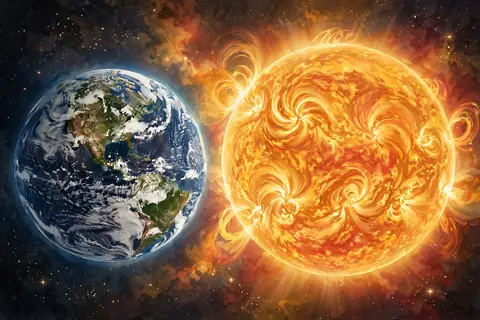
The Sun feels permanent. It was there for the dinosaurs, it was there for the pyramids, and it rises over your kitchen window every morning. But stars have life stories just like people do, with a birth, a long working life, and a dramatic old age.
Here's the short answer. The Sun formed about 4.6 billion years ago, and it's roughly halfway through the steady, main part of its life. It has stayed fairly stable for over four billion years and should stay that way for about five billion more. So calling it middle-aged is a pretty fair description.
How a Star Is Born
The Sun began as part of a giant cloud of gas, mostly hydrogen and helium. Part of that cloud collapsed under its own gravity. Most of the material gathered in the center, while the rest flattened into a spinning disk that became the planets.
The center grew so hot and dense that nuclear fusion switched on. Scientists think a shock wave from one or more nearby exploding stars may have triggered the collapse. Ancient meteorites hold chemical traces that point to supernovas near the Sun's birthplace.
How Scientists Know Its Age
Astronomers estimate the Sun's age using computer models of how stars evolve. The answer matches the age of the oldest material in the solar system, measured by radioactive dating at about 4.567 billion years.
The Sun's middle age shows on the inside. It shines by fusing hydrogen into helium in its core. Over time, the share of helium in the core has climbed from about 24% to about 60%. That's a bit like a gas gauge slowly moving toward empty.
In total, the Sun should spend about 10 to 11 billion years in this stable stage, which astronomers call the main sequence. So far, it has converted about 100 times the mass of Earth into energy. That sounds enormous, but it's only about 0.03% of the Sun's total mass.
Getting Brighter With Age
Unlike most of us, the Sun is getting brighter as it ages. Since its early days, it has grown about 15% wider and about 48% more luminous. Right now, it brightens by about 1% every 100 million years.
That slow change matters for Earth. Scientists estimate that in at least a billion years, the Sun's rising brightness will be enough to drive off Earth's liquid water. No need to cancel any vacations, though. That's a very long way off.
The Sun's Retirement Plan
The Sun isn't massive enough to explode as a supernova. Instead, in about five billion years, it will run low on hydrogen in its core and swell into a red giant. It will grow large enough to swallow Mercury and Venus. Earth's fate is less certain; it may be engulfed too, or it may survive.
After that, models suggest the Sun will shed its outer layers into a glowing cloud called a planetary nebula. What's left will be a small, dense white dwarf. It will no longer produce energy by fusion, but it will keep glowing from leftover heat for perhaps trillions of years.
So the next time you watch a sunset, remember you're looking at a star in the prime of its life. It's steady, reliable, and still has billions of good years left. Not a bad role model for the rest of us.