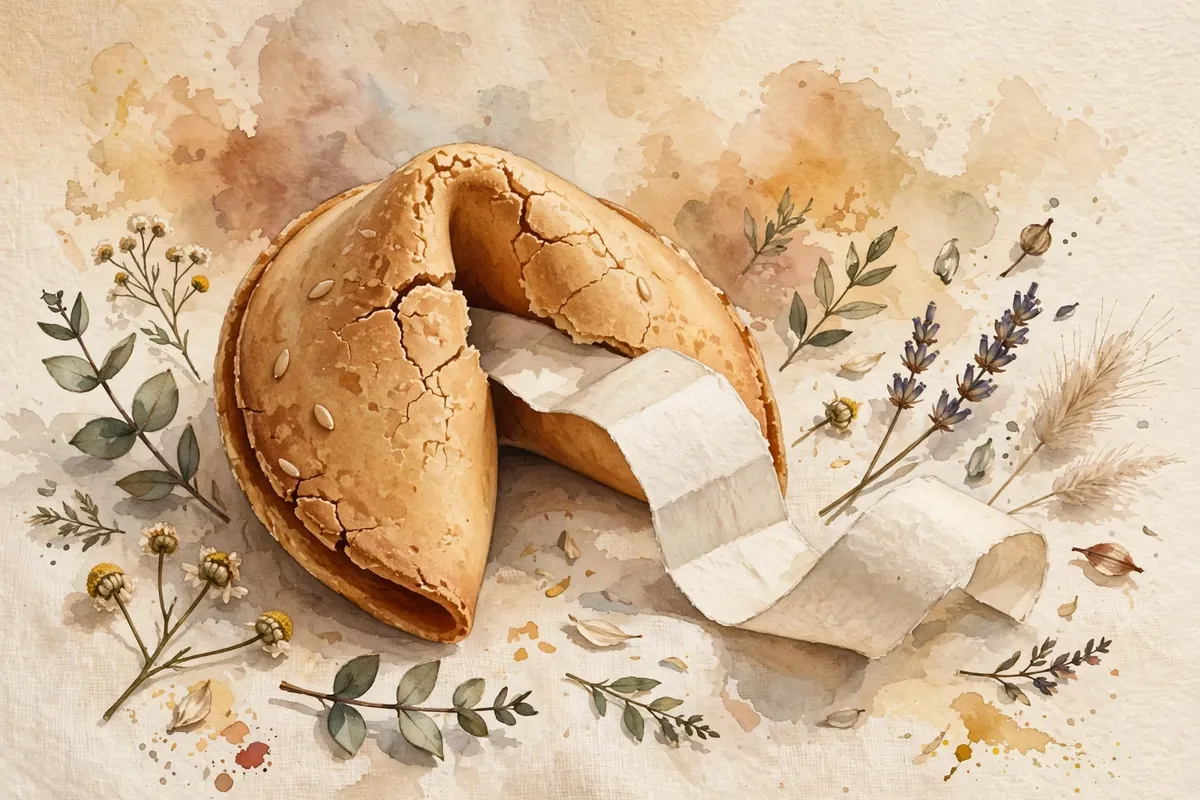
Few meals end as predictably as Chinese takeout in America. The check arrives, along with a little folded cookie hiding a slip of paper that promises good luck, wisdom, or a set of lucky numbers. It feels like a custom imported straight from China.
The short answer: fortune cookies are not Chinese in origin. Their exact beginnings are unclear, but they most likely came from cookies made by Japanese immigrants in California in the late 1800s or early 1900s. Chinese-American restaurants made them famous later.
A Cookie From Kyoto
As far back as the 19th century, bakers in Kyoto, Japan, made a cookie that looks a lot like today's fortune cookie. It's called tsujiura senbei, and it's still sold in parts of Japan, including near the famous Fushimi Inari shrine in Kyoto.
The Japanese version is a bit different. It's slightly larger, made with darker dough, and flavored with sesame and miso. Its paper fortune is tucked into the bend of the cookie rather than inside. Japan also has a temple tradition of random paper fortunes called omikuji.
California's Cookie Feud
Several people in California claimed to have introduced the cookie. Makoto Hagiwara, who ran the Japanese Tea Garden in San Francisco's Golden Gate Park, is reported to have been the first in the U.S. to serve the modern version, in the early 1900s. A San Francisco bakery called Benkyodo made them.
In Los Angeles, David Jung, founder of the Hong Kong Noodle Company, said he invented the cookie in 1918. Seiichi Kito, founder of Fugetsu-do in Little Tokyo, also claimed credit, saying he got the idea from omikuji and sold his cookies to Chinese restaurants.
In 1983, San Francisco's Court of Historical Review took up the case to settle the dispute. One piece of evidence was a fortune cookie reading "S.F. Judge who rules for L.A. Not Very Smart Cookie." The judge ruled for San Francisco and Hagiwara. The city of Los Angeles condemned the decision.
How Chinese Restaurants Took Over
Until around World War II, the treats were known as fortune tea cakes, a hint of their roots in Japanese tea cakes. Around that time, the business shifted from Japanese-American bakers to Chinese-American ones.
One theory is tied to a dark chapter of American history. During the war, more than 100,000 Japanese Americans were forced into internment camps, including people who made fortune cookies. That opened the door for Chinese-American manufacturers.
An American Original Today
About 3 billion fortune cookies are made each year worldwide, and most are eaten in the United States. The biggest maker, Wonton Food in Brooklyn, turns out more than 4.5 million a day.
Other big makers include Baily International in the Midwest and Peking Noodle in Los Angeles. Smaller local bakeries from Seattle to Philadelphia make their own, and many companies will even print custom fortunes for weddings and parties.
Those lucky numbers can be surprisingly lucky. In 2005, 110 Powerball players won about $19 million after using numbers from fortune cookies, which briefly led authorities to look into Wonton Food.
The cookie's Americanness shows overseas. In 1989, they were reportedly sold in Hong Kong as genuine American fortune cookies. When Wonton Food tried selling them in China in 1992, it gave up because they were seen as too American.
So the fortune cookie is really a California creation with Japanese roots and a Chinese-American career. Its own story is more surprising than most of the fortunes inside.