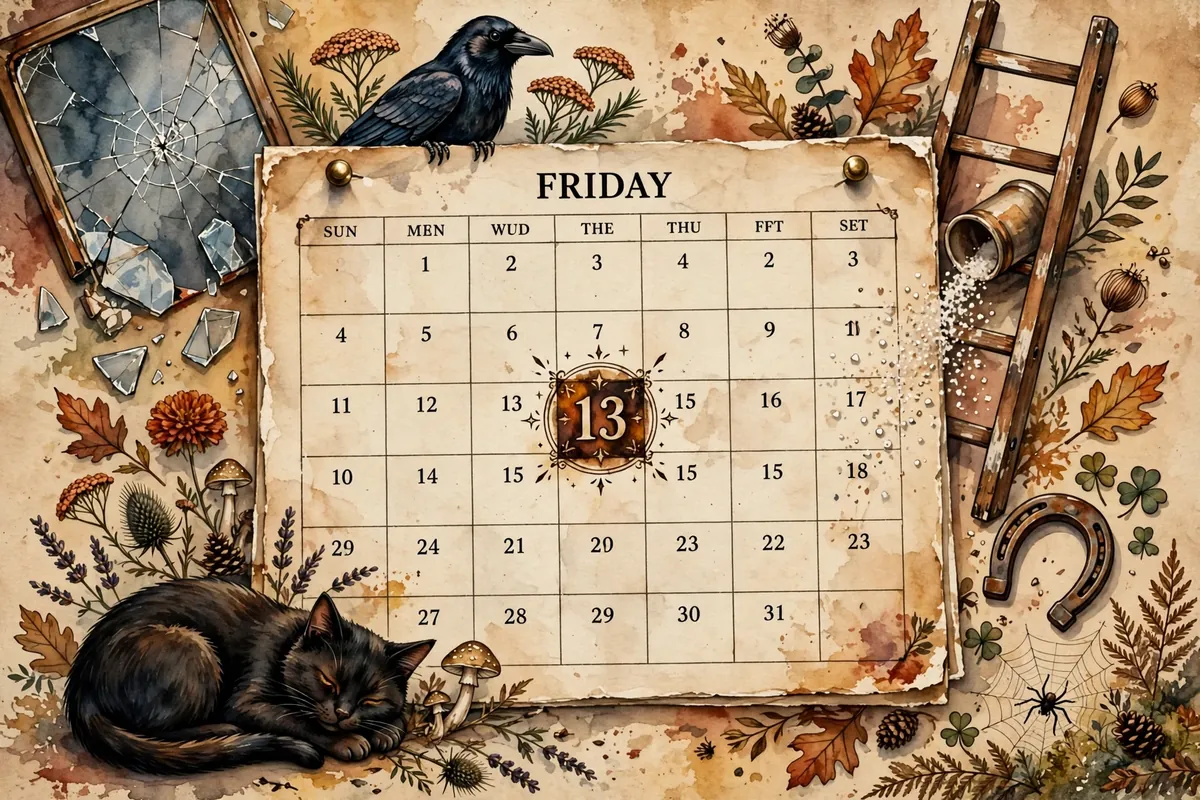
For some people, it's a day to tread carefully. Even folks who laugh off superstitions may feel a tiny flicker of unease when they notice the calendar says Friday the 13th. So where did this famously unlucky day come from?
Here's the short answer: nobody knows for certain. The number 13 and Fridays were each seen as unlucky for a long time, separately. But there's no record of the two being treated as especially unlucky together before the 19th century. The superstition seems to have taken shape in the 1800s and then spread in the early 1900s, possibly helped along by a popular novel.
Why 13 Got a Bad Name
One story often told about 13 comes from Norse mythology. Twelve gods were holding a dinner party in Valhalla when the trickster god Loki arrived uninvited as the 13th guest. He arranged for Balder, the god of joy, to be killed with a mistletoe-tipped arrow, and the world was plunged into sorrow.
There's a Christian connection, too. At the Last Supper, there were thirteen people in the room on the night before Jesus was crucified on Good Friday. That links both the number 13 and Friday to a dark moment in the Christian story.
What About the Knights Templar?
You may have heard that it all started on Friday, October 13, 1307, when officers of King Philip IV of France arrested the Knights Templar. It's a dramatic story, and some people do cite it as the origin. But historians agree the true origins remain murky, especially since the pairing of Friday and 13 doesn't appear in records until centuries later.
The 1800s Paper Trail
In France, an 1834 play includes a character who says he was born on Friday, December 13, 1813, "from which come all of my misfortunes." In English, an early reference comes from a biography of the composer Gioachino Rossini, who died on Friday, November 13, 1868. His biographer noted that Rossini, like many Italians, considered both Fridays and the number 13 unlucky.
Then, in 1907, T. W. Lawson published a popular novel called Friday, the Thirteenth. In it, a ruthless stockbroker uses the superstition to cause a panic on Wall Street. The book may have helped spread the idea far and wide.
How Often Does It Happen?
Every year has at least one Friday the 13th, and some have as many as three. It happens whenever a month begins on a Sunday. The year 2026, for example, has three: in February, March, and November. On average, one rolls around about every 212 days. Over the long run, the 13th of the month is very slightly more likely to land on a Friday than on any other day of the week.
The fear of 13 is so common that many hotels and buildings skip the number. A 13th floor may be labeled 14, 12A, or M, the 13th letter of the alphabet. The fear of Friday the 13th even has a tongue-twister of a name: paraskevidekatriaphobia.
So if the date makes you a little nervous, you're in good company. But history suggests it's more of a fun tradition than a curse. Odds are your Friday the 13th will be just like any other Friday, maybe with a good story to tell. And if anything does go wrong, you'll have the perfect excuse.