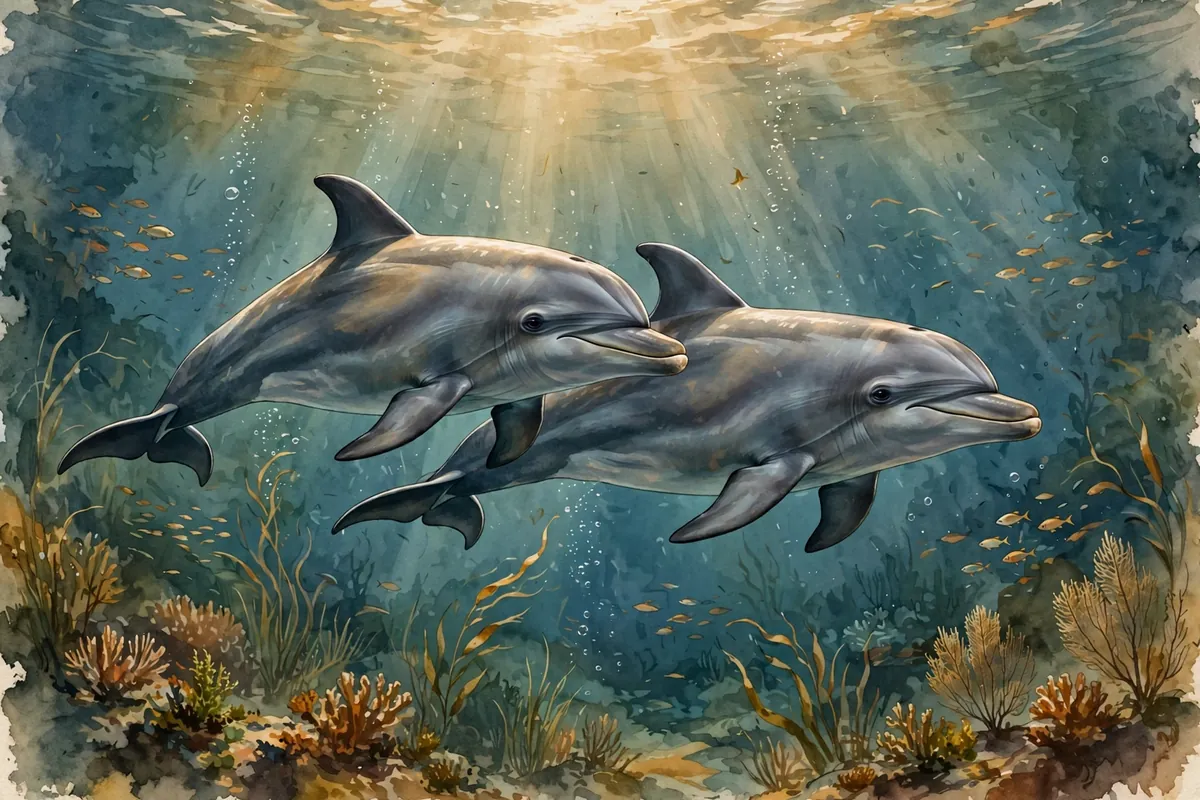
Imagine you're swimming in a murky ocean with dozens of friends spread out around you. You can't see them, and you can't wave. How do you let everyone know where you are, and how do you get one particular friend's attention? Bottlenose dolphins seem to have solved this problem in a very human way.
Each bottlenose dolphin has its own signature whistle, a learned, one-of-a-kind sound that announces who is calling. Other members of its group use that whistle to recognize the individual. Even more remarkable, dolphins sometimes copy another dolphin's signature whistle back, apparently to address that specific dolphin. Scientists consider these whistles the most name-like signal found so far in any animal besides us.
A Name a Calf Creates Itself
Unlike human babies, dolphin calves aren't handed a name. They develop their own signature whistle, usually within the first year of life, shaped by the sounds they hear around them. Once it's set, it rarely changes through adulthood and can stay stable for at least 12 years.
Calves make sure their whistle stands out. Most develop a signature that differs from the dolphins they spend the most time with. In fact, calves tend to model their whistles on adults they don't see very often. The finished whistle doesn't match any single dolphin's but borrows a little from several.
There's one interesting exception. Male calves often develop signature whistles that resemble their mother's. They don't copy her whistle outright. They use it as a model and make it their own.
Calling Out to a Friend
Dolphins use their own signature whistles most often when the group gets separated. It's a bit like shouting "I'm over here!" The whistles help mothers and calves stay in touch, keep groups together, and smooth out social life.
The really striking part is vocal copying. A bottlenose dolphin can repeat another dolphin's signature whistle almost perfectly, which appears to be a way of calling that individual. Dolphins with close relationships are the most likely to do it. According to researchers, humans and dolphins are the only species known to use vocal copying in friendly, cooperative situations.
Copying isn't the whole story, though. Some studies found that wild dolphins often copy the whistles of dolphins that aren't in their group at all, which suggests the whistles also help dolphins figure out where others are.
Dolphins Never Forget a Friend
Dolphins have impressive memories for these whistles. They can recognize the signature whistles of former companions after more than two decades apart. That's like hearing an old schoolmate's voice at a reunion and knowing exactly who it is.
Experiments suggest dolphins understand that a whistle stands for a particular dolphin. In playback studies, researchers paired a dolphin's whistle with that dolphin's urine and found that listeners connected the two, as if they knew the whistle and the scent belonged to the same individual.
How Scientists Listen In
Picking out signature whistles isn't easy, because dolphins make plenty of other whistles too. Researchers record them with underwater microphones called hydrophones. One clue helps: signature whistles tend to come in bursts, each one about 1 to 10 seconds after the last.
So next time you watch dolphins leaping alongside a boat, picture the conversation going on beneath the surface. Somewhere in all that chatter, one dolphin may be calling another by the closest thing the ocean has to a name.