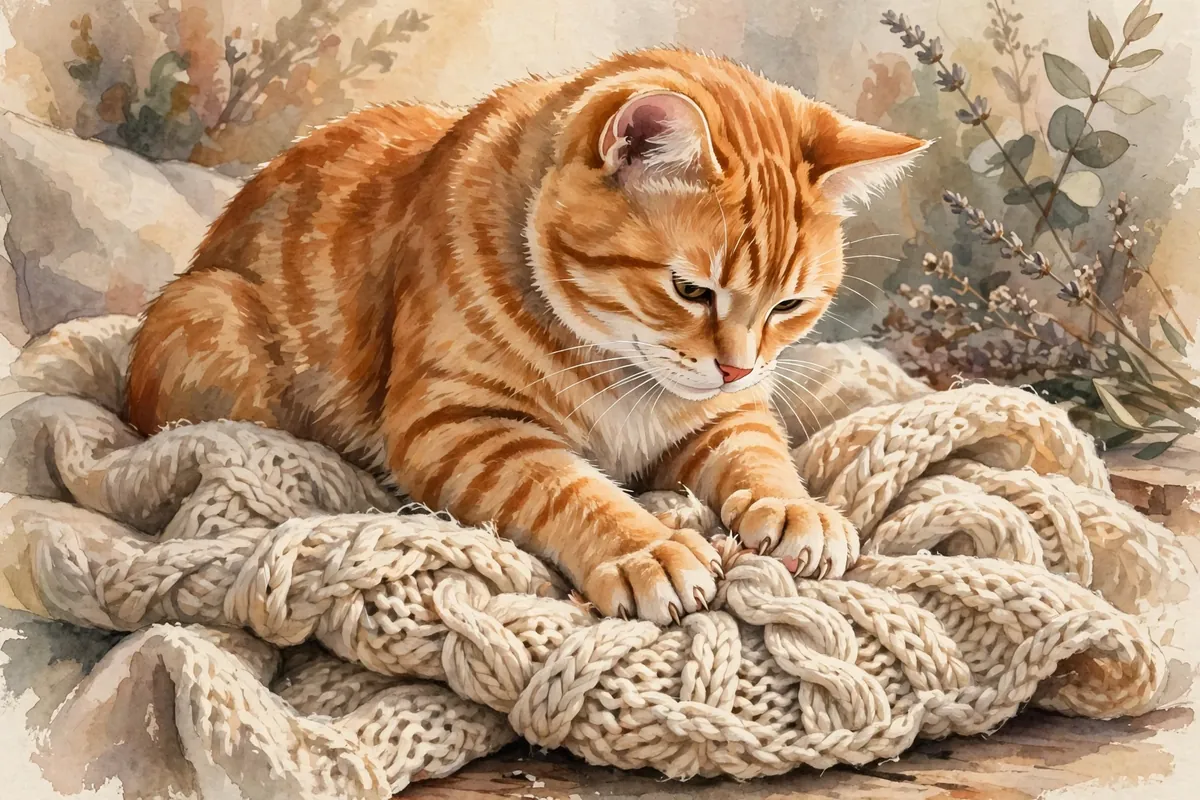
You settle onto the couch under a soft blanket, and within minutes your cat climbs aboard. Then it begins: left paw, right paw, left paw, eyes half shut, purring like a little engine. Cat lovers call it making biscuits. But what is your cat actually doing?
Nobody can say for certain, but the leading explanation goes back to kittenhood. Nursing kittens knead their mother's belly to help the milk flow. Many cats carry the habit into adulthood, and they tend to do it when they feel relaxed and content. There are a few other ideas, too, and more than one may be true.
A Leftover From Kittenhood
When kittens nurse, they push against their mother with their front paws, one at a time, in an alternating rhythm. That pressure helps stimulate milk. It's an instinct they're born with, and it seems to stick around long after weaning.
Purring is a big clue. Cats purr most when they're newborns, when they're feeding, or when they're trying to nurse. Many adult cats purr while kneading, and that overlap is one reason experts think kneading is a leftover instinct from those early days.
Some cats take it even further. A cat may adopt a favorite blanket like a security blanket, kneading it, purring, and even sucking on the fabric. Kittens taken from their mothers before they're fully weaned may knead a person they've adopted as a mother figure, and may try to suckle on a hand or an ear.
Domestic cats hold on to quite a few kitten-like traits as adults, and kneading may simply be one of them.
Other Ideas Scientists Have
One theory points to cats' wild ancestors, who had to tread down grass or leaves to make a temporary nest to rest in. In gardens where cats roam, you can sometimes find round, cat-sized nests pressed into long grass. Kneading is also often a warm-up to a nap, which fits the bed-making idea nicely.
Another idea involves scent. Cats have scent glands on the undersides of their paws, and when they knead, they likely leave their own scent behind. In other words, that blanket may be getting quietly labeled as theirs. So might you.
Some experts also think kneading simply feels good, much the way a long stretch feels good to us.
How a Biscuit Gets Made
The motion is surprisingly precise. A cat presses down firmly with one paw, spreading its toes so the claws come out, then curls its toes as it lifts the paw. It switches paws every second or two, settling into a steady rhythm.
Cats are picky about where they do it. They'll happily sit on a hard floor, but they only knead soft, giving surfaces. On something hard, some cats will march in place instead. That's also why a lap is such a popular spot, and why it can sting a bit when a big cat with sharp claws gets going.
Consider It a Compliment
Because kneading is so tied to a cat's mother, some experts think it may also be a way of showing affection to the humans in its life. Kneading paired with purring is usually taken as a sign of contentment and affection.
So the next time your cat climbs onto your blanket and starts making biscuits, you can take it as a quiet vote of confidence. In its own way, your cat is saying it feels safe, comfortable, and right at home with you.