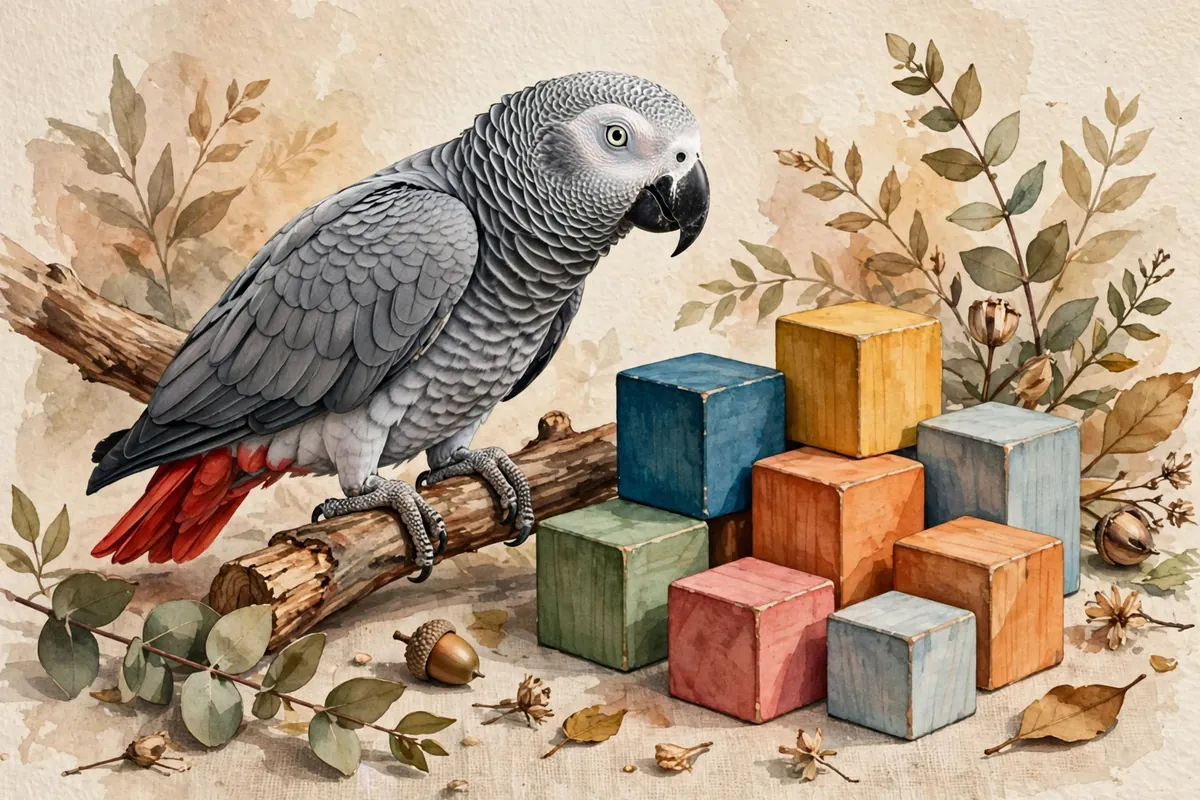
Plenty of parrots can say "hello" or whistle a tune. But for a long time, scientists assumed that's all it was: copying sounds without any idea what they meant. Birds simply weren't thought of as smart. Then along came a gray parrot named Alex.
Alex was a grey parrot, often called an African grey, who worked with animal psychologist Irene Pepperberg for about 30 years. He had a vocabulary of over 100 words. What made him special wasn't the number. It was that he seemed to understand what he was saying.
A Pet-Shop Bird With a Big Job
Pepperberg bought Alex at a pet store when he was about a year old, after finishing her PhD in theoretical chemistry. She wanted to study how a parrot thinks and communicates. Even his name was part of the plan: Alex stood for "avian language experiment," or "avian learning experiment."
The research started at Purdue University and later moved to the University of Arizona, Harvard, and Brandeis. Alex was born on May 18, 1976, and he stayed at the center of the project for the rest of his life.
How Do You Teach a Parrot?
Pepperberg used a method called model/rival. Alex would watch two trainers. One asked a question, and the other answered, acting as a rival for attention. When the answer was right, the reward was the object itself, not a snack. That way Alex could link the word directly to the thing.
Trainers even made mistakes on purpose. When that happened, the trainer got scolded and the object was taken away, so Alex could see what a wrong answer cost. In later years, Alex helped teach another parrot in the lab, and he sometimes corrected its mistakes. He was also heard practicing words when he was alone.
What Alex Could Do
By 1999, Pepperberg said Alex could identify 50 different objects, recognize quantities up to six, tell apart seven colors and five shapes, and understand ideas like bigger, smaller, same, and different. Show him a key of any size or color, and he could still call it a key.
In 2005, she reported that he grasped something like zero. Asked what was different between two identical objects, he would answer "none." And once, looking in a mirror, he asked "What color?" He learned the word "grey" after being told it six times. That moment is often described as one of the first times an animal is known to have asked a question.
Pepperberg was careful not to say Alex used "language." She called it a two-way communication code. She did say he seemed to show the intelligence of a five-year-old child in some ways, and the emotional level of a two-year-old.
Not Everyone Was Convinced
Some scientists stayed skeptical. Herbert Terrace, who had studied the famous chimpanzee Nim Chimpsky, argued that Alex was performing by rote, responding to cues rather than truly using language. The debate over what Alex really understood has never fully ended.
Still, his work helped change minds. It supported the idea that birds may be able to reason on a basic level, an idea many scientists once dismissed.
His Last Words
Alex was found dead in his cage on September 6, 2007, at age 31. It came as a surprise, since grey parrots in captivity live about 45 years on average. The night before, he had said what he said every evening when Pepperberg left the lab: "You be good. I love you. See you tomorrow."
It's hard to hear those words and not feel something. Whatever was going on inside that small gray head, Alex left the world a little more curious about what birds are really thinking.