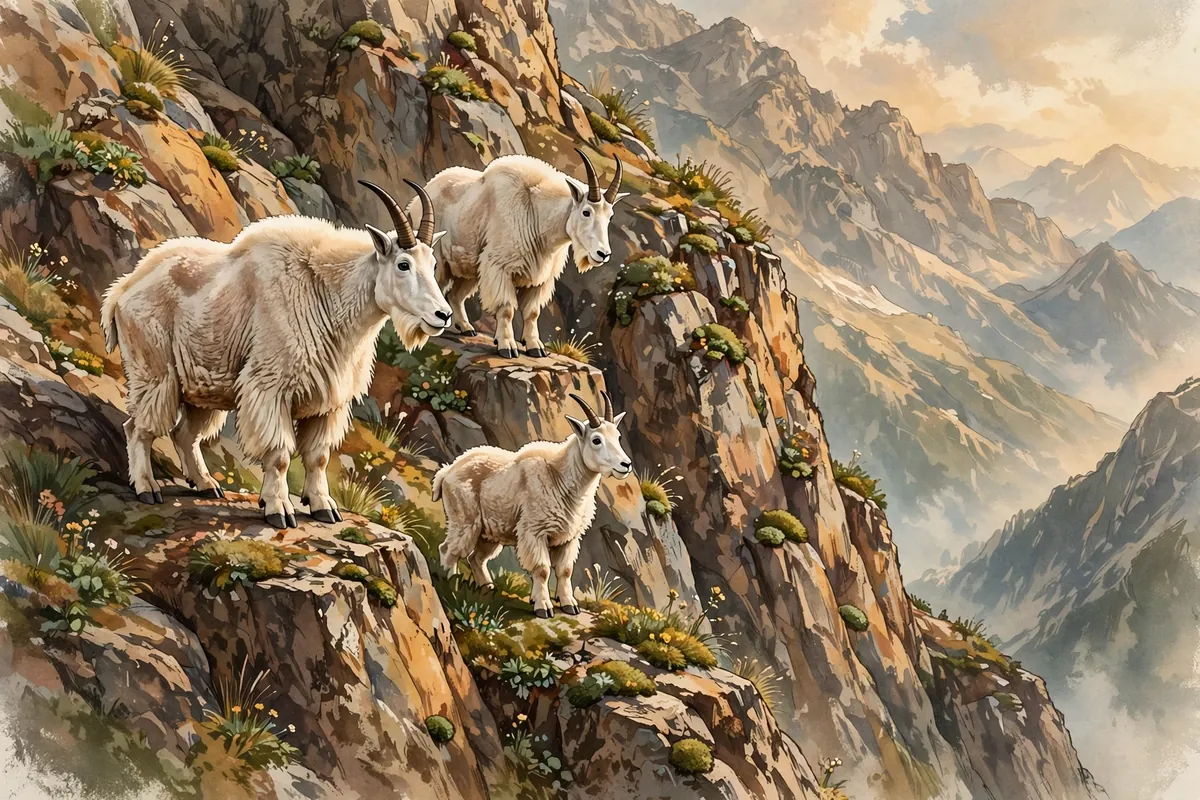
If you've ever seen a photo of a mountain goat perched on a cliff face, it looks almost impossible. There's a sheer drop below, barely any ledge to stand on, and the goat seems totally relaxed. Mountain goats are commonly seen on sheer rock faces, near-vertical cliffs, and icy passes. How do they pull it off?
Their feet are built for it. Each hoof is split in two and can spread apart to grip the rock. Underneath are soft inner pads that give traction, a bit like the rubber sole of a hiking boot. Sharp dewclaws at the tips help keep them from slipping. Add powerful shoulder and neck muscles, and you get an animal that can handle slopes steeper than 60 degrees.
Built-In Climbing Gear
Mountain goats live in the rugged mountains of western North America, in habitats that can top 13,000 feet. They're the largest mammals found at those heights, and they usually stay above the tree line all year. Day to day, a goat usually sticks to the same mountain face or basin, moving around as it needs food, rest, shelter from heat or cold, and safety.
Researchers who filmed a mountain goat climbing a 45-degree slope in the Canadian Rockies found that it moves in two phases. First it pushes with its back legs while tucking its front legs close to its chest. Then it brings its back legs up and straightens its front legs, lifting its body up the slope. Keeping its elbows close to its center of balance helps it stay steady.
Why Live on a Cliff at All?
The steep terrain is their best defense. Predators like bears, wolves, and cougars have a much harder time following them onto sheer rock. That's why mountain goats generally avoid lower elevations, except during food shortages or very bad weather.
The cougar may be their main predator, because it's both powerful and nimble enough to move through rocky ground. Even golden and bald eagles can pose a danger to young goats.
Climbing Within Hours of Birth
Baby mountain goats, called kids, are born in late spring on isolated ledges. They weigh a little over 6 pounds at birth and start trying to run and climb within hours.
Their mothers are watchful guardians. A mother will lead her kid out of danger, stand over it when predators appear, and even position herself below it on steep slopes to stop it from falling. Below the tree line, where predators are more common, mothers will even fight to protect themselves and their young.
Here's a surprise: the mountain goat isn't actually a true goat. It belongs to a group called goat-antelopes and is more closely related to animals like the European chamois than to the goats on a farm.
Other Goats That Climb Everything
True goats are climbers too. In Italy, Alpine ibex have been seen scaling the 57-degree wall of the Cingino Dam to lick salts from the stone. Only the lighter females and young make that climb, zigzagging up and coming straight down.
In Morocco, domestic goats famously climb high into argan trees to reach the fruit. It's a remarkable sight, though all that browsing can harm the trees. So whether on a cliff, a dam, or a tree branch, goats seem determined to prove that up is always the best direction.