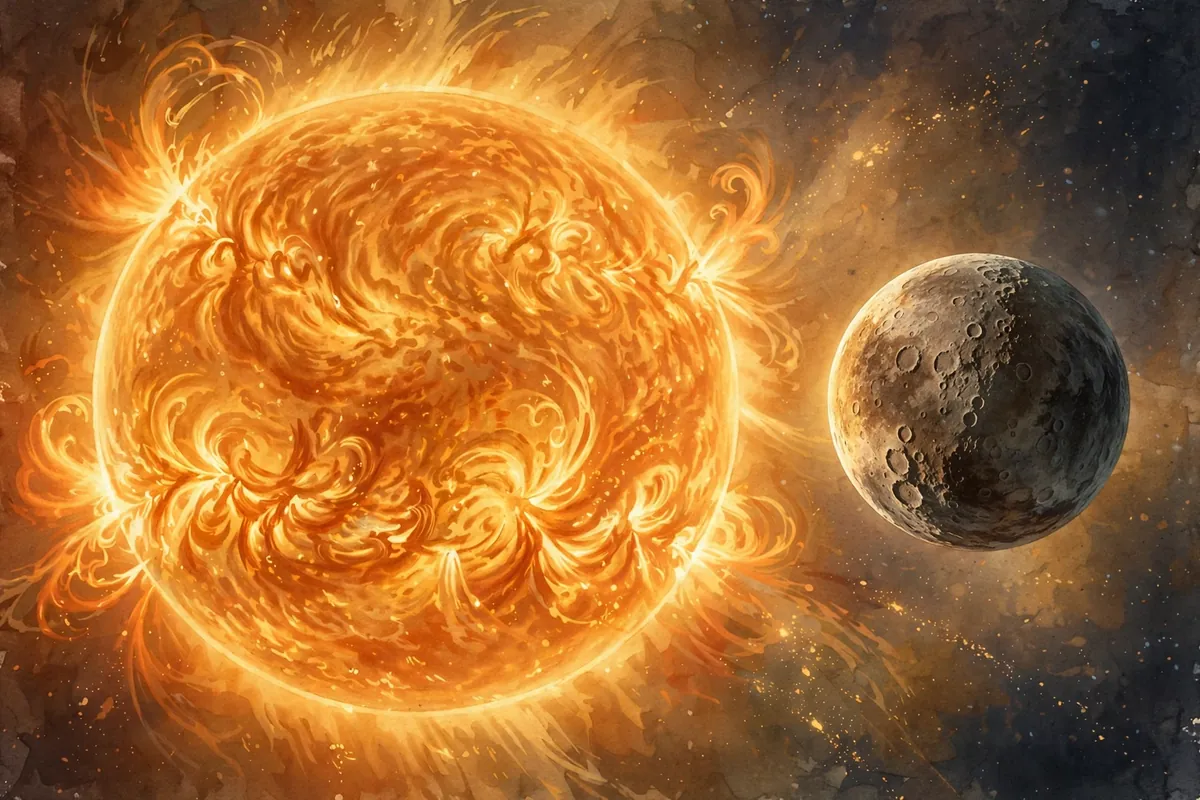
If you lived on Mercury, you'd be celebrating a lot of birthdays. The little planet closest to the Sun finishes a full lap in a fraction of the time Earth does. But Mercury has an even stranger trick up its sleeve when it comes to telling time.
It's true: a year on Mercury lasts just 88 Earth days. But a single day, measured from one sunrise to the next, lasts about 176 Earth days. That means a Mercury day is twice as long as a Mercury year.
The Fastest Planet in the Solar System
Mercury is the smallest planet and the closest to the Sun. It races along its orbit at about 29.5 miles per second, much faster than Earth's 18.5 miles per second. With such a short path and such high speed, it completes an orbit in 88 days.
The ancient Romans noticed how quickly it moved across the sky. They named it after Mercury, the swift-footed messenger of the gods, because it moves faster than any other planet. Even earlier, ancient Greeks realized that the bright morning star and evening star they saw near the Sun were the same planet.
Why a Day Lasts Two Years
Mercury spins slowly, turning once on its axis about every 58.65 Earth days. That spin is locked into a special rhythm with its orbit: Mercury spins exactly three times for every two trips around the Sun.
Because the planet is moving around the Sun while it slowly turns, the Sun takes a long time to come back to the same spot in the sky. The result is a solar day of about 176 Earth days. One side of the planet stays in sunlight for a whole Mercury year, then sits in darkness for the next one.
For a long time, astronomers got this wrong. In the 1880s, Giovanni Schiaparelli suggested that Mercury always kept one face toward the Sun, turning once every 88 days. The mistake happened partly by coincidence: whenever Mercury was best placed for viewing from Earth, it tended to show nearly the same face.
A Sky That Plays Tricks
Mercury's lopsided orbit creates some odd sights. At certain spots on its equator, the Sun passes overhead, then appears to reverse direction and pass overhead again, then reverses once more for a third pass. The whole show takes about 16 Earth days.
Temperatures swing wildly. At the equator, the surface can reach about 790 degrees Fahrenheit in sunlight and drop to minus 270 at night. Even so, Mercury is only the second-hottest planet. Venus is hotter, because Mercury has almost no atmosphere to trap heat.
Ice on the Planet Next to the Sun
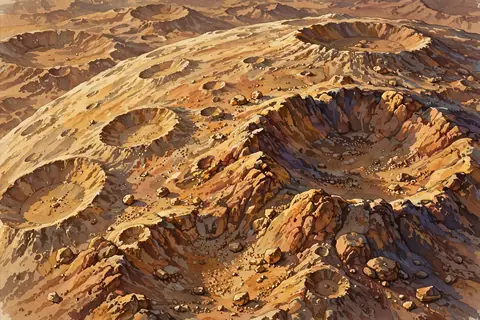
Here's the biggest surprise of all. Mercury has water ice. Because the planet barely tilts, the floors of deep craters near its poles never see direct sunlight. They stay extremely cold, and NASA's MESSENGER spacecraft confirmed ice there using images of craters at the north pole.
Mercury is also hard to visit. A spacecraft has to make a bigger change in speed to reach and orbit Mercury than it would for a mission to Mars. Only a few missions have made the trip, including Mariner 10, MESSENGER, and BepiColombo.
So if you ever feel like the days drag on, be glad you don't live on Mercury. There, you'd celebrate two birthdays before the Sun finally rose again.