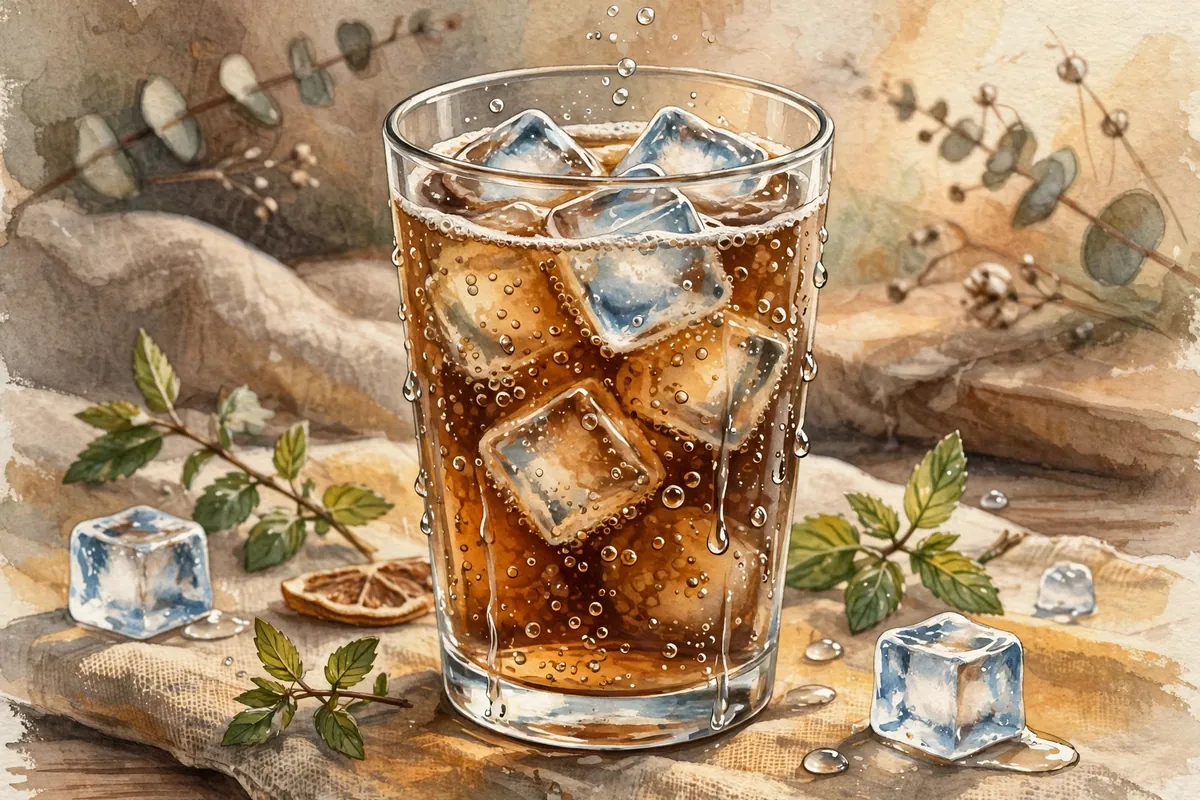
Pour a cold soda over a glass full of ice and listen. There's a crackle, a pop, maybe a sharp snap. Look closely and you'll see fine cracks spreading through the cubes like lines on a map. So why does perfectly good ice break apart the second it hits your drink?
Here's the short answer: it's thermal shock. Ice straight from the freezer is much colder than 32 degrees Fahrenheit. When it lands in a warmer drink, its outer layer warms up quickly while the center stays very cold. Ice expands slightly as it warms, so the outside tries to grow while the inside doesn't. That uneven strain builds until the ice cracks, and you hear it happen.
What Thermal Shock Means
Thermal shock is stress caused by a sudden change in temperature. When one part of an object heats up or cools down faster than another, the parts expand by different amounts. That creates strain inside the material. If the strain is stronger than the material can handle, it fractures. Engineers even test materials by measuring them after repeated rounds of sudden heating and cooling to see how well they hold up.
You've probably seen the same thing with glass. Pour boiling water into a cold glass and it can shatter. That's why some kitchen glassware is made from borosilicate glass, which is designed to handle sudden temperature changes better than ordinary glass.
Ice Grows When It Warms
Here's the part that surprises people. Frozen ice behaves like most solids: it gets slightly denser as it gets colder and expands a little as it warms. So the surface of a freezer-cold cube swells as it heats up toward its melting point, while the icy core lags behind. The outer layer ends up pulling against the inside until something gives.
That's separate from the big expansion that happens when water first freezes. Liquid water grows by about 9 percent when it turns into ice. That's why ice floats, and it's the same force behind frost heaving, which can crack roads and building foundations.
Want fewer cracks? One way engineers prevent thermal shock is by changing temperature gradually. In theory, letting ice sit out for a minute before you drop it in should soften the shock a bit.
Why Some Ice Is Cloudy
Homemade ice cubes often look cloudy in the middle. That happens when water freezes quickly or contains a lot of dissolved minerals. As water freezes, dissolved gases come out as tiny bubbles. Once a layer of ice forms on top, those bubbles get trapped inside.
Commercial ice makers get around this by using flowing purified water and cooling from the bottom, so bubbles wash away as the cube grows. The result is crystal-clear ice.
A Quick History of the Ice Tray
The ice tray has a charming backstory. In 1928, inventor Lloyd Groff Copeman was collecting sap for maple syrup when he noticed that slush flaked right off his rubber boots. That gave him the idea for rubber ice trays, and by 1933 he had patented designs including a metal tray with individual rubber cups. That same year, Guy L. Tinkham invented the first flexible, all-metal stainless steel ice tray.
So the next time your drink starts crackling, you'll know it isn't bad ice. It's physics at work, one tiny tug-of-war at a time.