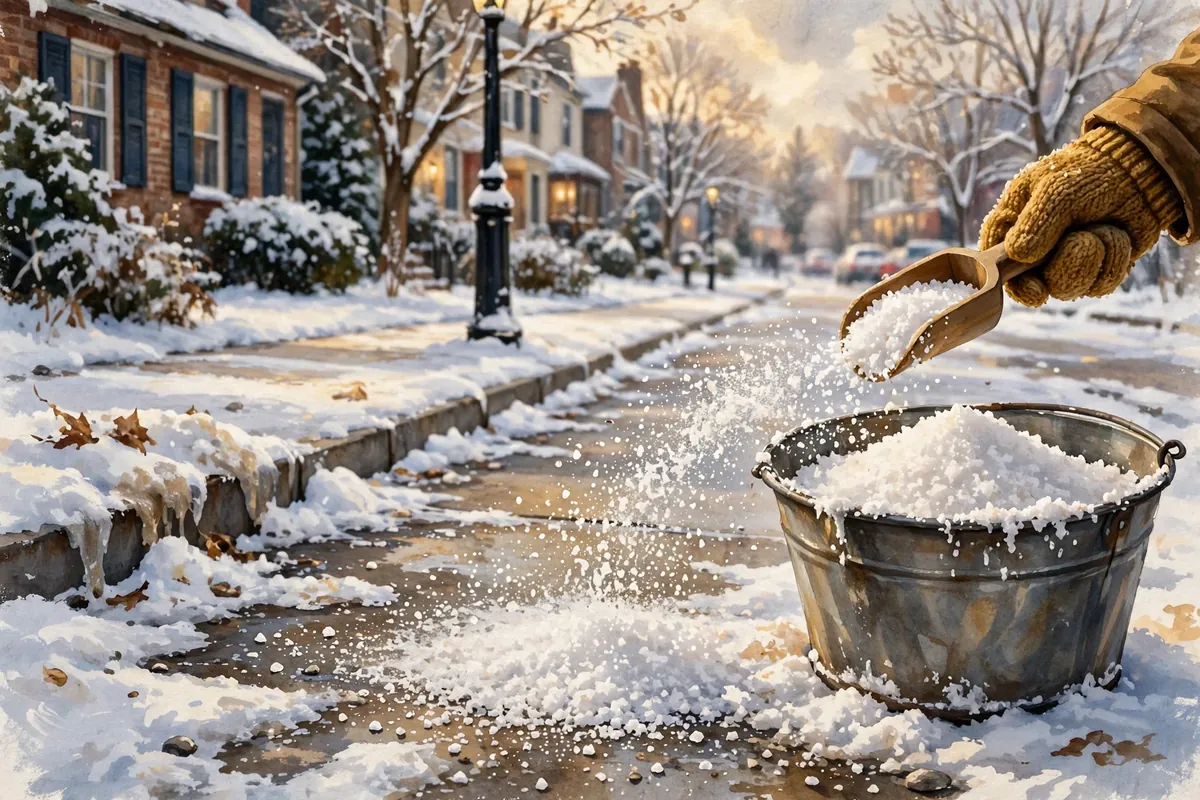
It's a winter ritual across much of America. The forecast calls for freezing rain, and out come the bags of rock salt for the driveway, the steps, and the walk to the mailbox. A few handfuls later, slick ice turns to wet slush. But salt is cold, and it isn't on fire. So how does it melt ice?
The short answer is that salt lowers the temperature at which water freezes. Pure water freezes at 32°F, but salty water has to get much colder before it turns solid. When salt mixes with the thin film of water on top of ice, it creates a salty brine that stays liquid below 32°F. Ice touching that brine melts, and the process keeps spreading. Scientists call this freezing-point depression.
The Same Trick in Your Car and the Ocean
Freezing-point depression happens whenever you dissolve something in a liquid. The mixture freezes at a lower temperature than the pure liquid. It's the same reason seawater stays liquid at temperatures below 32°F.
Your car uses this trick too. Antifreeze in the radiator is a mix of water and a chemical called ethylene glycol, and that mix resists freezing in winter. Old-fashioned ice cream makers rely on it as well, packing salt with ice around the canister to make an extra-cold bath that freezes the cream.
Why Salt Gives Up in Deep Cold
Salt has its limits. Ordinary rock salt, which is sodium chloride, works well on a typical winter day but struggles in bitter cold. Salty water can stay liquid down to roughly 0°F, and at most about minus 6°F. When the pavement gets colder than that, rock salt stops doing its job.
For colder weather, crews turn to other salts, such as calcium chloride and magnesium chloride. They lower the freezing point even further, and they also give off heat as they dissolve. Some modern mixes that combine rock salt with magnesium chloride and certain organic compounds can work down to about minus 29°F.
How Road Salt Took Over
Using salt on roads is newer than you might think. In the early 20th century, Paris spread salt on a large scale to fight black ice, though it corroded iron and hurt the hooves of horses pulling carts. In the United States, New Hampshire experimented with salting roads in 1938 and adopted a statewide policy by the winter of 1941 to 1942.
Before that, winter road crews mostly relied on plows and on sand or cinders for grip. After World War II, as highways expanded and drivers came to expect bare pavement, salt use exploded. In 2013, an estimated 14 million tons of salt were used on roads in North America.
A Little Goes a Long Way
Salt has some downsides. It speeds up rust on cars and on the steel inside concrete bridges. It can build up in soil and water, and depending on the amount, it can harm some plants and animals. That's one reason airports use other chemicals, and why many cities are looking for ways to use less.
So the next time you sprinkle salt on a slippery step, you'll know what's going on. You're not heating the ice. You're simply making it a lot harder for that water to stay frozen. Use only what you need, and sweep up the extra once the ice is gone.